§10.22 Integrals
Contents
- §10.22(i) Indefinite Integrals
- §10.22(ii) Integrals over Finite Intervals
- §10.22(iii) Integrals over the Interval
- §10.22(iv) Integrals over the Interval
- §10.22(v) Hankel Transform
- §10.22(vi) Compendia
§10.22(i) Indefinite Integrals
In this subsection and denote cylinder functions(§10.2(ii)) of orders and , respectively, not necessarily distinct.
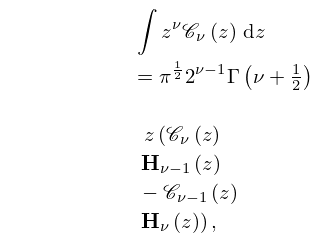
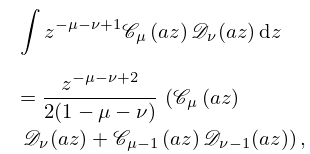
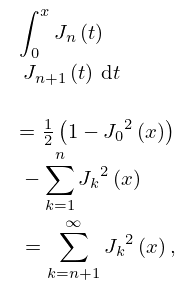
| 10.22.1 | ||||
| 10.22.2 | |||
| . | |||
For the Struve function see §11.2(i).
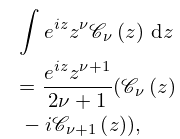
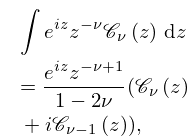
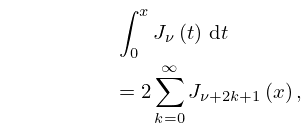
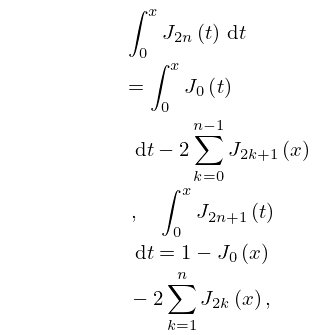
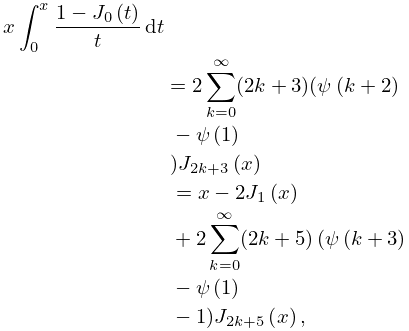
| 10.22.3 | ||||
| , | ||||
| . | ||||
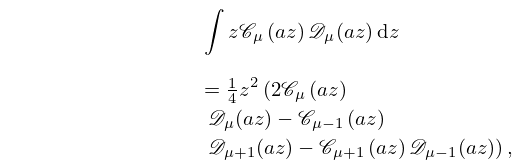
Products
| 10.22.4 | |||
| , | |||
| 10.22.5 | ||||
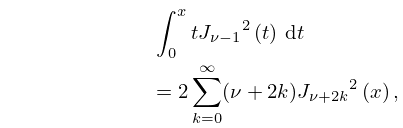
| 10.22.6 | ||||
| , | ||||
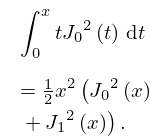
| 10.22.7 | ||||
| , | ||||
| . | ||||
§10.22(ii) Integrals over Finite Intervals
Throughout this subsection .
Trigonometric Arguments
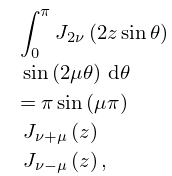
| 10.22.13 | ||||
| , | ||||
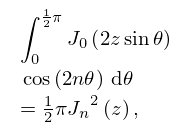
| 10.22.14 | ||||
| , | ||||
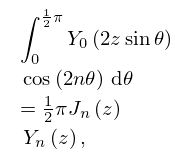
| 10.22.15 | ||||
| . | ||||
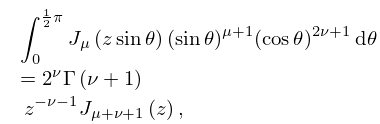
| 10.22.16 | ||||
| . | ||||
| 10.22.17 | |||
| , | |||
| 10.22.18 | |||
| . | |||
| 10.22.19 | |||
| , , | |||
| 10.22.20 | ||||
| , | ||||
| 10.22.21 | ||||
| . | ||||
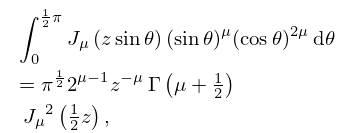
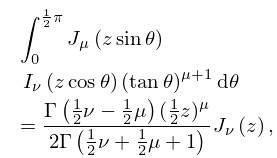
| 10.22.22 | |||
| . | |||
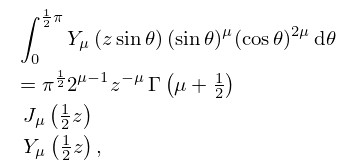
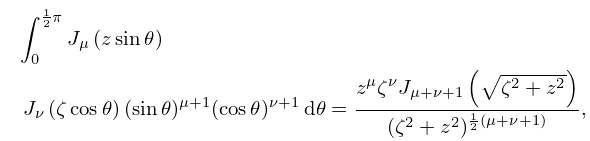
| 10.22.23 | ||||
| , . | ||||
| 10.22.24 | ||||
| . | ||||
| 10.22.25 | ||||
| . | ||||
For see §10.25(ii).
| 10.22.26 | |||
| . | |||
Products
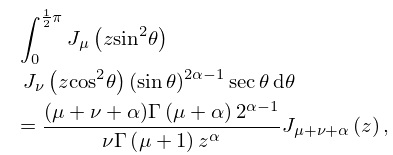
| 10.22.27 | ||||
| , | ||||
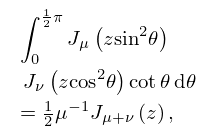
| 10.22.28 | ||||
| , | ||||
| 10.22.29 | ||||
| 10.22.30 | |||
| . | |||
Convolutions
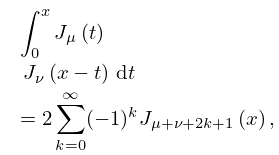
| 10.22.31 | |||
| . | |||
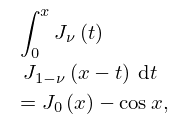
| 10.22.32 | ||||
| . | ||||
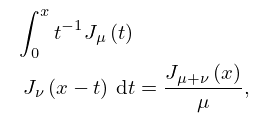
| 10.22.33 | ||||
| . | ||||
| 10.22.34 | |||
| . | |||
| 10.22.35 | |||
| . | |||
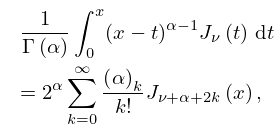
Fractional Integral
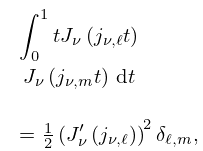
Orthogonality
Also, if are real constants with and , then
| 10.22.38 | |||
where and are positive zeros of . (Compare (10.22.55)).
§10.22(iii) Integrals over the Interval
§10.22(iv) Integrals over the Interval
| 10.22.41 | ||||
| , | ||||
| 10.22.42 | ||||
| . | ||||
| 10.22.43 | ||||
| , , | ||||
| 10.22.44 | ||||
| , . | ||||
| 10.22.45 | |||
| . | |||
| 10.22.46 | |||
| , , . | |||
| 10.22.47 | |||
| . | |||
For see §10.25(ii).
| 10.22.48 | |||
| . | |||
| 10.22.49 | |||
| , | |||
| 10.22.50 | |||
| . | |||
For the hypergeometric function see §15.2(i).
| 10.22.51 | ||||
| , , | ||||
| 10.22.52 | ||||
| , | ||||
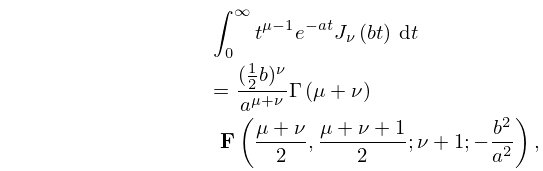
| 10.22.53 | |||
| , . | |||
For and see §10.25(ii).
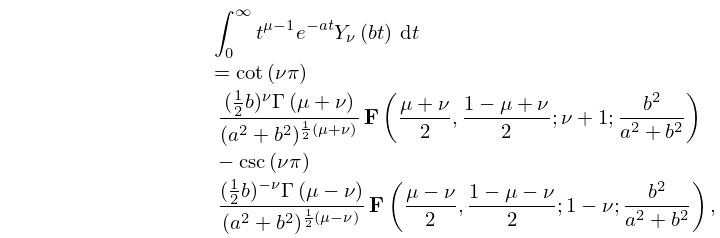
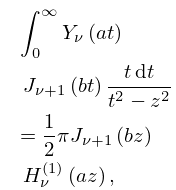
| 10.22.54 | |||
| , . | |||
For the confluent hypergeometric function see §13.2(i).
Orthogonality
| 10.22.55 | |||
| . | |||
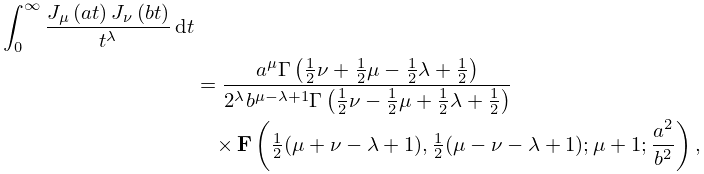
Weber–Schafheitlin Discontinuous Integrals, including Special Cases
| 10.22.56 | |||
| , . | |||
If , then interchange and , and also and . If , then
| 10.22.57 | ||||
| . | ||||
| 10.22.58 | ||||
| , . | ||||
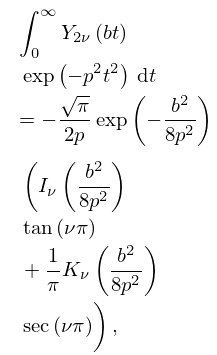
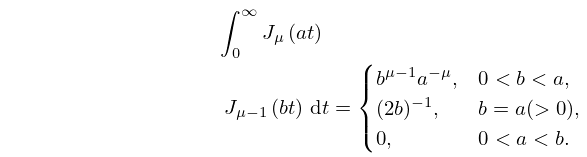
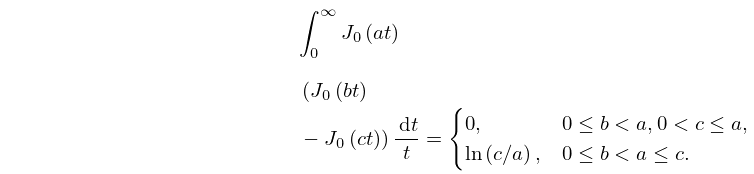
When
| 10.22.59 | |||
| 10.22.60 | |||
When ,
| 10.22.61 | |||
When ,
| 10.22.62 | |||
When ,
| 10.22.63 | |||
When and ,
| 10.22.64 | |||
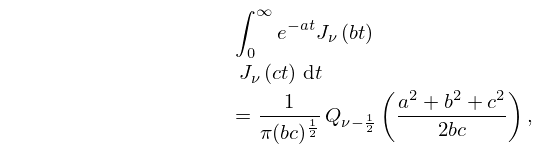
| 10.22.65 | |||
Other Double Products
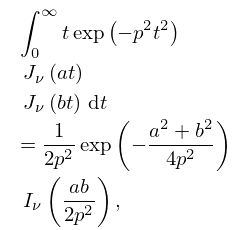
In (10.22.66)–(10.22.70) are positive constants.
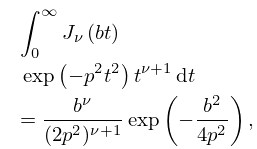
| 10.22.66 | ||||
| . | ||||
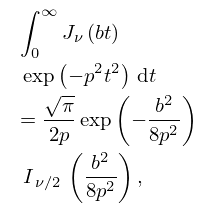
| 10.22.67 | ||||
| . | ||||
| 10.22.68 | ||||
| . | ||||
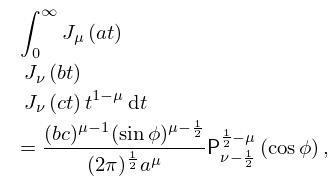
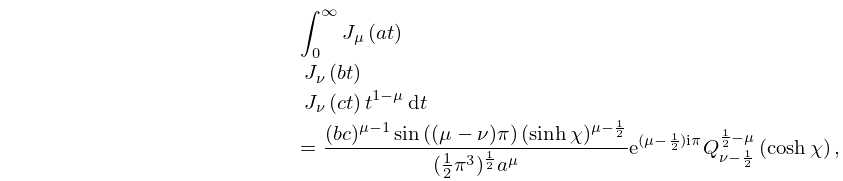
For the associated Legendre function see §14.3(ii) with . For and see §10.25(ii).
| 10.22.69 | ||||
| . | ||||
| 10.22.70 | ||||
| , . | ||||
Equation (10.22.70) also remains valid if the order of the functions on both sides is replaced by , , and the constraint is replaced by .
See also §1.17(ii) for an integral representation of the Dirac delta in terms of a product of Bessel functions.
Triple Products
In (10.22.71) and (10.22.72) are positive constants.
| 10.22.71 | ||||
| . | ||||
| 10.22.72 | ||||
| . | ||||
For the Ferrers function and the associated Legendre function , see §§14.3(i) and 14.3(ii), respectively.
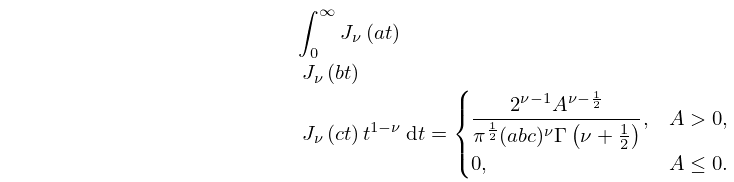
In (10.22.74) and (10.22.75), are positive constants and
| 10.22.73 | ||||
(Thus if are the sides of a triangle, then is the area of the triangle.)
If , then
| 10.22.74 | ||||
| If , then | ||||
| 10.22.75 | ||||
§10.22(v) Hankel Transform
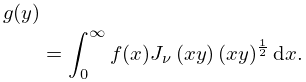
The Hankel transform (or Bessel transform) of a function is defined as
| 10.22.76 | |||
Hankel’s inversion theorem is given by
| 10.22.77 | |||
Sufficient conditions for the validity of (10.22.77) are that when , or that and when ; see Titchmarsh (1986a, Theorem 135, Chapter 8) and Akhiezer (1988, p. 62).
For asymptotic expansions of Hankel transforms see Wong (1976, 1977), Frenzen and Wong (1985a) and Galapon and Martinez (2014).
For collections of Hankel transforms see Erdélyi et al. (1954b, Chapter 8) and Oberhettinger (1972).
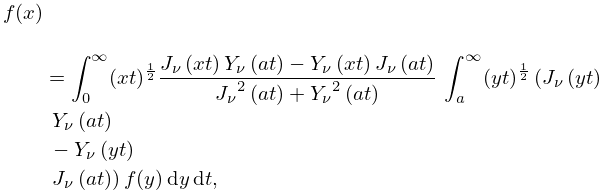
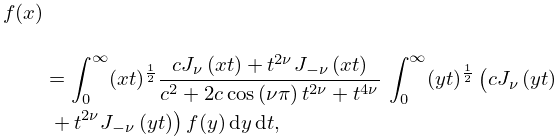
The following two formulas are generalizations of the Hankel transform. These are examples of the self-adjoint extensions and the Weyl alternatives of §1.18(ix).
| 10.22.78 | |||
| . | |||
This is the Weber transform. A sufficient condition for the validity is .
| 10.22.79 | |||
| . | |||
Sufficient conditions for the validity of (10.22.79) are that when , or that and when ; see Titchmarsh (1962a, pp. 88–90).
§10.22(vi) Compendia
For collections of integrals of the functions , , , and , including integrals with respect to the order, see Andrews et al. (1999, pp. 216–225), Apelblat (1983, §12), Erdélyi et al. (1953b, §§7.7.1–7.7.7 and 7.14–7.14.2), Erdélyi et al. (1954a, b), Gradshteyn and Ryzhik (2000, §§5.5 and 6.5–6.7), Gröbner and Hofreiter (1950, pp. 196–204), Luke (1962), Magnus et al. (1966, §3.8), Marichev (1983, pp. 191–216), Oberhettinger (1974, §§1.10 and 2.7), Oberhettinger (1990, §§1.13–1.16 and 2.13–2.16), Oberhettinger and Badii (1973, §§1.14 and 2.12), Okui (1974, 1975), Prudnikov et al. (1986b, §§1.8–1.10, 2.12–2.14, 3.2.4–3.2.7, 3.3.2, and 3.4.1), Prudnikov et al. (1992a, §§3.12–3.14), Prudnikov et al. (1992b, §§3.12–3.14), Watson (1944, Chapters 5, 12, 13, and 14), and Wheelon (1968).