§20.11 Generalizations and Analogs
Contents
- §20.11(i) Gauss Sum
- §20.11(ii) Ramanujan’s Theta Function and -Series
- §20.11(iii) Ramanujan’s Change of Base
- §20.11(iv) Theta Functions with Characteristics
- §20.11(v) Permutation Symmetry
§20.11(i) Gauss Sum
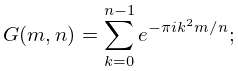
For relatively prime integers with and even, the Gauss sum is defined by
| 20.11.1 | |||
see Lerch (1903). It is a discrete analog of theta functions. If both are positive, then allows inversion of its arguments as a modular transformation (compare (23.15.3) and (23.15.4)):
| 20.11.2 | |||
This is the discrete analog of the Poisson identity (§1.8(iv)).
§20.11(ii) Ramanujan’s Theta Function and -Series
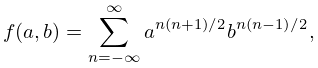
Ramanujan’s theta function is defined by
| 20.11.3 | |||
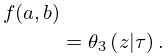
where and . With the substitutions , , with , we have
| 20.11.4 | |||
§20.11(iii) Ramanujan’s Change of Base
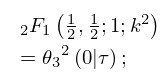
As in §20.11(ii), the modulus of elliptic integrals (§19.2(ii)), Jacobian elliptic functions (§22.2), and Weierstrass elliptic functions (§23.6(ii)) can be expanded in -series via (20.9.1). However, in this case is no longer regarded as an independent complex variable within the unit circle, because is related to the variable of the theta functions via (20.9.2). This is Jacobi’s inversion problem of §20.9(ii).
The first of equations (20.9.2) can also be written
| 20.11.5 | |||
see §19.5. Similar identities can be constructed for , , and . These results are called Ramanujan’s changes of base. Each provides an extension of Jacobi’s inversion problem. See Berndt et al. (1995) and Shen (1998). For applications to rapidly convergent expansions for see Chudnovsky and Chudnovsky (1988), and for applications in the construction of elliptic-hypergeometric series see Rosengren (2004).
§20.11(iv) Theta Functions with Characteristics
§20.11(v) Permutation Symmetry
A further development on the lines of Neville’s notation (§20.1) is as follows.
For , , and , define twelve combined theta functions by
| 20.11.6 | ||||
| , | ||||
| 20.11.7 | ||||
| , | ||||
| 20.11.8 | ||||
| . | ||||
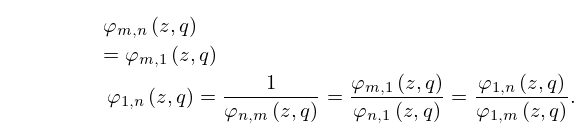
Then
| 20.11.9 | |||
The importance of these combined theta functions is that sets of twelve equations for the theta functions often can be replaced by corresponding sets of three equations of the combined theta functions, plus permutation symmetry. Such sets of twelve equations include derivatives, differential equations, bisection relations, duplication relations, addition formulas (including new ones for theta functions), and pseudo-addition formulas.
For further information, see Carlson (2011).