Digital Library of Mathematical Functions
About the Project
NIST
23 Weierstrass Elliptic and Modular FunctionsModular Functions

§23.15 Definitions

Contents

§23.15(i) General Modular Functions

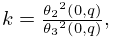
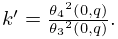
In §§23.1523.19, k and k^{{\prime}} (\in\Complex) denote the Jacobi modulus and complementary modulus, respectively, and q=e^{{i\pi\tau}} (\imagpart{\tau}>0) denotes the nome; compare §§20.1 and 22.1. Thus

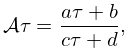
Also \mathcal{A} denotes a bilinear transformation on \tau, given by

in which a,b,c,d are integers, with

23.15.4ad-bc=1.

The set of all bilinear transformations of this form is denoted by SL(2,\Integer) (Serre (1973, p. 77)).

A modular function f(\tau) is a function of \tau that is meromorphic in the half-plane \imagpart{\tau}>0, and has the property that for all \mathcal{A}\in\mbox{SL}(2,\Integer), or for all \mathcal{A} belonging to a subgroup of SL(2,\Integer),

where c_{\mathcal{A}} is a constant depending only on \mathcal{A}, and \ell (the level) is an integer or half an odd integer. (Some references refer to 2\ell as the level). If, as a function of q, f(\tau) is analytic at q=0, then f(\tau) is called a modular form. If, in addition, f(\tau)\to 0 as q\to 0, then f(\tau) is called a cusp form.

§23.15(ii) Functions \mathop{\lambda\/}\nolimits\!\left(\tau\right), \mathop{J\/}\nolimits\!\left(\tau\right), \mathop{\eta\/}\nolimits\!\left(\tau\right)

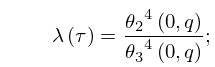
Elliptic Modular Function

23.15.6\mathop{\lambda\/}\nolimits\!\left(\tau\right)=\frac{{\mathop{\theta_{{2}}\/}%
\nolimits^{{4}}}\!\left(0,q\right)}{{\mathop{\theta_{{3}}\/}\nolimits^{{4}}}\!%
\left(0,q\right)};

compare also (23.15.2).

Klein’s Complete Invariant

23.15.7\mathop{J\/}\nolimits\!\left(\tau\right)=\frac{\left({\mathop{\theta_{{2}}\/}%
\nolimits^{{8}}}\!\left(0,q\right)+{\mathop{\theta_{{3}}\/}\nolimits^{{8}}}\!%
\left(0,q\right)+{\mathop{\theta_{{4}}\/}\nolimits^{{8}}}\!\left(0,q\right)%
\right)^{3}}{54\left({\mathop{\theta_{{1}}\/}\nolimits^{{\prime}}}\!\left(0,q%
\right)\right)^{8}},

where (as in §20.2(i))

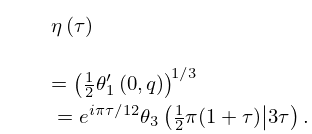
Dedekind’s Eta Function (or Dedekind Modular Function)

In (23.15.9) the branch of the cube root is chosen to agree with the second equality; in particular, when \tau lies on the positive imaginary axis the cube root is real and positive.