Digital Library of Mathematical Functions
About the Project
NIST
24 Bernoulli and Euler PolynomialsProperties

§24.16 Generalizations

Contents

§24.16(i) Higher-Order Analogs

Polynomials and Numbers of Integer Order

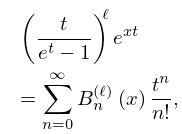
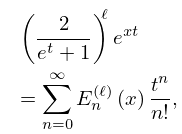
For \ell=0,1,2,\ldots, Bernoulli and Euler polynomials of order \ell are defined respectively by

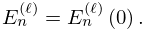
When x=0 they reduce to the Bernoulli and Euler numbers of order \ell:

Also for \ell=1,2,3,\ldots,

For this and other properties see Milne-Thomson (1933, pp. 126–153) or Nörlund (1924, pp. 144–162).

For extensions of \mathop{B^{{(\ell)}}_{{n}}\/}\nolimits\!\left(x\right) to complex values of x, n, and \ell, and also for uniform asymptotic expansions for large x and large n, see Temme (1995b).

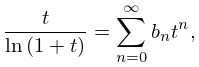
Bernoulli Numbers of the Second Kind

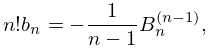
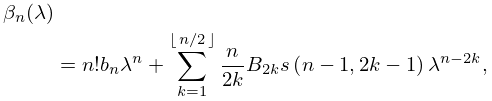
Degenerate Bernoulli Numbers

For sufficiently small |t|,

24.16.7\frac{t}{(1+\lambda t)^{{\ifrac{1}{\lambda}}}-1}=\sum_{{n=0}}^{{\infty}}\beta_%
{n}(\lambda)\frac{t^{n}}{n!},

Here \mathop{s\/}\nolimits\!\left(n,m\right) again denotes the Stirling number of the first kind.

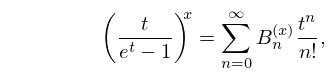
Nörlund Polynomials

\mathop{B^{{(x)}}_{{n}}\/}\nolimits is a polynomial in x of degree n. (This notation is consistent with (24.16.3) when x=\ell.)

§24.16(ii) Character Analogs

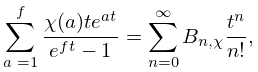
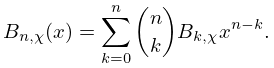
Let \chi be a primitive Dirichlet character \mod f (see §27.8). Then f is called the conductor of \chi. Generalized Bernoulli numbers and polynomials belonging to \chi are defined by

Let \chi_{0} be the trivial character and \chi_{4} the unique (nontrivial) character with f=4; that is, \chi_{4}(1)=1, \chi_{4}(3)=-1, \chi_{4}(2)=\chi_{4}(4)=0. Then

For further properties see Berndt (1975a).

§24.16(iii) Other Generalizations

In no particular order, other generalizations include: Bernoulli numbers and polynomials with arbitrary complex index (Butzer et al. (1992)); Euler numbers and polynomials with arbitrary complex index (Butzer et al. (1994)); q-analogs (Carlitz (1954b), Andrews and Foata (1980)); conjugate Bernoulli and Euler polynomials (Hauss (1997, 1998)); Bernoulli–Hurwitz numbers (Katz (1975)); poly-Bernoulli numbers (Kaneko (1997)); Universal Bernoulli numbers (Clarke (1989)); p-adic integer order Bernoulli numbers (Adelberg (1996)); p-adic q-Bernoulli numbers (Kim and Kim (1999)); periodic Bernoulli numbers (Berndt (1975b)); cotangent numbers (Girstmair (1990b)); Bernoulli–Carlitz numbers (Goss (1978)); Bernoulli-Padé numbers (Dilcher (2002)); Bernoulli numbers belonging to periodic functions (Urbanowicz (1988)); cyclotomic Bernoulli numbers (Girstmair (1990a)); modified Bernoulli numbers (Zagier (1998)); higher-order Bernoulli and Euler polynomials with multiple parameters (Erdélyi et al. (1953a, §§1.13.1, 1.14.1)).