§24.17 Mathematical Applications
Contents
§24.17(i) Summation
Euler–Maclaurin Summation Formula
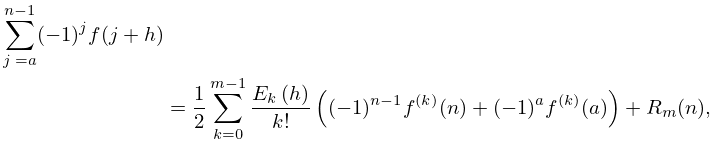
Boole Summation Formula
Let and , and be integers such that , , and is absolutely integrable over . Then with the notation of §24.2(iii)
| 24.17.1 | |||
where
| 24.17.2 | |||
Calculus of Finite Differences
§24.17(ii) Spline Functions
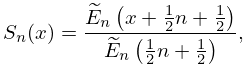
Euler Splines
Let denote the class of functions that have continuous derivatives on and are polynomials of degree at most in each interval , . The members of are called cardinal spline functions. The functions
| 24.17.3 | |||
| , | |||
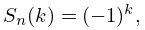
are called Euler splines of degree . For each , is the unique bounded function such that and
| 24.17.4 | |||
| . | |||
The function is also optimal in a certain sense; see Schoenberg (1971).
Bernoulli Monosplines
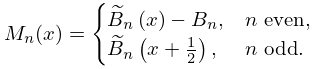
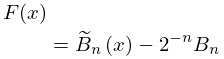
A function of the form , with is called a cardinal monospline of degree . Again with the notation of §24.2(iii) define
| 24.17.5 | |||
is a monospline of degree , and it follows from (24.4.25) and (24.4.27) that
| 24.17.6 | |||
| . | |||
For each the function is also the unique cardinal monospline of degree satisfying (24.17.6), provided that
| 24.17.7 | |||
| , | |||
for some positive constant .
For any the function
| 24.17.8 | |||
is the unique cardinal monospline of degree having the least supremum norm on (minimality property).
§24.17(iii) Number Theory
Bernoulli and Euler numbers and polynomials occur in: number theory via (24.4.7), (24.4.8), and other identities involving sums of powers; the Riemann zeta function and -series (§25.15, Apostol (1976), and Ireland and Rosen (1990)); arithmetic of cyclotomic fields and the classical theory of Fermat’s last theorem (Ribenboim (1979) and Washington (1997)); -adic analysis (Koblitz (1984, Chapter 2)).