32.10 Special Function Solutions32.12 Asymptotic Approximations for Complex Variables

§32.11 Asymptotic Approximations for Real Variables

Contents

§32.11(i) First Painlevé Equation

There are solutions of (32.2.1) such that

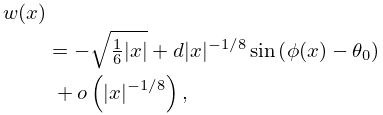
32.11.1 w(x)=-\sqrt{\tfrac{1}{6}|x|}+d|x|^{{-1/8}}\mathop{\sin\/}\nolimits\!\left(\phi(x)-\theta _{0}\right)+\mathop{o\/}\nolimits\!\left(|x|^{{-1/8}}\right), x\to-\infty,

where

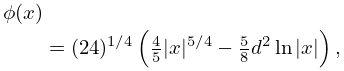
32.11.2 \phi(x)=(24)^{{1/4}}\left(\tfrac{4}{5}|x|^{{5/4}}-\tfrac{5}{8}d^{2}\mathop{\ln\/}\nolimits|x|\right),

and d and \theta _{0} are constants.

There are also solutions of (32.2.1) such that

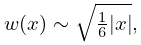
32.11.3 w(x)\sim\sqrt{\tfrac{1}{6}|x|}, x\to-\infty.

Next, for given initial conditions w(0)=0 and w^{{\prime}}(0)=k, with k real, w(x) has at least one pole on the real axis. There are two special values of k, k_{1} and k_{2}, with the properties -0.45142\; 8<k_{1}<-0.45142\; 7, 1.85185\; 3<k_{2}<1.85185\; 5, and such that:

  1. If k<k_{1}, then w(x)>0 for x_{0}<x<0, where x_{0} is the first pole on the negative real axis.

  2. If k_{1}<k<k_{2}, then w(x) oscillates about, and is asymptotic to, -\sqrt{\tfrac{1}{6}|x|} as x\to-\infty.

  3. If k_{2}<k, then w(x) changes sign once, from positive to negative, as x passes from x_{0} to 0.

For illustration see Figures 32.3.1 to 32.3.4, and for further information see Joshi and Kitaev (2005), Joshi and Kruskal (1992), Kapaev (1988), Kapaev and Kitaev (1993), and Kitaev (1994).

§32.11(ii) Second Painlevé Equation

Consider the special case of \mbox{P}_{{\mbox{\scriptsize II}}} with \alpha=0:

32.11.4 w^{{\prime\prime}}=2w^{3}+xw,

with boundary condition

32.11.5 w(x)\to 0, x\to+\infty.

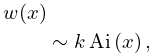
Any nontrivial real solution of (32.11.4) that satisfies (32.11.5) is asymptotic to k\mathop{\mathrm{Ai}\/}\nolimits\!\left(x\right), for some nonzero real k, where \mathop{\mathrm{Ai}\/}\nolimits denotes the Airy function (§9.2). Conversely, for any nonzero real k, there is a unique solution w_{k}(x) of (32.11.4) that is asymptotic to k\mathop{\mathrm{Ai}\/}\nolimits\!\left(x\right) as x\to+\infty.

If |k|<1, then w_{k}(x) exists for all sufficiently large |x| as x\to-\infty, and

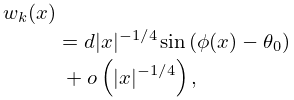
32.11.6 w_{k}(x)=d|x|^{{-1/4}}\mathop{\sin\/}\nolimits\!\left(\phi(x)-\theta _{0}\right)+\mathop{o\/}\nolimits\!\left(|x|^{{-1/4}}\right),

where

32.11.7 \phi(x)=\tfrac{2}{3}|x|^{{3/2}}-\tfrac{3}{4}d^{2}\mathop{\ln\/}\nolimits|x|,

and d (\neq 0), \theta _{0} are real constants. Connection formulas for d and \theta _{0} are given by

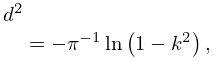
32.11.8 d^{2}=-\pi^{{-1}}\mathop{\ln\/}\nolimits\!\left(1-k^{2}\right),
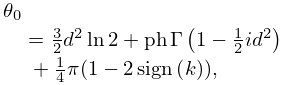
32.11.9 \theta _{0}=\tfrac{3}{2}d^{2}\mathop{\ln\/}\nolimits 2+\mathop{\mathrm{ph}\/}\nolimits\mathop{\Gamma\/}\nolimits\!\left(1-\tfrac{1}{2}id^{2}\right)+\tfrac{1}{4}\pi(1-2\mathop{\mathrm{sign}\/}\nolimits\!\left(k\right)),

where \mathop{\Gamma\/}\nolimits is the gamma function (§5.2(i)), and the branch of the \mathop{\mathrm{ph}\/}\nolimits function is immaterial.

If |k|=1, then

32.11.10 w_{k}(x)\sim\mathop{\mathrm{sign}\/}\nolimits\!\left(k\right)\sqrt{\tfrac{1}{2}|x|}, x\to-\infty.

If |k|>1, then w_{k}(x) has a pole at a finite point x=c_{0}, dependent on k, and

32.11.11 w_{k}(x)\sim\mathop{\mathrm{sign}\/}\nolimits\!\left(k\right)(x-c_{0})^{{-1}}, x\to c_{0}+.

For illustration see Figures 32.3.5 and 32.3.6, and for further information see Ablowitz and Clarkson (1991), Bassom et al. (1998), Clarkson and McLeod (1988), Deift and Zhou (1995), Segur and Ablowitz (1981), and Suleĭmanov (1987). For numerical studies see Miles (1978, 1980) and Rosales (1978).

§32.11(iii) Modified Second Painlevé Equation

Replacement of w by iw in (32.11.4) gives

32.11.12 w^{{\prime\prime}}=-2w^{3}+xw.

Any nontrivial real solution of (32.11.12) satisfies

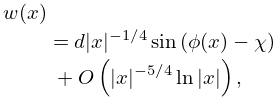
32.11.13 w(x)=d|x|^{{-1/4}}\mathop{\sin\/}\nolimits\!\left(\phi(x)-\chi\right)+\mathop{O\/}\nolimits\!\left(|x|^{{-5/4}}\mathop{\ln\/}\nolimits|x|\right), x\to-\infty,

where

32.11.14 \phi(x)=\tfrac{2}{3}|x|^{{3/2}}+\tfrac{3}{4}d^{2}\mathop{\ln\/}\nolimits|x|,

with d (\neq 0) and \chi arbitrary real constants.

In the case when

32.11.15 \chi+\tfrac{3}{2}d^{2}\mathop{\ln\/}\nolimits 2-\tfrac{1}{4}\pi-\mathop{\mathrm{ph}\/}\nolimits\mathop{\Gamma\/}\nolimits\!\left(\tfrac{1}{2}id^{2}\right)=n\pi,

with n\in\Integer, we have

32.11.16 w(x)\sim k\mathop{\mathrm{Ai}\/}\nolimits\!\left(x\right), x\to+\infty,

where k is a nonzero real constant. The connection formulas for k are

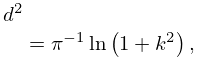
32.11.17 d^{2}=\pi^{{-1}}\mathop{\ln\/}\nolimits\!\left(1+k^{2}\right), \mathop{\mathrm{sign}\/}\nolimits\!\left(k\right)=(-1)^{n}.

§32.11(iv) Third Painlevé Equation

For \mbox{P}_{{\mbox{\scriptsize III}}}, with \alpha=-\beta=2\nu (\in\Real) and \gamma=-\delta=1,

32.11.25 w(x)-1\sim-\lambda\mathop{\Gamma\/}\nolimits\!\left(\nu+\tfrac{1}{2}\right)2^{{-2\nu}}x^{{-\nu-(1/2)}}e^{{-2x}}, x\to+\infty,

where \lambda is an arbitrary constant such that -1/\pi<\lambda<1/\pi, and

32.11.26 w(x)\sim Bx^{\sigma}, x\to 0,

where B and \sigma are arbitrary constants such that B\neq 0 and |\realpart{\sigma}|<1. The connection formulas relating (32.11.25) and (32.11.26) are

32.11.27 \sigma=(2/\pi)\mathop{\mathrm{arcsin}\/}\nolimits\!\left(\pi\lambda\right),
32.11.28 B=2^{{-2\sigma}}\frac{{\mathop{\Gamma\/}\nolimits^{{2}}}\!\left(\tfrac{1}{2}(1-\sigma)\right)\mathop{\Gamma\/}\nolimits\!\left(\tfrac{1}{2}(1+\sigma)+\nu\right)}{{\mathop{\Gamma\/}\nolimits^{{2}}}\!\left(\tfrac{1}{2}(1+\sigma)\right)\mathop{\Gamma\/}\nolimits\!\left(\tfrac{1}{2}(1-\sigma)+\nu\right)}.

See also Abdullaev (1985), Novokshënov (1985), Its and Novokshënov (1986), Kitaev (1987), Bobenko (1991), Bobenko and Its (1995), Tracy and Widom (1997), and Kitaev and Vartanian (2004).

§32.11(v) Fourth Painlevé Equation

Consider \mbox{P}_{{\mbox{\scriptsize IV}}} with \alpha=2\nu+1 (\in\Real) and \beta=0, that is,

32.11.29 w^{{\prime\prime}}=\frac{(w^{{\prime}})^{2}}{2w}+\frac{3}{2}w^{3}+4xw^{2}+2(x^{2}-2\nu-1)w,

and with boundary condition

32.11.30 w(x)\to 0, x\to+\infty.

Any nontrivial solution of (32.11.29) that satisfies (32.11.30) is asymptotic to h{\mathop{U\/}\nolimits^{{2}}}\!\left(-\nu-\frac{1}{2},\sqrt{2}x\right) as x\to+\infty, where h (\neq 0) is a constant. Conversely, for any h (\neq 0) there is a unique solution w_{h}(x) of (32.11.29) that is asymptotic to h{\mathop{U\/}\nolimits^{{2}}}\!\left(-\nu-\frac{1}{2},\sqrt{2}x\right) as x\to+\infty. Here \mathop{U\/}\nolimits denotes the parabolic cylinder function (§12.2).

Now suppose x\to-\infty. If 0\leq h<h^{{*}}, where

32.11.31 h^{{*}}=\ifrac{1}{\left(\pi^{{1/2}}\mathop{\Gamma\/}\nolimits\!\left(\nu+1\right)\right)},

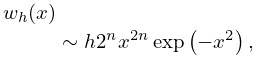
then w_{h}(x) has no poles on the real axis. Furthermore, if \nu=n=0,1,2,\dots, then

32.11.32 w_{h}(x)\sim h2^{n}x^{{2n}}\mathop{\exp\/}\nolimits\!\left(-x^{2}\right), x\to-\infty.

Alternatively, if \nu is not zero or a positive integer, then

32.11.33 w_{h}(x)=-\tfrac{2}{3}x+\tfrac{4}{3}d\sqrt{3}\mathop{\sin\/}\nolimits\!\left(\phi(x)-\theta _{0}\right)+\mathop{O\/}\nolimits\!\left(x^{{-1}}\right), x\to-\infty,

where

32.11.34 \phi(x)=\tfrac{1}{3}\sqrt{3}x^{2}-\tfrac{4}{3}d^{2}\sqrt{3}\mathop{\ln\/}\nolimits\!\left(\sqrt{2}|x|\right),

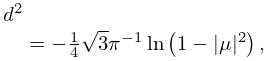
and d (>0) and \theta _{0} are real constants. Connection formulas for d and \theta _{0} are given by

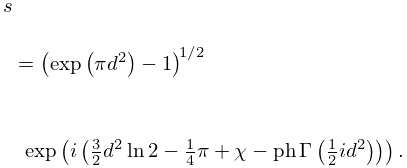
where

32.11.37 \mu=1+\left(\ifrac{2ih\pi^{{3/2}}\mathop{\exp\/}\nolimits\!\left(-i\pi\nu\right)}{\mathop{\Gamma\/}\nolimits\!\left(-\nu\right)}\right),

and the branch of the \mathop{\mathrm{ph}\/}\nolimits function is immaterial.

Next if h=h^{{*}}, then

32.11.38 w_{{h^{{*}}}}(x)\sim-2x, x\to-\infty,

and w_{{h^{{*}}}}(x) has no poles on the real axis.

Lastly if h>h^{{*}}, then w_{h}(x) has a simple pole on the real axis, whose location is dependent on h.

For illustration see Figures 32.3.732.3.10. In terms of the parameter k that is used in these figures h=2^{{3/2}}k^{2}.