Digital Library of Mathematical Functions
About the Project
NIST
32 Painlevé TranscendentsProperties

§32.10 Special Function Solutions

Contents

§32.10(i) Introduction

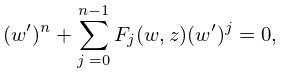
For certain combinations of the parameters, \mbox{P}_{{\mbox{\scriptsize II}}}\mbox{P}_{{\mbox{\scriptsize VI}}} have particular solutions expressible in terms of the solution of a Riccati differential equation, which can be solved in terms of special functions defined in other chapters. All solutions of \mbox{P}_{{\mbox{\scriptsize II}}}\mbox{P}_{{\mbox{\scriptsize VI}}} that are expressible in terms of special functions satisfy a first-order equation of the form

32.10.1(w^{{\prime}})^{n}+\sum_{{j=0}}^{{n-1}}F_{j}(w,z)(w^{{\prime}})^{j}=0,

where F_{j}(w,z) is polynomial in w with coefficients that are rational functions of z.

§32.10(ii) Second Painlevé Equation

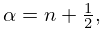
\mbox{P}_{{\mbox{\scriptsize II}}} has solutions expressible in terms of Airy functions (§9.2) iff

32.10.2\alpha=n+\tfrac{1}{2},

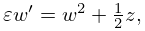
with n\in\Integer. For example, if \alpha=\tfrac{1}{2}\varepsilon, with \varepsilon=\pm 1, then the Riccati equation is

32.10.3\varepsilon w^{{\prime}}=w^{2}+\tfrac{1}{2}z,

with solution

32.10.4w(z;\tfrac{1}{2}\varepsilon)=-\varepsilon\phi^{{\prime}}(z)/\phi(z),

where

32.10.5\phi(z)=C_{1}\mathop{\mathrm{Ai}\/}\nolimits\!\left(-2^{{-1/3}}z\right)+C_{2}%
\mathop{\mathrm{Bi}\/}\nolimits\!\left(-2^{{-1/3}}z\right),

with C_{1}, C_{2} arbitrary constants.

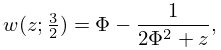
Solutions for other values of \alpha are derived from w(z;\pm\tfrac{1}{2}) by application of the Bäcklund transformations (32.7.1) and (32.7.2). For example,

32.10.6w(z;\tfrac{3}{2})=\Phi-\dfrac{1}{2\Phi^{2}+z},
32.10.7w(z;\tfrac{5}{2})=\dfrac{1}{2\Phi^{2}+z}+\dfrac{2z\Phi^{2}+\Phi+z^{2}}{4\Phi^{%
3}+2z\Phi-1},

where \Phi=\phi^{{\prime}}(z)/\phi(z), with \phi(z) given by (32.10.5).

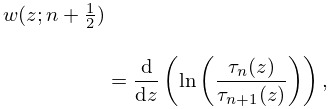
More generally, if n=1,2,3,\dots, then

where \tau_{n}(z) is the n\times n determinant

32.10.9\tau_{n}(z)=\begin{vmatrix}\phi(z)&\phi^{{\prime}}(z)&\cdots&\phi^{{(n-1)}}(z)%
\\
\phi^{{\prime}}(z)&\phi^{{\prime\prime}}(z)&\cdots&\phi^{{(n)}}(z)\\
\vdots&\vdots&\ddots&\vdots\\
\phi^{{(n-1)}}(z)&\phi^{{(n)}}(z)&\cdots&\phi^{{(2n-2)}}(z)\end{vmatrix},

and

32.10.10w(z;-n-\tfrac{1}{2})=-w(z;n+\tfrac{1}{2}).

§32.10(iii) Third Painlevé Equation

If \gamma\delta\neq 0, then as in §32.2(ii) we may set \gamma=1 and \delta=-1. \mbox{P}_{{\mbox{\scriptsize III}}} then has solutions expressible in terms of Bessel functions (§10.2) iff

with n\in\Integer, and \varepsilon_{1}=\pm 1, \varepsilon_{2}=\pm 1, independently. In the case \varepsilon_{1}\alpha+\varepsilon_{2}\beta=2, the Riccati equation is

32.10.12zw^{{\prime}}=\varepsilon_{1}zw^{2}+(\alpha\varepsilon_{1}-1)w+\varepsilon_{2}z.

If \alpha\neq\varepsilon_{1}, then (32.10.12) has the solution

32.10.13w(z)=-\varepsilon_{1}\phi^{{\prime}}(z)/\phi(z),

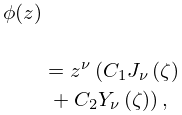
where

with \zeta=\sqrt{\varepsilon_{1}\varepsilon_{2}}z, \nu=\tfrac{1}{2}\alpha\varepsilon_{1}, and C_{1}, C_{2} arbitrary constants.

For examples and plots see Milne et al. (1997). For determinantal representations see Forrester and Witte (2002) and Okamoto (1987c).

§32.10(iv) Fourth Painlevé Equation

\mbox{P}_{{\mbox{\scriptsize IV}}} has solutions expressible in terms of parabolic cylinder functions (§12.2) iff either

32.10.15\beta=-2(2n+1+\varepsilon\alpha)^{2},

or

32.10.16\beta=-2n^{2},

with n\in\Integer and \varepsilon=\pm 1. In the case when n=0 in (32.10.15), the Riccati equation is

32.10.17w^{{\prime}}=\varepsilon(w^{2}+2zw)-2(1+\varepsilon\alpha),

which has the solution

32.10.18w(z)=-\varepsilon\phi^{{\prime}}(z)/\phi(z),

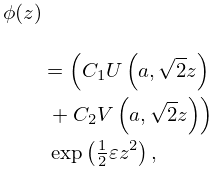
where

with a=\alpha+\tfrac{1}{2}\varepsilon, and C_{1}, C_{2} arbitrary constants. When a+\tfrac{1}{2} is zero or a negative integer the \mathop{U\/}\nolimits parabolic cylinder functions reduce to Hermite polynomials (§18.3) times an exponential function; thus

32.10.20w(z;-m,-2(m-1)^{2})=-\frac{{\mathop{H_{{m-1}}\/}\nolimits^{{\prime}}}\!\left(z%
\right)}{\mathop{H_{{m-1}}\/}\nolimits\!\left(z\right)},m=1,2,3,\dots,

and

32.10.21w(z;-m,-2(m+1)^{2})=-2z+\frac{{\mathop{H_{{m}}\/}\nolimits^{{\prime}}}\!\left(%
z\right)}{\mathop{H_{{m}}\/}\nolimits\!\left(z\right)},m=0,1,2,\dots.

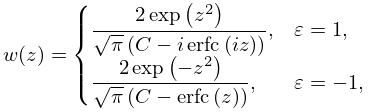
If 1+\varepsilon\alpha=0, then (32.10.17) has solutions

where C is an arbitrary constant and \mathop{\mathrm{erfc}\/}\nolimits is the complementary error function (§7.2(i)).

For examples and plots see Bassom et al. (1995). For determinantal representations see Forrester and Witte (2001) and Okamoto (1986).

§32.10(v) Fifth Painlevé Equation

If \delta\neq 0, then as in §32.2(ii) we may set \delta=-\tfrac{1}{2}. \mbox{P}_{{\mbox{\scriptsize V}}} then has solutions expressible in terms of Whittaker functions (§13.14(i)), iff

32.10.23a+b+\varepsilon_{3}\gamma=2n+1,

or

32.10.24(a-n)(b-n)=0,

where n\in\Integer, a=\varepsilon_{1}\sqrt{2\alpha}, and b=\varepsilon_{2}\sqrt{-2\beta}, with \varepsilon_{j}=\pm 1, j=1,2,3, independently. In the case when n=0 in (32.10.23), the Riccati equation is

32.10.25zw^{{\prime}}=aw^{2}+(b-a+\varepsilon_{3}z)w-b.

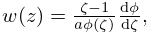
If a\neq 0, then (32.10.25) has the solution

32.10.26w(z)=-z\phi^{{\prime}}(z)/(a\phi(z)),

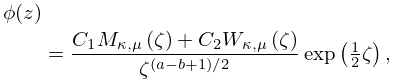
where

with \zeta=\varepsilon_{3}z, \kappa=\tfrac{1}{2}(a-b+1), \mu=\tfrac{1}{2}(a+b), and C_{1}, C_{2} arbitrary constants.

For determinantal representations see Forrester and Witte (2002), Masuda (2004), and Okamoto (1987b).

§32.10(vi) Sixth Painlevé Equation

\mbox{P}_{{\mbox{\scriptsize VI}}} has solutions expressible in terms of hypergeometric functions (§15.2(i)) iff

32.10.28a+b+c+d=2n+1,

where n\in\Integer, a=\varepsilon_{1}\sqrt{2\alpha}, b=\varepsilon_{2}\sqrt{-2\beta}, c=\varepsilon_{3}\sqrt{2\gamma}, and d=\varepsilon_{4}\sqrt{1-2\delta}, with \varepsilon_{j}=\pm 1, j=1,2,3,4, independently. If n=1, then the Riccati equation is

32.10.29w^{{\prime}}=\frac{aw^{2}}{z(z-1)}+\frac{(b+c)z-a-c}{z(z-1)}w-\frac{b}{z-1}.

If a\neq 0, then (32.10.29) has the solution

where

32.10.31\phi(\zeta)=C_{1}\mathop{F\/}\nolimits\!\left(b,-a;b+c;\zeta\right)+C_{2}\zeta%
^{{-b+1-c}}\*\mathop{F\/}\nolimits\!\left(-a-b-c+1,-c+1;2-b-c;\zeta\right),

with C_{1}, C_{2} arbitrary constants.

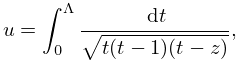
Next, let \Lambda=\Lambda(u,z) be the elliptic function (§§22.15(ii), 23.2(iii)) defined by

where the fundamental periods 2\phi_{1} and 2\phi_{2} are linearly independent functions satisfying the hypergeometric equation

Then \mbox{P}_{{\mbox{\scriptsize VI}}}, with \alpha=\beta=\gamma=0 and \delta=\tfrac{1}{2}, has the general solution

32.10.34w(z;0,0,0,\tfrac{1}{2})=\Lambda(C_{1}\phi_{1}+C_{2}\phi_{2},z),

with C_{1}, C_{2} arbitrary constants. The solution (32.10.34) is an essentially transcendental function of both constants of integration since \mbox{P}_{{\mbox{\scriptsize VI}}} with \alpha=\beta=\gamma=0 and \delta=\tfrac{1}{2} does not admit an algebraic first integral of the form P(z,w,w^{{\prime}},C)=0, with C a constant.
For determinantal representations see Forrester and Witte (2004) and Masuda (2004).