§25.10 Zeros
Contents
§25.10(i) Distribution
The product representation (25.2.11) implies for . Also, for , a property first established in Hadamard (1896) and de la Vallée Poussin (1896a, b) in the proof of the prime number theorem (25.16.3). The functional equation (25.4.1) implies for . These are called the trivial zeros. Except for the trivial zeros, for . In the region , called the critical strip, has infinitely many zeros, distributed symmetrically about the real axis and about the critical line . The Riemann hypothesis states that all nontrivial zeros lie on this line.
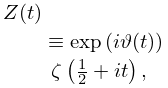
Calculations relating to the zeros on the critical line make use of the real-valued function
| 25.10.1 | |||
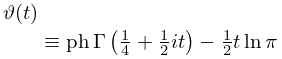
where
| 25.10.2 | |||
is chosen to make real, and assumes its principal value. Because , vanishes at the zeros of , which can be separated by observing sign changes of . Because changes sign infinitely often, has infinitely many zeros with real.
§25.10(ii) Riemann–Siegel Formula
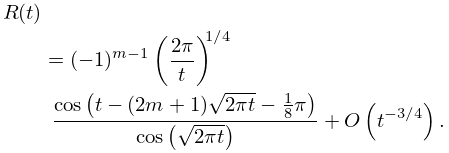
Riemann developed a method for counting the total number of zeros of in that portion of the critical strip with . By comparing with the number of sign changes of we can decide whether has any zeros off the line in this region. Sign changes of are determined by multiplying (25.9.3) by to obtain the Riemann–Siegel formula:
| 25.10.3 | |||
| , | |||
where as .
The error term can be expressed as an asymptotic series that begins
| 25.10.4 | |||
Riemann also developed a technique for determining further terms. Calculations based on the Riemann–Siegel formula reveal that the first ten billion zeros of in the critical strip are on the critical line (van de Lune et al. (1986)). More than 41% of all the zeros in the critical strip lie on the critical line (Bui et al. (2011)).
For further information on the Riemann–Siegel expansion see Berry (1995).