§27.12 Asymptotic Formulas: Primes
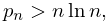
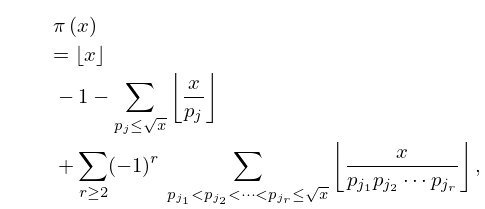
is the th prime, beginning with . is the number of primes less than or equal to .
| 27.12.1 | |||
| 27.12.2 | |||
| . | |||
| 27.12.3 | |||
| , | |||
where the series terminates when the product of the first primes exceeds .
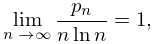
As
| 27.12.4 | |||
Prime Number Theorem
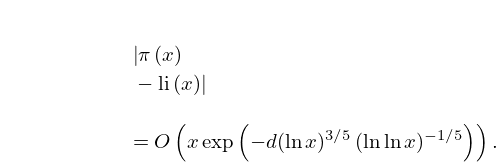
There exists a positive constant such that
| 27.12.5 | |||
| . | |||
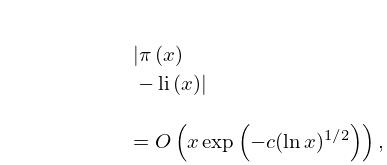
For the logarithmic integral see (6.2.8). The best available asymptotic error estimate (2009) appears in Korobov (1958) and Vinogradov (1958): there exists a positive constant such that
| 27.12.6 | |||
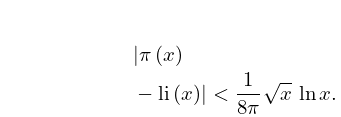
The Riemann hypothesis (§25.10(i)) is equivalent to the statement that for every ,
| 27.12.7 | |||
If is relatively prime to the modulus , then there are infinitely many primes congruent to .
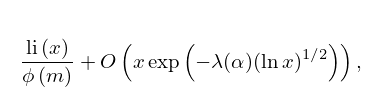
The number of such primes not exceeding is
| 27.12.8 | |||
| , , | |||
where depends only on , and is the Euler totient function (§27.2).
A Mersenne prime is a prime of the form . The largest known prime (2018) is the Mersenne prime . For current records see The Great Internet Mersenne Prime Search.
A pseudoprime test is a test that correctly identifies most composite numbers. For example, if , then is composite. Descriptions and comparisons of pseudoprime tests are given in Bressoud and Wagon (2000, §§2.4, 4.2, and 8.2) and Crandall and Pomerance (2005, §§3.4–3.6).
A Carmichael number is a composite number for which for all . There are infinitely many Carmichael numbers.