§25.16 Mathematical Applications
Contents
§25.16(i) Distribution of Primes
In studying the distribution of primes , Chebyshev (1851) introduced a function (not to be confused with the digamma function used elsewhere in this chapter), given by
| 25.16.1 | |||
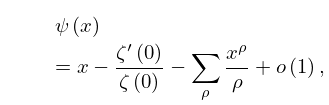
which is related to the Riemann zeta function by
| 25.16.2 | |||
| , | |||
where the sum is taken over the nontrivial zeros of .
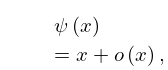
The prime number theorem (27.2.3) is equivalent to the statement
| 25.16.3 | |||
| . | |||
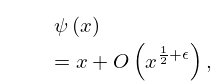
The Riemann hypothesis is equivalent to the statement
| 25.16.4 | |||
| , | |||
for every .
§25.16(ii) Euler Sums
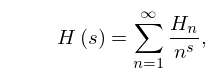
is analytic for , and can be extended meromorphically into the half-plane for every positive integer by use of the relations
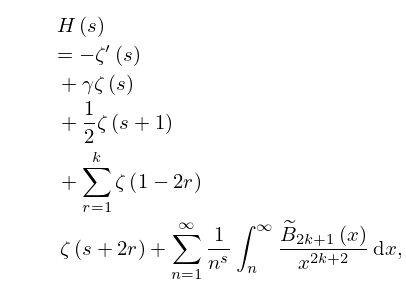
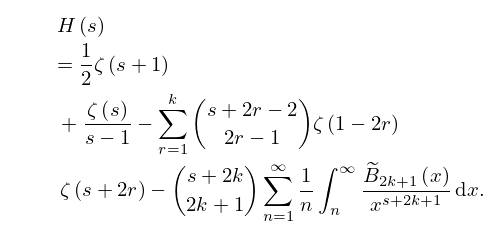
| 25.16.6 | |||
| 25.16.7 | |||
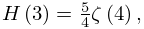
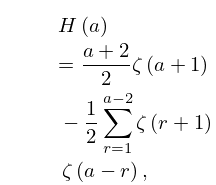
For integer (), can be evaluated in terms of the zeta function:
| 25.16.8 | ||||
| 25.16.9 | |||
| . | |||
Also,
| 25.16.10 | |||
| . | |||
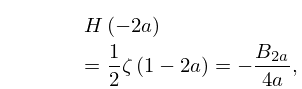
has a simple pole with residue () at each odd negative integer , .
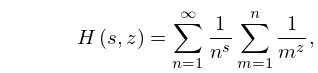
is the special case of the function
| 25.16.11 | |||
| , | |||
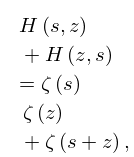
which satisfies the reciprocity law
| 25.16.12 | |||
when both and are finite.
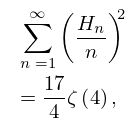
For further properties of see Apostol and Vu (1984). Related results are:
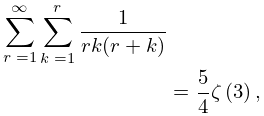
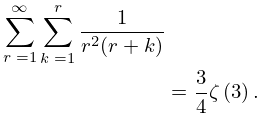
| 25.16.13 | ||||
| 25.16.14 | ||||
| 25.16.15 | ||||
For further generalizations, see Flajolet and Salvy (1998).