8 Incomplete Gamma and Related FunctionsIncomplete Gamma Functions8.10 Inequalities8.12 Uniform Asymptotic Expansions for Large Parameter
§8.11 Asymptotic Approximations and Expansions
Contents
- §8.11(i) Large , Fixed
- §8.11(ii) Large , Fixed
- §8.11(iii) Large , Fixed
- §8.11(iv) Large , Bounded
- §8.11(v) Other Approximations
§8.11(i) Large , Fixed
Define
| 8.11.1 | |||
| 8.11.2 | |||
| . | |||
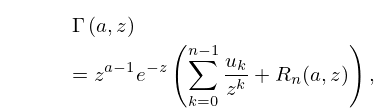
Then as with and fixed
| 8.11.3 | |||
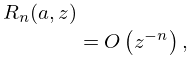
| , | |||
where denotes an arbitrary small positive constant.
§8.11(ii) Large , Fixed
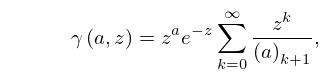
| 8.11.4 | |||
| . | |||
This expansion is absolutely convergent for all finite , and it can also be regarded as a generalized asymptotic expansion (§2.1(v)) of as in .
Also,
| 8.11.5 | |||
| , . | |||
§8.11(iii) Large , Fixed
If , with fixed, then as
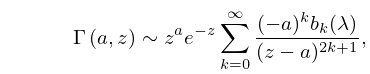
| 8.11.6 | |||
| , . | |||
| 8.11.7 | |||
| , . | |||
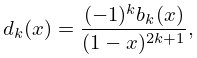
where
| 8.11.8 | ||||
and for ,
| 8.11.9 | |||
§8.11(iv) Large , Bounded
If and , then
| 8.11.10 | |||
| 8.11.11 | |||
§8.11(v) Other Approximations
As ,
| 8.11.12 | |||
| . | |||
For sharp error bounds and an exponentially-improved extension, see Nemes (2016). This reference also contains explicit formulas for the coefficients in terms of Stirling numbers.
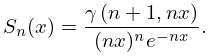
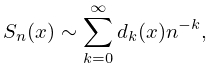
For the function defined by (8.4.11),
| 8.11.13 | |||
With , an asymptotic expansion of follows from (8.11.14) and (8.11.16).
If is defined by
| 8.11.14 | |||
then
| 8.11.15 | |||
As
| 8.11.16 | |||
| 8.11.17 | |||
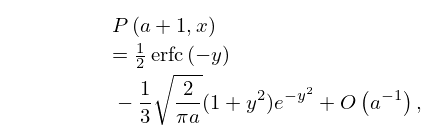
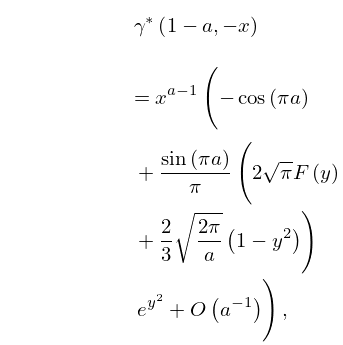
Also,
| 8.11.18 | |||
| , | |||
uniformly for , with
| 8.11.19 | ||||
| , | ||||
and as in §8.11(iii).