§8.12 Uniform Asymptotic Expansions for Large Parameter
Define
| 8.12.1 | ||||
where the branch of the square root is continuous and satisfies as . Then
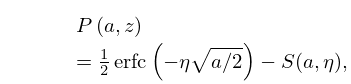
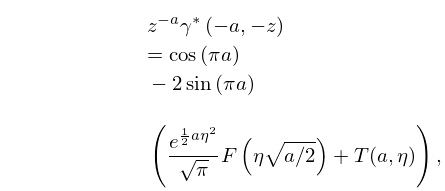
| 8.12.2 | ||||
Also, denote
| 8.12.3 | |||
| 8.12.4 | |||
| 8.12.5 | |||
and
| 8.12.6 | |||
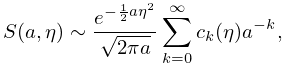
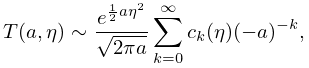
where is Dawson’s integral; see §7.2(ii). Then as in the sector ,
| 8.12.7 | |||
| 8.12.8 | |||
in each case uniformly with respect to in the sector ().
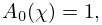
With , the coefficients are given by
| 8.12.9 | ||||
| 8.12.10 | |||
| , | |||
where , , are the coefficients that appear in the asymptotic expansion (5.11.3) of . The right-hand sides of equations (8.12.9), (8.12.10) have removable singularities at , and the Maclaurin series expansion of is given by
| 8.12.11 | |||
| , | |||
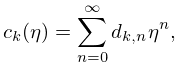
where ,
| 8.12.12 | ||||
| , | ||||
| , , | ||||
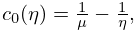
and are defined by
| 8.12.13 | |||
| . | |||
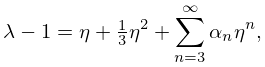
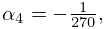
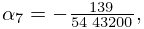
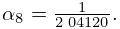
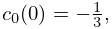
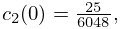
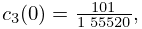
In particular,
| 8.12.14 | ||||
For numerical values of to 30D for and , where , see DiDonato and Morris (1986).
Special cases are given by
| 8.12.15 | |||
| , | |||
| 8.12.16 | |||
| , | |||
where
| 8.12.17 | ||||
For error bounds for (8.12.7) see Paris (2002a). For the asymptotic behavior of as see Dunster et al. (1998) and Olde Daalhuis (1998c). The last reference also includes an exponentially-improved version (§2.11(iii)) of the expansions (8.12.4) and (8.12.7) for .
A different type of uniform expansion with coefficients that do not possess a removable singularity at is given by
| 8.12.18 | |||
for in , with for and for . Here
| 8.12.19 | ||||
and
| 8.12.20 | ||||
Higher coefficients , , up to , are given in Paris (2002b).
Lastly, a uniform approximation for for large , with error bounds, can be found in Dunster (1996a).
For other uniform asymptotic approximations of the incomplete gamma functions in terms of the function see Paris (2002b) and Dunster (1996a).