§27.14 Unrestricted Partitions
Contents
- §27.14(i) Partition Functions
- §27.14(ii) Generating Functions and Recursions
- §27.14(iii) Asymptotic Formulas
- §27.14(iv) Relation to Modular Functions
- §27.14(v) Divisibility Properties
- §27.14(vi) Ramanujan’s Tau Function
§27.14(i) Partition Functions
A fundamental problem studies the number of ways can be written as a sum of positive integers , that is, the number of solutions of
| 27.14.1 | |||
| . | |||
The number of summands is unrestricted, repetition is allowed, and the order of the summands is not taken into account. The corresponding unrestricted partition function is denoted by , and the summands are called parts; see §26.9(i). For example, because there are exactly seven partitions of : .
The number of partitions of into at most parts is denoted by ; again see §26.9(i).
§27.14(ii) Generating Functions and Recursions
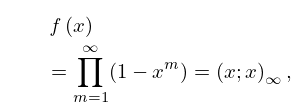
Euler introduced the reciprocal of the infinite product
| 27.14.2 | |||
| , | |||
as a generating function for the function defined in §27.14(i):
| 27.14.3 | |||
with . Euler’s pentagonal number theorem states that
| 27.14.4 | |||
where the exponents , , , , , , are the pentagonal numbers, defined by
| 27.14.5 | |||
| . | |||
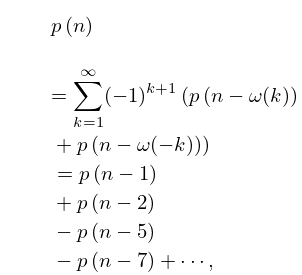
Multiplying the power series for with that for and equating coefficients, we obtain the recursion formula
| 27.14.6 | |||
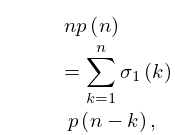
where is defined to be if . Logarithmic differentiation of the generating function leads to another recursion:
| 27.14.7 | |||
where is defined by (27.2.10) with .
§27.14(iii) Asymptotic Formulas
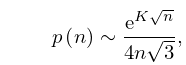
These recursions can be used to calculate , which grows very rapidly. For example, = , and . For large
| 27.14.8 | |||
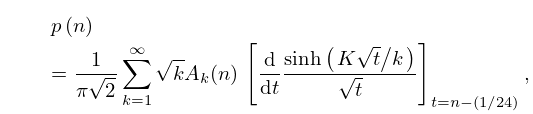
where (Hardy and Ramanujan (1918)). Rademacher (1938) derives a convergent series that also provides an asymptotic expansion for :
| 27.14.9 | |||
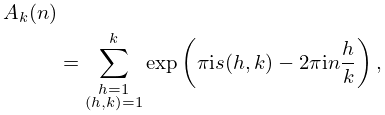
where
| 27.14.10 | |||
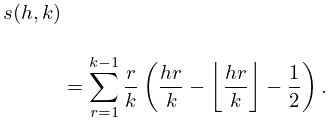
and is a Dedekind sum given by
| 27.14.11 | |||
§27.14(iv) Relation to Modular Functions
§27.14(v) Divisibility Properties
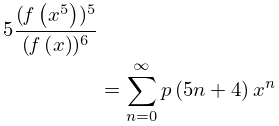
Ramanujan (1921) gives identities that imply divisibility properties of the partition function. For example, the Ramanujan identity
| 27.14.15 | |||
implies . Ramanujan also found that and for all . After decades of nearly fruitless searching for further congruences of this type, it was believed that no others existed, until it was shown in Ono (2000) that there are infinitely many. Ono proved that for every prime there are integers and such that for all . For example, .
§27.14(vi) Ramanujan’s Tau Function
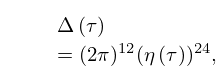
The discriminant function is defined by
| 27.14.16 | |||
| , | |||
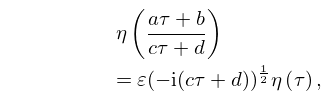
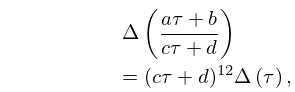
and satisfies the functional equation
| 27.14.17 | |||
if are integers with and .
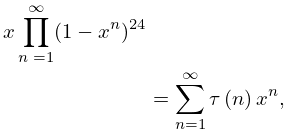
The 24th power of in (27.14.12) with is an infinite product that generates a power series in with integer coefficients called Ramanujan’s tau function :
| 27.14.18 | |||
| . | |||
The tau function is multiplicative and satisfies the more general relation:
| 27.14.19 | |||
| . | |||
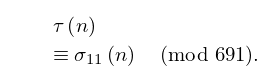
Lehmer (1947) conjectures that is never 0 and verifies this for all by studying various congruences satisfied by , for example:
| 27.14.20 | |||