§18.30 Associated OP’s
Contents
- §18.30(i) Associated Jacobi Polynomials
- §18.30(ii) Associated Legendre Polynomials
- §18.30(iii) Associated Laguerre Polynomials
- §18.30(iv) Associated Hermite Polynomials
- §18.30(v) Associated Meixner–Pollaczek Polynomials
- §18.30(vi) Corecursive Orthogonal Polynomials
- §18.30(vii) Corecursive and Associated Monic Orthogonal Polynomials
- §18.30(viii) Other Associated Polynomials
Assuming equation (18.2.8) with its initialization defines a set of OP’s, , the corresponding associated orthogonal polynomials of order are the as defined by shifting the index in the recurrence coefficients by adding a constant , functions of , say , being replaced by . The inequality , for is replaced by
| 18.30.1 | |||
| . | |||

The constant is usually taken as a positive integer. However, if the recurrence coefficients are polynomial, or rational, functions of , polynomials of degree may be well defined for provided that Askey and Wimp (1984).
The order recurrence is initialized as
| 18.30.2 | ||||

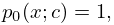
and then for consecutive
| 18.30.3 | |||

Associated polynomials and the related corecursive polynomials appear in Ismail (2009, §§2.3, 2.6, and 2.10), where the relationship of OP’s to continued fractions is made evident. The lowest order monic versions of both of these appear in §18.2(x), (18.2.31) defining the associated monic polynomials, and (18.2.32) their closely related cousins the corecursive polynomials.
§18.30(i) Associated Jacobi Polynomials
These are defined by
| 18.30.4 | |||
| , | |||

where is given by (18.30.2) and (18.30.3), with , , and as in (18.9.2). Explicitly,
| 18.30.5 | |||
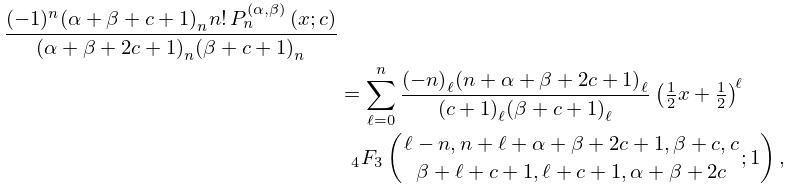
where the generalized hypergeometric function is defined by (16.2.1).
For corresponding corecursive associated Jacobi polynomials, corecursive associated polynomials being discussed in §18.30(vii), see Letessier (1995). For other results for associated Jacobi polynomials, see Wimp (1987) and Ismail and Masson (1991).
§18.30(ii) Associated Legendre Polynomials
These are defined by
| 18.30.6 | |||
| . | |||
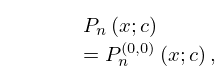
Explicitly,
| 18.30.7 | |||

in which are the Legendre polynomials of Table 18.3.1.
For further results on associated Legendre polynomials see Chihara (1978, Chapter VI, §12).
§18.30(iii) Associated Laguerre Polynomials
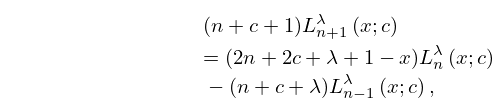
The recursion relation for the associated Laguerre polynomials, see (18.30.2), (18.30.3) is
| 18.30.8 | ||||
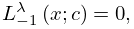
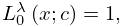
and
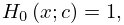
| 18.30.9 | |||
| . | |||
Orthogonality
| 18.30.10 | |||
| , , or , , | |||

with weight function
| 18.30.11 | |||
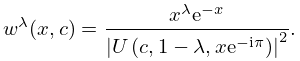
For the confluent hypergeometric function see §13.2(i). These constraints guarantee that the orthogonality only involves the integral , as above.
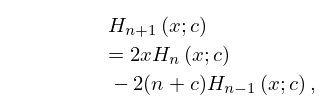
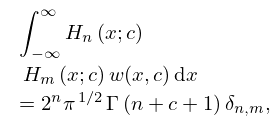
§18.30(iv) Associated Hermite Polynomials


§18.30(v) Associated Meixner–Pollaczek Polynomials
In view of (18.22.8) the associated Meixner–Pollaczek polynomials are defined by the recurrence relation
| 18.30.16 | ||||
| . | ||||



They can be expressed in terms of type 3 Pollaczek polynomials (which are also associated type 2 Pollaczek polynomials) by (18.35.10).
Orthogonality
| 18.30.17 | |||
| or , | |||
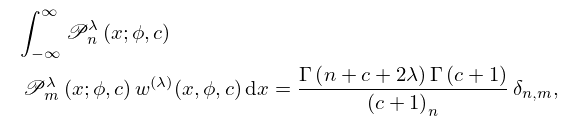
with weight function
| 18.30.18 | |||

For Gauss’ hypergeometric function see (15.2.1).
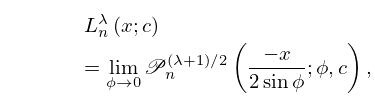

§18.30(vi) Corecursive Orthogonal Polynomials
The corecursive orthogonal polynomials, , these being linearly independent solutions of the recurrence for the , are defined as follows:
| 18.30.21 | ||||
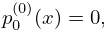
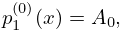
and then, as per usual, then, for consecutive ,
| 18.30.22 | |||

Note that this is the same recurrence as in (18.2.8) for the traditional OP’s, but with a different initialization. Ismail (2009, §2.3) discusses the meaning of linearly independent in this situation.
Numerator and Denominator Polynomials
The are also referred to as the numerator polynomials, the then being the denominator polynomials, in that the -th approximant of the continued fraction, ,
| 18.30.23 | |||

is given by
| 18.30.24 | |||

and of (18.30.23) and (18.30.24) are, also, precisely those of (18.2.34) and (18.2.35), now expressed via the traditional, , , coefficients, rather than the monic, , , recursion coefficients.
Markov’s Theorem
The ratio , as defined here, thus provides the same statement of Markov’s Theorem, as in (18.2.9_5), but now in terms of differently obtained numerator and denominator polynomials. Namely, if the interval is bounded, then
| 18.30.25 | |||
| . | |||

Ismail (2009, §2.6) discusses this in a different notation; also note the assumption that , made throughout that reference, Ismail (2009, p. 16).
§18.30(vii) Corecursive and Associated Monic Orthogonal Polynomials
Defining associated orthogonal polynomials and their relationship to their corecursive counterparts is particularly simple via use of the recursion relations for the monic, rather than via those for the traditional polynomials. The simplicity of the relationship follows from the fact that the monic polynomials have been rescaled so that the coefficient of the highest power of in , namely, , is unity; for a note on this standardization, see §18.2(iii). The notations and are used here to distinguish the two sets of monic polynomials from the (traditional) polynomials and of the preceding subsection.
Associated Monic OP’s
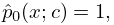


The “Zeroth” Corecursive Monic OP
The zeroth order corecursive monic polynomials follow directly from the alternate initialization
| 18.30.28 | ||||
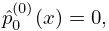
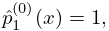
followed by use of the recursion of (18.30.27).
Relationship of Monic Corecursive and Monic Associated OP’s
It is easily seen that , and then
| 18.30.29 | |||

follows by induction on . This being the relationship established in §18.2(x) following (18.2.32). The usage of §18.2(x), where the monic associated polynomials, there denoted , instead of , are referred to as the first associated such polynomials in §18.2(x), is now evident. The ratio is then the of (18.2.35), leading to Markov’s theorem as stated in (18.30.25).
More generally, the th corecursive monic polynomials (defined with the initialization of (18.30.28) followed by the recurrence of (18.30.27)) are related to the st monic associated polynomials by
| 18.30.30 | |||

See Ismail (2009, p. 46 ), where the th corecursive polynomial is also related to an appropriate continued fraction, given here as its th convergent,
| 18.30.31 | |||

§18.30(viii) Other Associated Polynomials