§18.28 Askey–Wilson Class
Contents
- §18.28(i) Introduction
- §18.28(ii) Askey–Wilson Polynomials
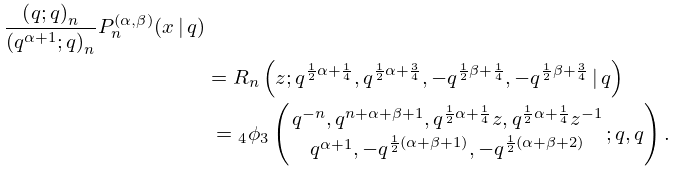
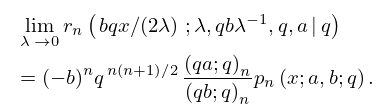
- §18.28(iii) Al-Salam–Chihara Polynomials
- §18.28(iv) -Al-Salam–Chihara Polynomials
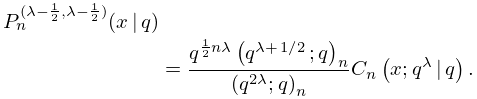
- §18.28(v) Continuous -Ultraspherical Polynomials
- §18.28(vi) Continuous -Hermite Polynomials
- §18.28(vii) Continuous -Hermite Polynomials
- §18.28(viii) -Racah Polynomials
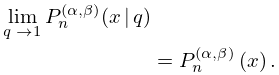
- §18.28(ix) Continuous -Jacobi Polynomials
- §18.28(x) Limit Relations
- §18.28(xi) Limits for
§18.28(i) Introduction
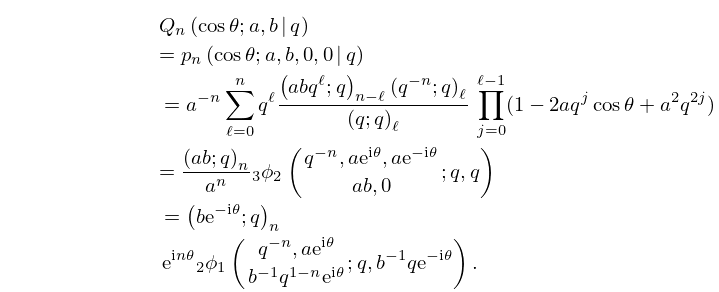
The Askey–Wilson class OP’s comprise the four-parameter families of Askey–Wilson polynomials and of -Racah polynomials, and cases of these families obtained by specialization of parameters. The Askey–Wilson polynomials form a system of OP’s , , that are orthogonal with respect to a weight function on a bounded interval, possibly supplemented with discrete weights on a finite set. The -Racah polynomials form a system of OP’s , , that are orthogonal with respect to a weight function on a sequence , , with a constant. Both the Askey–Wilson polynomials and the -Racah polynomials can best be described as functions of (resp. ) such that in the Askey–Wilson case, and in the -Racah case, and both are eigenfunctions of a second order -difference operator similar to (18.27.1).
In the remainder of this section the Askey–Wilson class OP’s are defined by their -hypergeometric representations, followed by their orthogonal properties. For further properties see Koekoek et al. (2010, Chapter 14). See also Gasper and Rahman (2004, pp. 180–199), Ismail (2009, Chapter 15), and Koornwinder (2012). For the notation of -hypergeometric functions see §§17.2 and 17.4(i).
§18.28(ii) Askey–Wilson Polynomials
| 18.28.1 | |||
| 18.28.1_5 | |||
The polynomials are symmetric in the parameters .
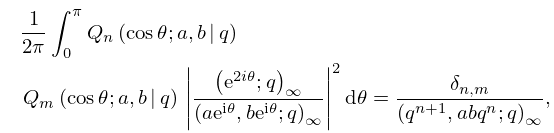
Orthogonality
Assume are all real, or two of them are real and two form a conjugate pair, or none of them are real but they form two conjugate pairs.
| 18.28.2 | |||
| , , | |||
where
| 18.28.3 | |||
| 18.28.4 | |||
| 18.28.5 | |||
| . | |||
More generally,
| 18.28.6 | |||
| , | |||
with and as above. Also, are the points with any of the whose absolute value exceeds , and the sum is over the with . See Koekoek et al. (2010, Eq. (14.1.3)) for the value of when .
-Difference Equation
| 18.28.6_1 | |||
where the operator is defined by
| 18.28.6_2 | |||
Recurrence Relation
| 18.28.6_3 | |||
where and
| 18.28.6_4 | ||||
Duality
Define dual parameters in terms of by
assuming . Then
| 18.28.6_5 | |||
| . | |||
§18.28(iii) Al-Salam–Chihara Polynomials
§18.28(iv) -Al-Salam–Chihara Polynomials
| 18.28.9 | |||
| 18.28.10 | |||
Eq. (18.28.10) is valid when either
| 18.28.11 | |||
or
| 18.28.12 | |||
If, in addition to (18.28.11) or (18.28.12), we have , then the measure in (18.28.10) is the unique orthogonality measure. Also, if , then (18.28.10) holds with interchanged. For further nondegenerate cases see Chihara and Ismail (1993) and Christiansen and Ismail (2006).
§18.28(v) Continuous -Ultraspherical Polynomials
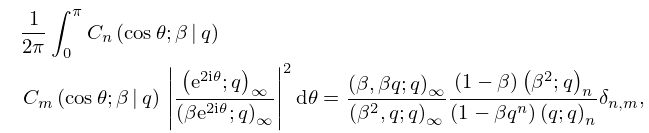
| 18.28.13 | ||||
| 18.28.14 | ||||
| 18.28.15 | |||
| . | |||
These polynomials are also called Rogers polynomials.
§18.28(vi) Continuous -Hermite Polynomials
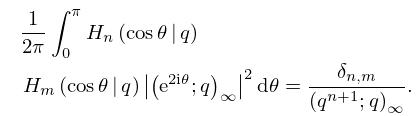
| 18.28.16 | |||
| 18.28.17 | |||
§18.28(vii) Continuous -Hermite Polynomials
| 18.28.18 | |||
§18.28(viii) -Racah Polynomials
With ,
| 18.28.19 | |||
| , , or ; . | |||
| 18.28.20 | |||
| , | |||
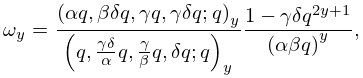
with
| 18.28.21 | |||
| 18.28.22 | |||
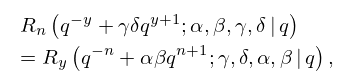
Duality
| 18.28.23 | |||
| , , or ; . | |||
Leonard (1982) classified all (finite or infinite) discrete systems of OP’s on a set for which there is a system of discrete OP’s on a set such that . These systems are the -Racah polynomials and its limit cases.
§18.28(ix) Continuous -Jacobi Polynomials
Let and let be given by (18.28.1_5). The continuous -Jacobi polynomial is defined by
| 18.28.24 | |||
Specialization to continuous -ultraspherical:
| 18.28.25 | |||
§18.28(x) Limit Relations
Let be as defined in (18.28.1_5) and put , .
From Askey–Wilson to Big -Jacobi
| 18.28.26 | |||
From Askey–Wilson to Little -Jacobi
| 18.28.27 | |||
| 18.28.28 | |||
From Askey–Wilson to Wilson
| 18.28.29 | |||
From Continuous -Jacobi to Jacobi
| 18.28.30 | |||
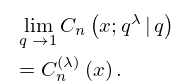
From Continuous -Ultraspherical to Ultraspherical
| 18.28.31 | |||
From Continuous -Ultraspherical to Continuous -Hermite
| 18.28.32 | |||
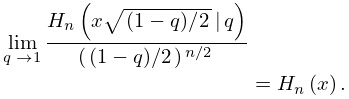
From Continuous -Hermite to Hermite
| 18.28.33 | |||
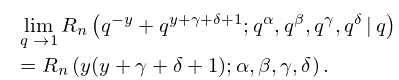
From -Racah to Racah
| 18.28.34 | |||
§18.28(xi) Limits for
Bannai and Ito (1984) introduced OP’s, called the Bannai–Ito polynomials which are the limit for of the -Racah polynomials. They have to be included in the classification by Leonard (1982), mentioned in §18.28(viii). In Tsujimoto et al. (2012) an extension of the Bannai–Ito polynomials occurs as eigenfunctions of a Dunkl type operator. Genest et al. (2016) showed that these polynomials coincide with the nonsymmetric Wilson polynomials in Groenevelt (2007).