Digital Library of Mathematical Functions
About the Project
NIST
18 Orthogonal PolynomialsAskey Scheme

§18.25 Wilson Class: Definitions

Contents

§18.25(i) Preliminaries

For the Wilson class OP’s p_{n}(x) with x=\lambda(y): if the y-orthogonality set is \{0,1,\dots,N\}, then the role of the differentiation operator \ifrac{d}{dx} in the Jacobi, Laguerre, and Hermite cases is played by the operator \Delta_{{y}} followed by division by \Delta_{{y}}(\lambda(y)), or by the operator \nabla_{{y}} followed by division by \nabla_{{y}}(\lambda(y)). Alternatively if the y-orthogonality interval is (0,\infty), then the role of \ifrac{d}{dx} is played by the operator \delta_{{y}} followed by division by \delta_{{y}}(\lambda(y)).

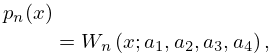
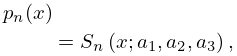
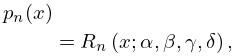
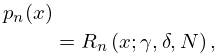
Table 18.25.1 lists the transformations of variable, orthogonality ranges, and parameter constraints that are needed in §18.2(i) for the Wilson polynomials \mathop{W_{{n}}\/}\nolimits\!\left(x;a,b,c,d\right), continuous dual Hahn polynomials \mathop{S_{{n}}\/}\nolimits\!\left(x;a,b,c\right), Racah polynomials \mathop{R_{{n}}\/}\nolimits\!\left(x;\alpha,\beta,\gamma,\delta\right), and dual Hahn polynomials \mathop{R_{{n}}\/}\nolimits\!\left(x;\gamma,\delta,N\right).

Table 18.25.1: Wilson class OP’s: transformations of variable, orthogonality ranges, and parameter constraints.
p_{n}(x) x=\lambda(y)

Orthogonality

range for y

Constraints
\mathop{W_{{n}}\/}\nolimits\!\left(x;a,b,c,d\right) y^{2} (0,\infty)

\realpart{(a,b,c,d)}>0;

nonreal parameters in conjugate pairs

\mathop{S_{{n}}\/}\nolimits\!\left(x;a,b,c\right) y^{2} (0,\infty)

\realpart{(a,b,c)}>0;

nonreal parameters in conjugate pairs

\mathop{R_{{n}}\/}\nolimits\!\left(x;\alpha,\beta,\gamma,\delta\right) y(y+\gamma+\delta+1) \{0,1,\dots,N\}

\alpha+1 or \beta+\delta+1 or \gamma+1=-N;

for further constraints see (18.25.1)

\mathop{R_{{n}}\/}\nolimits\!\left(x;\gamma,\delta,N\right) y(y+\gamma+\delta+1) \{0,1,\dots,N\} \gamma,\delta>-1 or <-N

Further Constraints for Racah Polynomials

If \alpha+1=-N, then the weights will be positive iff one of the following eight sets of inequalities holds:

The first four sets imply \gamma+\delta>-2, and the last four imply \gamma+\delta<-2N.

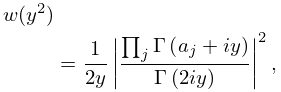
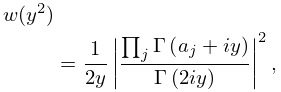
§18.25(ii) Weights and Normalizations: Continuous Cases

§18.25(iii) Weights and Normalizations: Discrete Cases

§18.25(iv) Leading Coefficients

Table 18.25.2 provides the leading coefficients k_{n}18.2(iii)) for the Wilson, continuous dual Hahn, Racah, and dual Hahn polynomials.