§15.10 Hypergeometric Differential Equation
Contents
§15.10(i) Fundamental Solutions
| 15.10.1 | |||
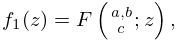
This is the hypergeometric differential equation. It has regular singularities at , with corresponding exponent pairs , , , respectively. When none of the exponent pairs differ by an integer, that is, when none of , , is an integer, we have the following pairs , of fundamental solutions. They are also numerically satisfactory (§2.7(iv)) in the neighborhood of the corresponding singularity.
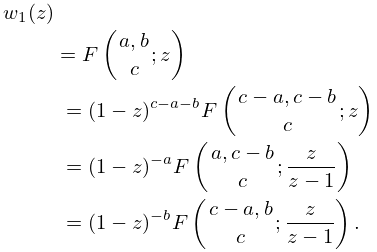
Singularity
| 15.10.2 | ||||
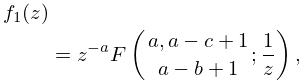
| 15.10.3 | |||
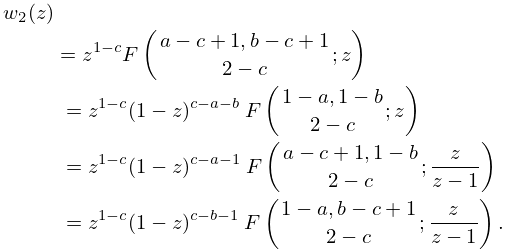
Singularity
| 15.10.4 | ||||
| 15.10.5 | |||
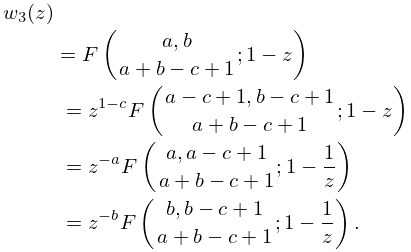
Singularity
| 15.10.6 | ||||
| 15.10.7 | |||
(a) If equals , and , then fundamental solutions in the neighborhood of are given by (15.10.2) with the interpretation (15.2.5) for .
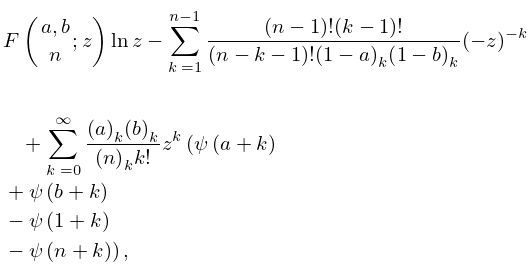
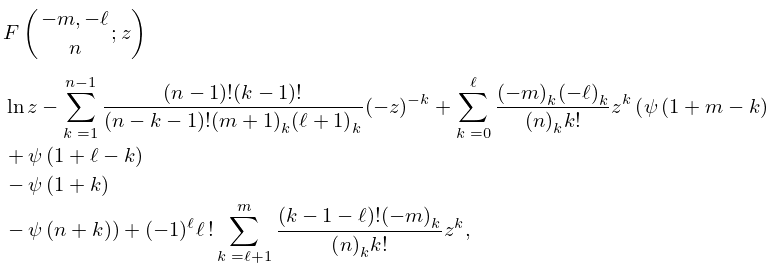
(b) If equals , and , then fundamental solutions in the neighborhood of are given by and
| 15.10.8 | |||
| , | |||
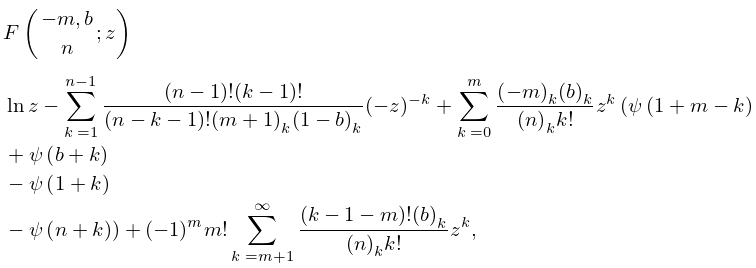
or
| 15.10.9 | |||
| , ; , | |||
or
| 15.10.10 | |||
| , ; , . | |||
(c) If the parameter in the differential equation equals , then fundamental solutions in the neighborhood of are given by times those in (a) and (b), with and replaced throughout by and , respectively.
(d) If equals , or , then fundamental solutions in the neighborhood of are given by those in (a), (b), and (c) with replaced by .
(e) Finally, if equals , or , then fundamental solutions in the neighborhood of are given by times those in (a), (b), and (c) with and replaced by and , respectively.
§15.10(ii) Kummer’s 24 Solutions and Connection Formulas
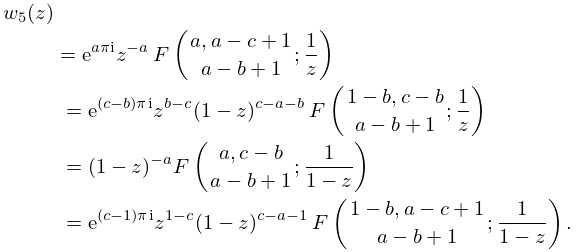
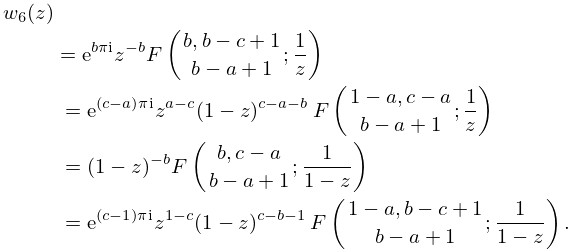
The three pairs of fundamental solutions given by (15.10.2), (15.10.4), and (15.10.6) can be transformed into 18 other solutions by means of (15.8.1), leading to a total of 24 solutions known as Kummer’s solutions.
| 15.10.11 | ||||
| 15.10.12 | ||||
| 15.10.13 | ||||
| 15.10.14 | ||||
| 15.10.15 | ||||
| 15.10.16 | ||||
The connection formulas for the principal branches of Kummer’s solutions are:
| 15.10.17 | ||||
| 15.10.18 | ||||
| 15.10.19 | ||||
| 15.10.20 | ||||
| 15.10.21 | ||||
| 15.10.22 | ||||
| 15.10.23 | ||||
| 15.10.24 | ||||
| 15.10.25 | ||||
| 15.10.26 | ||||
| 15.10.27 | ||||
| 15.10.28 | ||||
| 15.10.29 | ||||
| 15.10.30 | ||||
| 15.10.31 | ||||
| 15.10.32 | ||||
| 15.10.33 | ||||
| 15.10.34 | ||||
| 15.10.35 | ||||
| 15.10.36 | ||||