§15.12 Asymptotic Approximations
Contents
§15.12(i) Large Variable
§15.12(ii) Large
Let denote an arbitrary small positive constant. Also let be real or complex and fixed, and at least one of the following conditions be satisfied:
-
(a)
and/or .
-
(b)
and for all .
-
(c)
and .
-
(d)
and , where
15.12.1 with restricted so that .
Then for fixed ,
| 15.12.2 | |||
| . | |||
Similar results for other sectors are given in Wagner (1988). For the more general case in which and see Wagner (1990).
For large and with see López and Pagola (2011).
§15.12(iii) Other Large Parameters
Again, throughout this subsection denotes an arbitrary small positive constant, and are real or complex and fixed.
As ,
| 15.12.3 | |||
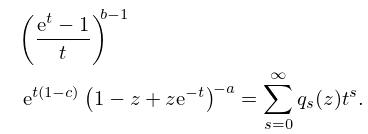
where and , , are defined by the generating function
| 15.12.4 | |||
If , then (15.12.3) applies when . If , then (15.12.3) applies when .
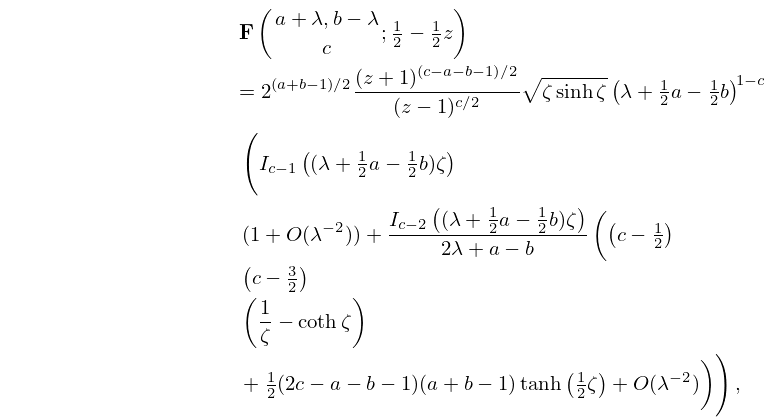
If , then as with ,
| 15.12.5 | |||
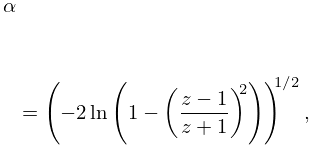
where
| 15.12.6 | |||
For see §10.25(ii). For this result and an extension to an asymptotic expansion with error bounds see Jones (2001).
If , then as with ,
| 15.12.7 | |||
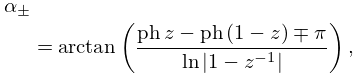
where
| 15.12.8 | |||
with the branch chosen to be continuous and when . For see §12.2, and for an extension to an asymptotic expansion see Olde Daalhuis (2003a).
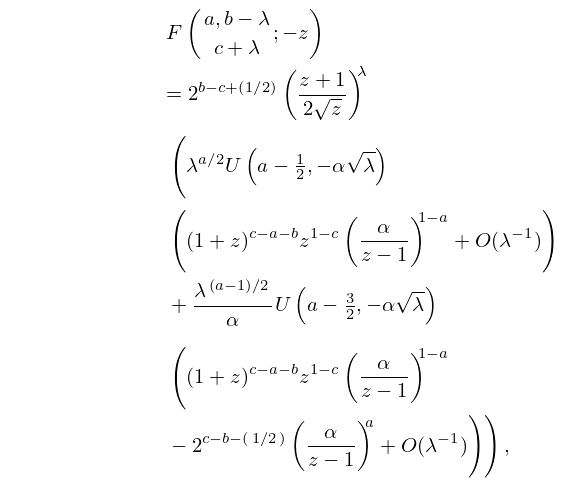
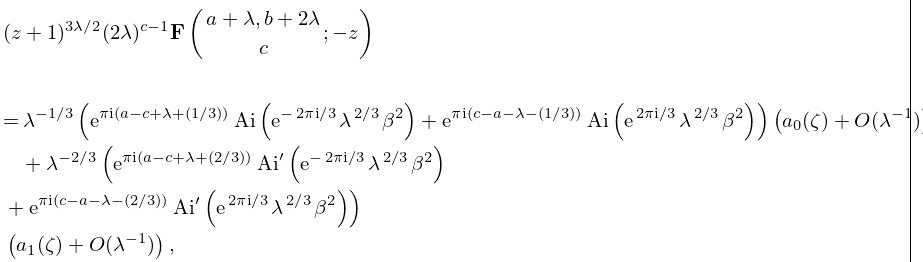
If , then as with ,
| 15.12.9 | |||
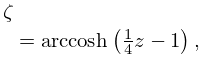
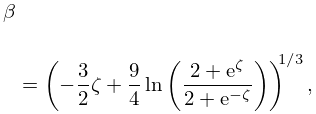
where
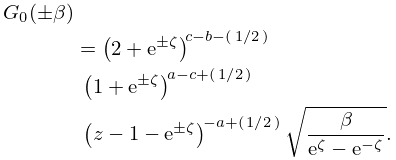
| 15.12.10 | ||||
| 15.12.11 | ||||
with the branch chosen to be continuous and when . Also,
| 15.12.12 | ||||
where
| 15.12.13 | |||
For see §9.2, and for further information and an extension to an asymptotic expansion see Olde Daalhuis (2003b). (Two errors in this reference are corrected in (15.12.9).)
By combination of the foregoing results of this subsection with the linear transformations of §15.8(i) and the connection formulas of §15.10(ii), similar asymptotic approximations for can be obtained with or , . For more details see Farid Khwaja and Olde Daalhuis (2014). For other extensions, see Wagner (1986), Temme (2003) and Temme (2015, Chapters 12 and 28).