§27.13 Functions
Contents
- §27.13(i) Introduction
- §27.13(ii) Goldbach Conjecture
- §27.13(iii) Waring’s Problem
- §27.13(iv) Representation by Squares
§27.13(i) Introduction
Whereas multiplicative number theory is concerned with functions arising from prime factorization, additive number theory treats functions related to addition of integers. The basic problem is that of expressing a given positive integer as a sum of integers from some prescribed set whose members are primes, squares, cubes, or other special integers. Each representation of as a sum of elements of is called a partition of , and the number of such partitions is often of great interest. The subsections that follow describe problems from additive number theory. See also Apostol (1976, Chapter 14) and Apostol and Niven (1994, pp. 33–34).
§27.13(ii) Goldbach Conjecture
Every even integer is the sum of two odd primes. In this case, is the number of solutions of the equation , where and are odd primes. Goldbach’s assertion is that for all even . This conjecture dates back to 1742 and was undecided in 2009, although it has been confirmed numerically up to very large numbers. Vinogradov (1937) proves that every sufficiently large odd integer is the sum of three odd primes, and Chen (1966) shows that every sufficiently large even integer is the sum of a prime and a number with no more than two prime factors.
The current status of Goldbach’s conjecture is described in the Wikipedia.
§27.13(iii) Waring’s Problem
This problem is named after Edward Waring who, in 1770, stated without proof and with limited numerical evidence, that every positive integer is the sum of four squares, of nine cubes, of nineteen fourth powers, and so on. Waring’s problem is to find, for each positive integer , whether there is an integer (depending only on ) such that the equation
| 27.13.1 | |||
has nonnegative integer solutions for all . The smallest that exists for a given is denoted by . Similarly, denotes the smallest for which (27.13.1) has nonnegative integer solutions for all sufficiently large .
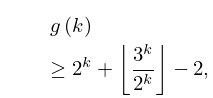
Lagrange (1770) proves that , and during the next 139 years the existence of was shown for . Hilbert (1909) proves the existence of for every but does not determine its corresponding numerical value. The exact value of is now known for every . For example, , , , , , and . A general formula states that
| 27.13.2 | |||
for all , with equality if . If with , then equality holds in (27.13.2) provided , a condition that is satisfied with at most a finite number of exceptions.
The existence of follows from that of because , but only the values and are known exactly. Some upper bounds smaller than are known. For example, , , , , and . Hardy and Littlewood (1925) conjectures that when is not a power of 2, and that when is a power of 2, but the most that is known (in 2009) is for some constant . A survey is given in Ellison (1971).
§27.13(iv) Representation by Squares
For a given integer the function is defined as the number of solutions of the equation
| 27.13.3 | |||
where the are integers, positive, negative, or zero, and the order of the summands is taken into account.
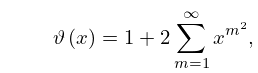
Jacobi (1829) notes that is the coefficient of in the square of the theta function :
| 27.13.4 | |||
| . | |||
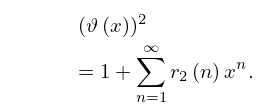
(In §20.2(i), is denoted by .) Thus,
| 27.13.5 | |||
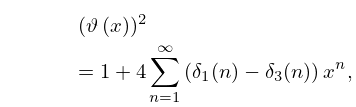
One of Jacobi’s identities implies that
| 27.13.6 | |||
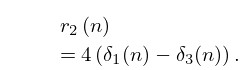
where and are the number of divisors of congruent respectively to 1 and 3 (mod 4), and by equating coefficients in (27.13.5) and (27.13.6) Jacobi deduced that
| 27.13.7 | |||
Hence because both divisors, and , are congruent to . In fact, there are four representations, given by , and four more with the order of summands reversed.
By similar methods Jacobi proved that if is odd, whereas, if is even, times the sum of the odd divisors of . Mordell (1917) notes that is the coefficient of in the power-series expansion of the th power of the series for . Explicit formulas for have been obtained by similar methods for , and , but they are more complicated. Exact formulas for have also been found for , and , and for all even . For values of the analysis of is considerably more complicated (see Hardy (1940)). Also, Milne (1996, 2002) announce new infinite families of explicit formulas extending Jacobi’s identities. For more than 8 squares, Milne’s identities are not the same as those obtained earlier by Mordell and others.