Digital Library of Mathematical Functions
About the Project
NIST
27 Functions of Number TheoryMultiplicative Number Theory

§27.11 Asymptotic Formulas: Partial Sums

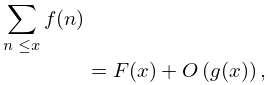
The behavior of a number-theoretic function f(n) for large n is often difficult to determine because the function values can fluctuate considerably as n increases. It is more fruitful to study partial sums and seek asymptotic formulas of the form

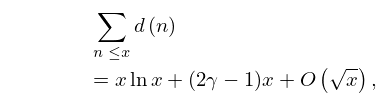
where F(x) is a known function of x, and \mathop{O\/}\nolimits\!\left(g(x)\right) represents the error, a function of smaller order than F(x) for all x in some prescribed range. For example, Dirichlet (1849) proves that for all x\geq 1,

27.11.2\sum_{{n\leq x}}\mathop{d\/}\nolimits\!\left(n\right)=x\mathop{\mathrm{log}\,%
\/}\nolimits x+(2\EulerConstant-1)x+\mathop{O\/}\nolimits\!\left(\sqrt{x}%
\right),

where \EulerConstant is Euler’s constant (§5.2(ii)). Dirichlet’s divisor problem (unsolved in 2009) is to determine the least number \theta_{0} such that the error term in (27.11.2) is \mathop{O\/}\nolimits\!\left(x^{\theta}\right) for all \theta>\theta_{0}. Kolesnik (1969) proves that \theta_{0}\leq\frac{12}{37}.

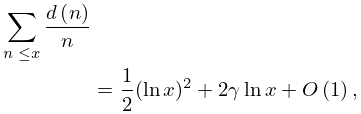
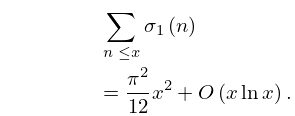
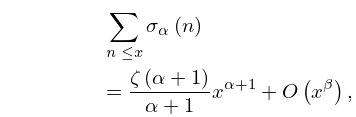
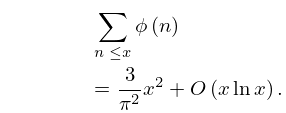
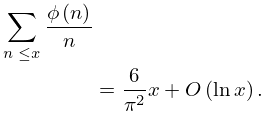
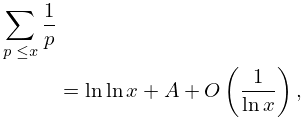
Equations (27.11.3)–(27.11.11) list further asymptotic formulas related to some of the functions listed in §27.2. They are valid for all x\geq 2. The error terms given here are not necessarily the best known.

where \EulerConstant again is Euler’s constant.

where A is a constant.

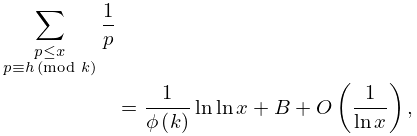
where \left(h,k\right)=1, k>0, and B is a constant depending on h and k.

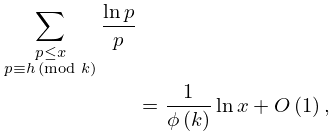
where \left(h,k\right)=1, k>0.

Letting x\to\infty in (27.11.9) or in (27.11.11) we see that there are infinitely many primes p\equiv h\;\;(\mathop{{\rm mod}}k) if h,k are coprime; this is Dirichlet’s theorem on primes in arithmetic progressions.

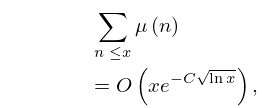
for some positive constant C,

27.11.13\lim_{{x\to\infty}}\frac{1}{x}\sum_{{n\leq x}}\mathop{\mu\/}\nolimits\!\left(n%
\right)=0,
27.11.14\lim_{{x\to\infty}}\sum_{{n\leq x}}\frac{\mathop{\mu\/}\nolimits\!\left(n%
\right)}{n}=0,
27.11.15\lim_{{x\to\infty}}\sum_{{n\leq x}}\frac{\mathop{\mu\/}\nolimits\!\left(n%
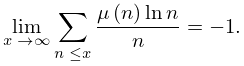
\right)\mathop{\mathrm{log}\,\/}\nolimits n}{n}=-1.

Each of (27.11.13)–(27.11.15) is equivalent to the prime number theorem (27.2.3). The prime number theorem for arithmetic progressions—an extension of (27.2.3) and first proved in de la Vallée Poussin (1896a, b)—states that if \left(h,k\right)=1, then the number of primes p\leq x with p\equiv h\;\;(\mathop{{\rm mod}}k) is asymptotic to x/(\mathop{\phi\/}\nolimits\!\left(k\right)\mathop{\mathrm{log}\,\/}\nolimits x) as x\to\infty.