1.13 Differential Equations1.15 Summability Methods

§1.14 Integral Transforms

Contents

§1.14(i) Fourier Transform

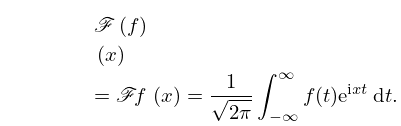
The Fourier transform of a real- or complex-valued function f(t) is defined by

1.14.1 F(x)=\frac{1}{\sqrt{2\pi}}\int^{\infty}_{{-\infty}}f(t)e^{{ixt}}dt.

(Some references replace ixt by -ixt.)

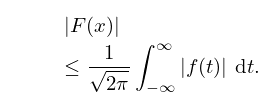
If f(t) is absolutely integrable on (-\infty,\infty), then F(x) is continuous, F(x)\to 0 as x\to\pm\infty, and

1.14.2 |F(x)|\leq\frac{1}{\sqrt{2\pi}}\int^{\infty}_{{-\infty}}|f(t)|dt.

Inversion

Suppose that f(t) is absolutely integrable on (-\infty,\infty) and of bounded variation in a neighborhood of t=u1.4(v)). Then
1.14.3 \tfrac{1}{2}(f(u+)+f(u-))=\frac{1}{\sqrt{2\pi}}\pvint^{\infty}_{{-\infty}}F(x)e^{{-ixu}}dx,

where the last integral denotes the Cauchy principal value (1.4.25).
In many applications f(t) is absolutely integrable and f^{{\prime}}(t) is continuous on (-\infty,\infty). Then

1.14.4 f(t)=\frac{1}{\sqrt{2\pi}}\int^{\infty}_{{-\infty}}F(x)e^{{-ixt}}dx.

Convolution

For Fourier transforms, the convolution (f*g)(t) of two functions f(t) and g(t) defined on (-\infty,\infty) is given by

1.14.5 (f*g)(t)=\frac{1}{\sqrt{2\pi}}\int^{\infty}_{{-\infty}}f(t-s)g(s)ds.

If f(t) and g(t) are absolutely integrable on (-\infty,\infty), then so is (f*g)(t), and its Fourier transform is F(x)G(x), where G(x) is the Fourier transform of g(t).

Parseval’s Formula

Suppose f(t) and g(t) are absolutely integrable on (-\infty,\infty), and F(x) and G(x) are their respective Fourier transforms. Then

1.14.6 (f*g)(t)=\frac{1}{\sqrt{2\pi}}\int^{\infty}_{{-\infty}}F(x)G(x)e^{{-itx}}dx,
1.14.7 \int^{\infty}_{{-\infty}}F(x)G(x)dx=\int^{\infty}_{{-\infty}}f(t)g(-t)dt,
1.14.8 \int^{\infty}_{{-\infty}}|F(x)|^{2}dx=\int^{\infty}_{{-\infty}}|f(t)|^{2}dt.

(1.14.8) is Parseval’s formula.

Uniqueness

If f(t) and g(t) are continuous and absolutely integrable on (-\infty,\infty), and F(x)=G(x) for all x, then f(t)=g(t) for all t.

§1.14(ii) Fourier Cosine and Sine Transforms

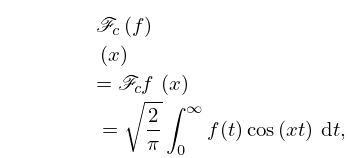
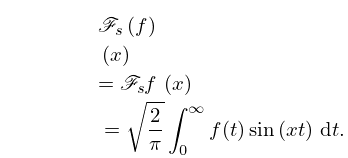
These are defined respectively by

1.14.9 F_{c}(x)=\sqrt{\frac{2}{\pi}}\int^{\infty}_{0}f(t)\mathop{\cos\/}\nolimits\!\left(xt\right)dt,
1.14.10 F_{s}(x)=\sqrt{\frac{2}{\pi}}\int^{\infty}_{0}f(t)\mathop{\sin\/}\nolimits\!\left(xt\right)dt.

Inversion

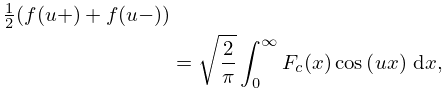
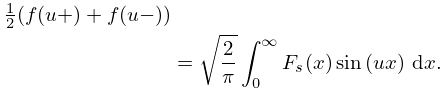
If f(t) is absolutely integrable on [0,\infty) and of bounded variation (§1.4(v)) in a neighborhood of t=u, then

Parseval’s Formula

If \int^{\infty}_{0}|f(t)|dt<\infty, g(t) is of bounded variation on (0,\infty) and g(t)\to 0 as t\to\infty, then

where G_{c}(x) and G_{s}(x) are respectively the cosine and sine transforms of g(t).

§1.14(iii) Laplace Transform

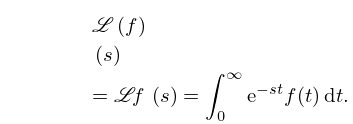
Suppose f(t) is a real- or complex-valued function and s is a real or complex parameter. The Laplace transform of f is defined by

1.14.17 \mathop{\mathscr{L}\/}\nolimits\left(f(t);s\right)=\int^{\infty}_{0}e^{{-st}}f(t)dt.

Alternative notations are \mathop{\mathscr{L}\/}\nolimits(f(t)), \mathop{\mathscr{L}\/}\nolimits(f;s), or even \mathop{\mathscr{L}\/}\nolimits(f), when it is not important to display all the variables.

Convergence and Analyticity

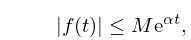
Assume that on [0,\infty) f(t) is piecewise continuous and of exponential growth, that is, constants M and \alpha exist such that

1.14.18 |f(t)|\leq Me^{{\alpha t}}, 0\leq t<\infty.

Then \mathop{\mathscr{L}\/}\nolimits\left(f(t);s\right) is an analytic function of s for \realpart{s}>\alpha. Moreover,

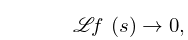
1.14.19 \mathop{\mathscr{L}\/}\nolimits\left(f(t);s\right)\to 0, \realpart{s}\to\infty.

Throughout the remainder of this subsection we assume (1.14.18) is satisfied and \realpart{s}>\alpha.

Inversion

If f(t) is continuous and f^{{\prime}}(t) is piecewise continuous on [0,\infty), then

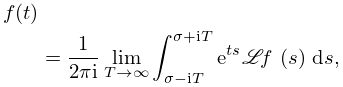
1.14.20 f(t)=\frac{1}{2\pi i}\lim _{{T\to\infty}}\int^{{\sigma+iT}}_{{\sigma-iT}}e^{{ts}}\mathop{\mathscr{L}\/}\nolimits\left(f(t);s\right)ds, \sigma>\alpha.

Moreover, if \mathop{\mathscr{L}\/}\nolimits\left(f(t);s\right)=\mathop{O\/}\nolimits\!\left(s^{{-K}}\right) in some half-plane \realpart{s}\geq\gamma and K>1, then (1.14.20) holds for \sigma>\gamma.

Translation

If \realpart{s}>\max(\realpart{(a+\alpha)},\alpha), then

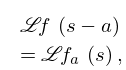
1.14.21 \mathop{\mathscr{L}\/}\nolimits\left(f(t);s-a\right)=\mathop{\mathscr{L}\/}\nolimits\left(e^{{at}}f(t);s\right).

Also, if a\geq 0 then

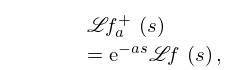
1.14.22 \mathop{\mathscr{L}\/}\nolimits\left(\mathop{H\/}\nolimits\!\left(t-a\right)f(t-a);s\right)=e^{{-as}}\mathop{\mathscr{L}\/}\nolimits\left(f(t);s\right),

where \mathop{H\/}\nolimits is the Heaviside function; see (1.16.13).

Differentiation and Integration

If f(t) is piecewise continuous, then

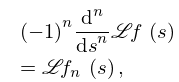
1.14.23 \frac{{d}^{n}}{{ds}^{n}}\mathop{\mathscr{L}\/}\nolimits\left(f(t);s\right)=\mathop{\mathscr{L}\/}\nolimits\left((-t)^{n}f(t);s\right), n=1,2,3,\dots.

If also \lim _{{t\to 0+}}f(t)/t exists, then

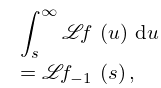
1.14.24 \int^{\infty}_{s}\mathop{\mathscr{L}\/}\nolimits\left(f(t);u\right)du=\mathop{\mathscr{L}\/}\nolimits\left(\frac{f(t)}{t};s\right).

Periodic Functions

If a>0 and f(t+a)=f(t) for t>0, then

1.14.25 \mathop{\mathscr{L}\/}\nolimits\left(f(t);s\right)=\frac{1}{1-e^{{-as}}}\int^{a}_{0}e^{{-st}}f(t)dt.

Alternatively if f(t+a)=-f(t) for t>0, then

1.14.26 \mathop{\mathscr{L}\/}\nolimits\left(f(t);s\right)=\frac{1}{1+e^{{-as}}}\int^{a}_{0}e^{{-st}}f(t)dt.

Derivatives

If f(t) is continuous on [0,\infty) and f^{{\prime}}(t) is piecewise continuous on (0,\infty), then

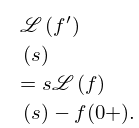
1.14.27 \mathop{\mathscr{L}\/}\nolimits\left(f^{{\prime}}(t);s\right)=s\mathop{\mathscr{L}\/}\nolimits\left(f(t);s\right)-f(0+).

If f(t) and f^{{\prime}}(t) are piecewise continuous on [0,\infty) with discontinuities at (0=) t_{0}<t_{1}<\dots<t_{n}, then

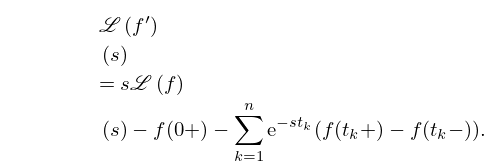
1.14.28 \mathop{\mathscr{L}\/}\nolimits\left(f^{{\prime}}(t);s\right)=s\mathop{\mathscr{L}\/}\nolimits\left(f(t);s\right)-f(0+)-\sum^{n}_{{k=1}}e^{{-st_{k}}}(f(t_{k}+)-f(t_{k}-)).

Next, assume f(t), f^{{\prime}}(t), \dots, f^{{(n-1)}}(t) are continuous and each satisfies (1.14.18). Also assume that f^{{(n)}}(t) is piecewise continuous on [0,\infty). Then

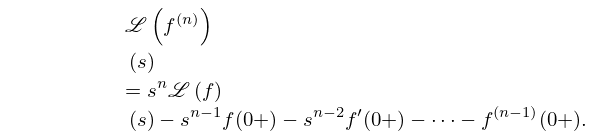
1.14.29 \mathop{\mathscr{L}\/}\nolimits\left(f^{{(n)}}(t);s\right)=s^{n}\mathop{\mathscr{L}\/}\nolimits\left(f(t);s\right)-s^{{n-1}}f(0+)-s^{{n-2}}f^{{\prime}}(0+)-\dots-f^{{(n-1)}}(0+).

Convolution

For Laplace transforms, the convolution of two functions f(t) and g(t), defined on [0,\infty), is

1.14.30 (f*g)(t)=\int^{t}_{0}f(u)g(t-u)du.

If f(t) and g(t) are piecewise continuous, then

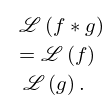
1.14.31 \mathop{\mathscr{L}\/}\nolimits(f*g)=\mathop{\mathscr{L}\/}\nolimits(f)\mathop{\mathscr{L}\/}\nolimits(g).

Uniqueness

If f(t) and g(t) are continuous and \mathop{\mathscr{L}\/}\nolimits(f)=\mathop{\mathscr{L}\/}\nolimits(g), then f(t)=g(t).

§1.14(iv) Mellin Transform

The Mellin transform of a real- or complex-valued function f(x) is defined by

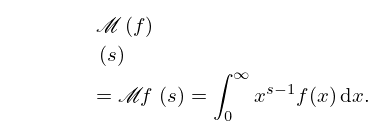
1.14.32 \mathop{\mathscr{M}\/}\nolimits\left(f;s\right)=\int^{\infty}_{0}x^{{s-1}}f(x)dx.

Alternative notations for \mathop{\mathscr{M}\/}\nolimits\left(f;s\right) are \mathop{\mathscr{M}\/}\nolimits\left(f(x);s\right) and \mathop{\mathscr{M}\/}\nolimits(f).

If x^{{\sigma-1}}f(x) is integrable on (0,\infty) for all \sigma in a<\sigma<b, then the integral (1.14.32) converges and \mathop{\mathscr{M}\/}\nolimits\left(f;s\right) is an analytic function of s in the vertical strip a<\realpart{s}<b. Moreover, for a<\sigma<b,

1.14.33 \lim _{{t\to\pm\infty}}\mathop{\mathscr{M}\/}\nolimits\left(f;\sigma+it\right)=0.

Note: If f(x) is continuous and \alpha and \beta are real numbers such that f(x)=\mathop{O\/}\nolimits\!\left(x^{\alpha}\right) as x\to 0+ and f(x)=\mathop{O\/}\nolimits\!\left(x^{\beta}\right) as x\to\infty, then x^{{\sigma-1}}f(x) is integrable on (0,\infty) for all \sigma\in(-\alpha,-\beta).

Inversion

Suppose the integral (1.14.32) is absolutely convergent on the line \realpart{s}=\sigma and f(x) is of bounded variation in a neighborhood of x=u. Then

1.14.34 \tfrac{1}{2}(f(u+)+f(u-))=\frac{1}{2\pi i}\lim _{{T\to\infty}}\int^{{\sigma+iT}}_{{\sigma-iT}}u^{{-s}}\mathop{\mathscr{M}\/}\nolimits\left(f;s\right)ds.

If f(x) is continuous on (0,\infty) and \mathop{\mathscr{M}\/}\nolimits\left(f;\sigma+it\right) is integrable on (-\infty,\infty), then

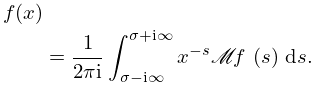
1.14.35 f(x)=\frac{1}{2\pi i}\int^{{\sigma+i\infty}}_{{\sigma-i\infty}}x^{{-s}}\mathop{\mathscr{M}\/}\nolimits\left(f;s\right)ds.

Parseval-type Formulas

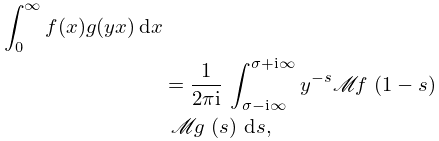
Suppose x^{{-\sigma}}f(x) and x^{{\sigma-1}}g(x) are absolutely integrable on (0,\infty) and either \mathop{\mathscr{M}\/}\nolimits\left(g;\sigma+it\right) or \mathop{\mathscr{M}\/}\nolimits\left(f;1-\sigma-it\right) is absolutely integrable on (-\infty,\infty). Then for y>0,

1.14.36 \int^{\infty}_{0}f(x)g(yx)dx=\frac{1}{2\pi i}\*\int^{{\sigma+i\infty}}_{{\sigma-i\infty}}y^{{-s}}\mathop{\mathscr{M}\/}\nolimits\left(f;1-s\right)\mathop{\mathscr{M}\/}\nolimits\left(g;s\right)ds,
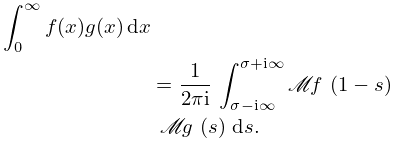
1.14.37 \int^{\infty}_{0}f(x)g(x)dx=\frac{1}{2\pi i}\*\int^{{\sigma+i\infty}}_{{\sigma-i\infty}}\mathop{\mathscr{M}\/}\nolimits\left(f;1-s\right)\mathop{\mathscr{M}\/}\nolimits\left(g;s\right)ds.

When f is real and \sigma=\tfrac{1}{2},

1.14.38 \int^{\infty}_{0}(f(x))^{2}dx=\frac{1}{2\pi}\int^{\infty}_{{-\infty}}\left|\mathop{\mathscr{M}\/}\nolimits\left(f;\tfrac{1}{2}+it\right)\right|^{2}dt.

Convolution

Let

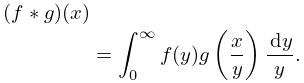
1.14.39 (f*g)(x)=\int^{\infty}_{0}f(y)g\left(\frac{x}{y}\right)\frac{dy}{y}.

If x^{{\sigma-1}}f(x) and x^{{\sigma-1}}g(x) are absolutely integrable on (0,\infty), then for s=\sigma+it,

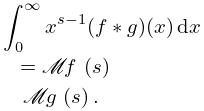
1.14.40 \int^{\infty}_{0}x^{{s-1}}(f*g)(x)dx=\mathop{\mathscr{M}\/}\nolimits\left(f;s\right)\mathop{\mathscr{M}\/}\nolimits\left(g;s\right).

§1.14(v) Hilbert Transform

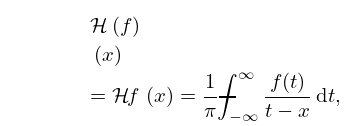
The Hilbert transform of a real-valued function f(t) is defined in the following equivalent ways:

Inversion

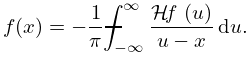
Suppose f(t) is continuously differentiable on (-\infty,\infty) and vanishes outside a bounded interval. Then

1.14.44 f(x)=-\frac{1}{\pi}\pvint^{\infty}_{{-\infty}}\frac{\mathop{\mathcal{H}\/}\nolimits\left(f;u\right)}{u-x}du.

Inequalities

If |f(t)|^{p}, p>1, is integrable on (-\infty,\infty), then so is |\mathop{\mathcal{H}\/}\nolimits\left(f;x\right)|^{p} and

1.14.45 \int^{\infty}_{{-\infty}}|\mathop{\mathcal{H}\/}\nolimits\left(f;x\right)|^{p}dx\leq A_{p}\int^{\infty}_{{-\infty}}|f(t)|^{p}dt,

where A_{p}=\mathop{\tan\/}\nolimits\!\left(\tfrac{1}{2}\pi/p\right) when 1<p\leq 2, or \mathop{\cot\/}\nolimits\!\left(\tfrac{1}{2}\pi/p\right) when p\geq 2. These bounds are sharp, and equality holds when p=2.

Fourier Transform

When f(t) satisfies the same conditions as those for (1.14.44),

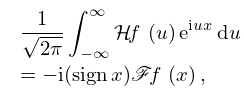
1.14.46 \frac{1}{\sqrt{2\pi}}\int _{{-\infty}}^{\infty}\mathop{\mathcal{H}\/}\nolimits\left(f;t\right)e^{{ixt}}dt=-i(\mathop{\mathrm{sign}\/}\nolimits x)F(x),

where F(x) is given by (1.14.1).

§1.14(vi) Stieltjes Transform

The Stieltjes transform of a real-valued function f(t) is defined by

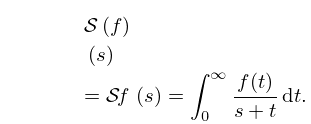
1.14.47 \mathop{\mathcal{S}\/}\nolimits\left(f;s\right)=\mathop{\mathcal{S}\/}\nolimits\left(f(t);s\right)=\mathop{\mathcal{S}\/}\nolimits(f)=\int^{\infty}_{0}\frac{f(t)}{s+t}dt.

Sufficient conditions for the integral to converge are that s is a positive real number, and f(t)=\mathop{O\/}\nolimits\!\left(t^{{-\delta}}\right) as t\to\infty, where \delta>0.

If the integral converges, then it converges uniformly in any compact domain in the complex s-plane not containing any point of the interval (-\infty,0]. In this case, \mathop{\mathcal{S}\/}\nolimits\left(f;s\right) represents an analytic function in the s-plane cut along the negative real axis, and

1.14.48 \frac{{d}^{m}}{{ds}^{m}}\mathop{\mathcal{S}\/}\nolimits\left(f;s\right)=(-1)^{m}m!\int^{\infty}_{0}\frac{f(t)dt}{(s+t)^{{m+1}}}, m=0,1,2,\dots.

Inversion

If f(t) is absolutely integrable on [0,R] for every finite R, and the integral (1.14.47) converges, then

1.14.49 \lim _{{t\to 0+}}\frac{\mathop{\mathcal{S}\/}\nolimits\left(f;-\sigma-it\right)-\mathop{\mathcal{S}\/}\nolimits\left(f;-\sigma+it\right)}{2\pi i}=\tfrac{1}{2}(f(\sigma+)+f(\sigma-)),

for all values of the positive constant \sigma for which the right-hand side exists.

Laplace Transform

If f(t) is piecewise continuous on [0,\infty) and the integral (1.14.47) converges, then

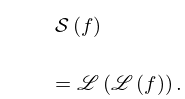
1.14.50 \mathop{\mathcal{S}\/}\nolimits(f)=\mathop{\mathscr{L}\/}\nolimits(\mathop{\mathscr{L}\/}\nolimits(f)).

§1.14(vii) Tables

Table 1.14.4: Laplace transforms.
f(t) \displaystyle\int^{\infty}_{0}e^{{-st}}f(t)dt
1 \dfrac{1}{s}, \realpart{s}>0
\dfrac{t^{n}}{n!} \dfrac{1}{s^{{n+1}}}, \realpart{s}>0
\dfrac{1}{\sqrt{\pi t}} \dfrac{1}{\sqrt{s}}, \realpart{s}>0
e^{{-at}} \dfrac{1}{s+a}, \realpart{(s+a)}>0
\dfrac{t^{n}e^{{-at}}}{n!} \dfrac{1}{(s+a)^{{n+1}}}, \realpart{(s+a)}>0
\dfrac{e^{{-at}}-e^{{-bt}}}{b-a} \dfrac{1}{(s+a)(s+b)}, a\not=b, \realpart{s}>-\realpart{a}, \realpart{s}>-\realpart{b}
\mathop{\sin\/}\nolimits\!\left(at\right) \dfrac{a}{s^{2}+a^{2}}, \realpart{s}>|\imagpart{a}|
\mathop{\cos\/}\nolimits\!\left(at\right) \dfrac{s}{s^{2}+a^{2}}, \realpart{s}>|\imagpart{a}|
\mathop{\sinh\/}\nolimits\!\left(at\right) \dfrac{a}{s^{2}-a^{2}}, \realpart{s}>|\realpart{a}|
\mathop{\cosh\/}\nolimits\!\left(at\right) \dfrac{s}{s^{2}-a^{2}}, \realpart{s}>|\realpart{a}|
t\mathop{\sin\/}\nolimits\!\left(at\right) \dfrac{2as}{(s^{2}+a^{2})^{2}}, \realpart{s}>|\imagpart{a}|
t\mathop{\cos\/}\nolimits\!\left(at\right) \dfrac{s^{2}-a^{2}}{(s^{2}+a^{2})^{2}}, \realpart{s}>|\imagpart{a}|
\dfrac{e^{{-bt}}-e^{{-at}}}{t} \displaystyle{\mathop{\ln\/}\nolimits\!\left(\frac{s+a}{s+b}\right)}, \realpart{s}>-\realpart{a}, \realpart{s}>-\realpart{b}
\dfrac{2(1-\mathop{\cosh\/}\nolimits\!\left(at\right))}{t} \displaystyle{\mathop{\ln\/}\nolimits\!\left(1-\frac{a^{2}}{s^{2}}\right)}, \realpart{(s+a)}>0
\dfrac{2(1-\mathop{\cos\/}\nolimits\!\left(at\right))}{t} \displaystyle{\mathop{\ln\/}\nolimits\!\left(1+\frac{a^{2}}{s^{2}}\right)}, \realpart{s}>0
\dfrac{\mathop{\sin\/}\nolimits\!\left(at\right)}{t} \mathop{\mathrm{arctan}\/}\nolimits\!\left(\dfrac{a}{s}\right), \realpart{s}>0

§1.14(viii) Compendia

For more extensive tables of the integral transforms of this section and tables of other integral transforms, see Erdélyi et al. (1954a, b), Gradshteyn and Ryzhik (2000), Marichev (1983), Oberhettinger (1972, 1974, 1990), Oberhettinger and Badii (1973), Oberhettinger and Higgins (1961), Prudnikov et al. (1986a, b, 1990, 1992a, 1992b).