Digital Library of Mathematical Functions
About the Project
NIST
9 Airy and Related FunctionsRelated Functions

§9.13 Generalized Airy Functions

Contents

§9.13(i) Generalizations from the Differential Equation

Equations of the form

9.13.1\frac{{d}^{2}w}{{dz}^{2}}=z^{n}w,n=1,2,3,\ldots,

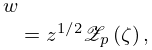
are used in approximating solutions to differential equations with multiple turning points; see §2.8(v). The general solution of (9.13.1) is given by
where

9.13.3
p=\frac{1}{n+2},
\zeta=\frac{2}{n+2}z^{{(n+2)/2}}=2pz^{{1/(2p)}},

and \mathop{\mathscr{Z}_{{p}}\/}\nolimits is any linear combination of the modified Bessel functions \mathop{I_{{p}}\/}\nolimits and e^{{p\pi i}}\mathop{K_{{p}}\/}\nolimits10.25(ii)).

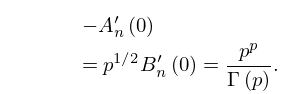
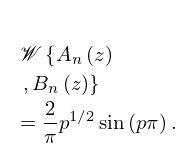
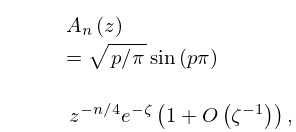
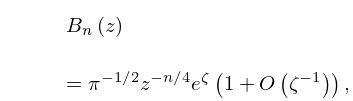
Swanson and Headley (1967) define independent solutions \mathop{A_{{n}}\/}\nolimits\!\left(z\right) and \mathop{B_{{n}}\/}\nolimits\!\left(z\right) of (9.13.1) by

when z is real and positive, and by analytic continuation elsewhere. (All solutions of (9.13.1) are entire functions of z.) When n=1, \mathop{A_{{n}}\/}\nolimits\!\left(z\right) and \mathop{B_{{n}}\/}\nolimits\!\left(z\right) become \mathop{\mathrm{Ai}\/}\nolimits\!\left(z\right) and \mathop{\mathrm{Bi}\/}\nolimits\!\left(z\right), respectively.

The distribution in \Complex and asymptotic properties of the zeros of \mathop{A_{{n}}\/}\nolimits\!\left(z\right), {\mathop{A_{{n}}\/}\nolimits^{{\prime}}}\!\left(z\right), \mathop{B_{{n}}\/}\nolimits\!\left(z\right), and {\mathop{B_{{n}}\/}\nolimits^{{\prime}}}\!\left(z\right) are investigated in Swanson and Headley (1967) and Headley and Barwell (1975).

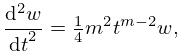
In Olver (1977a, 1978) a different normalization is used. In place of (9.13.1) we have

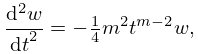
9.13.13\frac{{d}^{2}w}{{dt}^{2}}=\tfrac{1}{4}m^{2}t^{{m-2}}w,

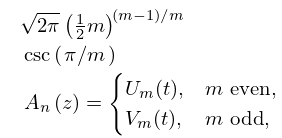
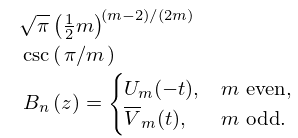
where m=3,4,5,\ldots. For real variables the solutions of (9.13.13) are denoted by U_{m}(t), U_{m}(-t) when m is even, and by V_{m}(t), \overline{V}_{m}(t) when m is odd. (The overbar has nothing to do with complex conjugates.) Their relations to the functions \mathop{A_{{n}}\/}\nolimits\!\left(z\right) and \mathop{B_{{n}}\/}\nolimits\!\left(z\right) are given by

Properties and graphs of U_{m}(t), V_{m}(t), \overline{V}_{m}(t) are included in Olver (1977a) together with properties and graphs of real solutions of the equation

9.13.17\frac{{d}^{2}w}{{dt}^{2}}=-\tfrac{1}{4}m^{2}t^{{m-2}}w,m even,

which are denoted by W_{m}(t), W_{m}(-t).

In \Complex, the solutions of (9.13.13) used in Olver (1978) are

The function on the right-hand side is recessive in the sector -(2j-1)\pi/m\leq\mathop{\mathrm{ph}\/}\nolimits z\leq(2j+1)\pi/m, and is therefore an essential member of any numerically satisfactory pair of solutions in this region.

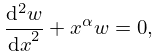
Another normalization of (9.13.17) is used in Smirnov (1960), given by

9.13.19\frac{{d}^{2}w}{{dx}^{2}}+x^{{\alpha}}w=0,

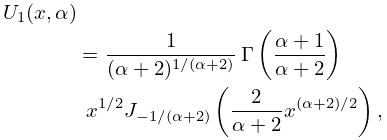
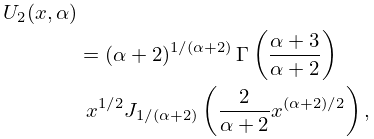
where \alpha>-2 and x>0. Solutions are w=U_{1}(x,\alpha), U_{2}(x,\alpha), where

and \mathop{J\/}\nolimits denotes the Bessel function (§10.2(ii)).

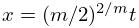
When \alpha is a positive integer the relation of these functions to W_{m}(t), W_{m}(-t) is as follows:

9.13.22
\alpha=m-2,
x=(m/2)^{{2/m}}t,

For properties of the zeros of the functions defined in this subsection see Laforgia and Muldoon (1988) and references given therein.

§9.13(ii) Generalizations from Integral Representations

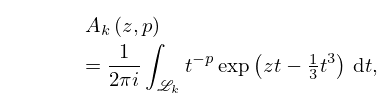
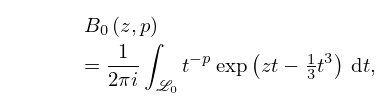
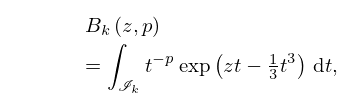
Reid (1972) and Drazin and Reid (1981, Appendix) introduce the following contour integrals in constructing approximate solutions to the Orr–Sommerfeld equation for fluid flow:

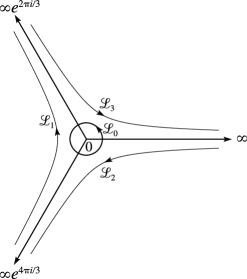
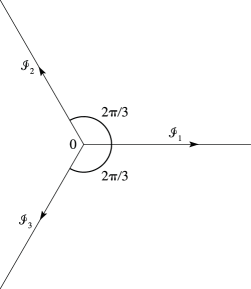
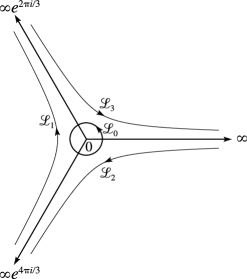
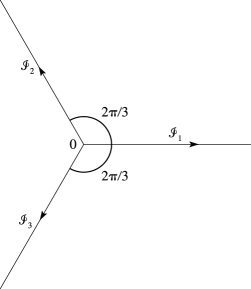
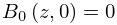
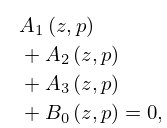
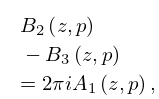
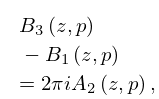
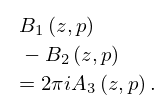
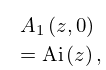
with z\in\Complex in all cases. The integration paths \mathscr{L}_{0}, \mathscr{L}_{1}, \mathscr{L}_{2}, \mathscr{L}_{3} are depicted in Figure 9.13.1. \mathscr{I}_{1}, \mathscr{I}_{2}, \mathscr{I}_{3} are depicted in Figure 9.13.2. When p is not an integer the branch of t^{{-p}} in (9.13.25) is usually chosen to be \mathop{\exp\/}\nolimits\!\left(-p(\mathop{\ln\/}\nolimits|t|+i\mathop{\mathrm%
{ph}\/}\nolimits t)\right) with 0\leq\mathop{\mathrm{ph}\/}\nolimits t<2\pi.

See accompanying text
Figure 9.13.1: t-plane. Paths \mathscr{L}_{0}, \mathscr{L}_{1}, \mathscr{L}_{2}, \mathscr{L}_{3}. Magnify
See accompanying text
Figure 9.13.2: t-plane. Paths \mathscr{I}_{1}, \mathscr{I}_{2}, \mathscr{I}_{3}. Magnify

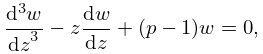
Each of the functions \mathop{A_{{k}}\/}\nolimits\!\left(z,p\right) and \mathop{B_{{k}}\/}\nolimits\!\left(z,p\right) satisfies the differential equation

9.13.31\frac{{d}^{3}w}{{dz}^{3}}-z\frac{dw}{dz}+(p-1)w=0,

and the difference equation

9.13.32f(p-3)-zf(p-1)+(p-1)f(p)=0.

Further properties of these functions, and also of similar contour integrals containing an additional factor (\mathop{\ln\/}\nolimits t)^{q}, q=1,2,\ldots, in the integrand, are derived in Reid (1972), Drazin and Reid (1981, Appendix), and Baldwin (1985). These properties include Wronskians, asymptotic expansions, and information on zeros.

For further generalizations via integral representations see Chin and Hedstrom (1978), Janson et al. (1993, §10), and Kamimoto (1998).