Digital Library of Mathematical Functions
About the Project
NIST
23 Weierstrass Elliptic and Modular FunctionsWeierstrass Elliptic Functions

§23.10 Addition Theorems and Other Identities

Contents

§23.10(i) Addition Theorems

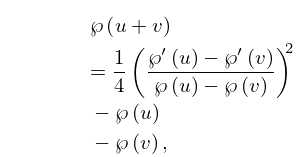
23.10.1\mathop{\wp\/}\nolimits\!\left(u+v\right)=\frac{1}{4}\left(\frac{{\mathop{\wp%
\/}\nolimits^{{\prime}}}\!\left(u\right)-{\mathop{\wp\/}\nolimits^{{\prime}}}%
\!\left(v\right)}{\mathop{\wp\/}\nolimits\!\left(u\right)-\mathop{\wp\/}%
\nolimits\!\left(v\right)}\right)^{2}-\mathop{\wp\/}\nolimits\!\left(u\right)-%
\mathop{\wp\/}\nolimits\!\left(v\right),
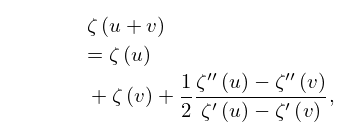
23.10.2\mathop{\zeta\/}\nolimits\!\left(u+v\right)=\mathop{\zeta\/}\nolimits\!\left(u%
\right)+\mathop{\zeta\/}\nolimits\!\left(v\right)+\frac{1}{2}\frac{{\mathop{%
\zeta\/}\nolimits^{{\prime\prime}}}\!\left(u\right)-{\mathop{\zeta\/}\nolimits%
^{{\prime\prime}}}\!\left(v\right)}{{\mathop{\zeta\/}\nolimits^{{\prime}}}\!%
\left(u\right)-{\mathop{\zeta\/}\nolimits^{{\prime}}}\!\left(v\right)},
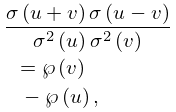
23.10.3\frac{\mathop{\sigma\/}\nolimits\!\left(u+v\right)\mathop{\sigma\/}\nolimits\!%
\left(u-v\right)}{{\mathop{\sigma\/}\nolimits^{{2}}}\!\left(u\right){\mathop{%
\sigma\/}\nolimits^{{2}}}\!\left(v\right)}=\mathop{\wp\/}\nolimits\!\left(v%
\right)-\mathop{\wp\/}\nolimits\!\left(u\right),

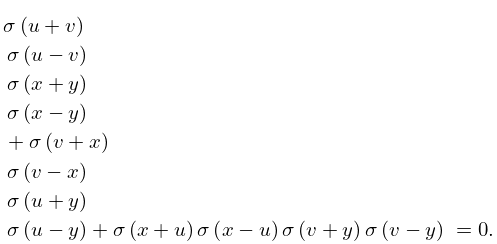
For further addition-type identities for the \mathop{\sigma\/}\nolimits-function see Lawden (1989, §6.4).

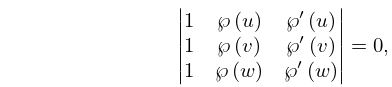
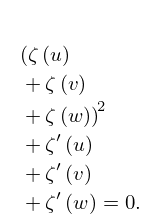
If u+v+w=0, then

23.10.5\begin{vmatrix}1&\mathop{\wp\/}\nolimits\!\left(u\right)&{\mathop{\wp\/}%
\nolimits^{{\prime}}}\!\left(u\right)\\
1&\mathop{\wp\/}\nolimits\!\left(v\right)&{\mathop{\wp\/}\nolimits^{{\prime}}}%
\!\left(v\right)\\
1&\mathop{\wp\/}\nolimits\!\left(w\right)&{\mathop{\wp\/}\nolimits^{{\prime}}}%
\!\left(w\right)\end{vmatrix}=0,

and

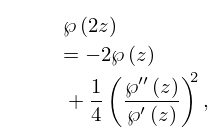
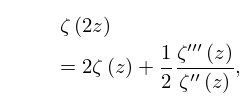
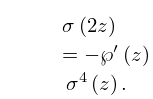
§23.10(ii) Duplication Formulas

23.10.7\mathop{\wp\/}\nolimits\!\left(2z\right)=-2\mathop{\wp\/}\nolimits\!\left(z%
\right)+\frac{1}{4}\left(\frac{{\mathop{\wp\/}\nolimits^{{\prime\prime}}}\!%
\left(z\right)}{{\mathop{\wp\/}\nolimits^{{\prime}}}\!\left(z\right)}\right)^{%
2},

(23.10.8) continues to hold when e_{1}, e_{2}, e_{3} are permuted cyclically.

23.10.9\mathop{\zeta\/}\nolimits\!\left(2z\right)=2\mathop{\zeta\/}\nolimits\!\left(z%
\right)+\frac{1}{2}\frac{{\mathop{\zeta\/}\nolimits^{{\prime\prime\prime}}}\!%
\left(z\right)}{{\mathop{\zeta\/}\nolimits^{{\prime\prime}}}\!\left(z\right)},

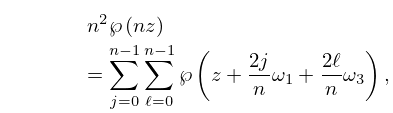
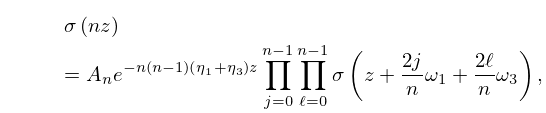
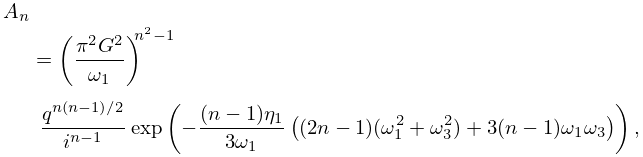
§23.10(iii) n-Tuple Formulas

§23.10(iv) Homogeneity

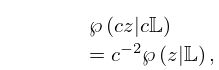
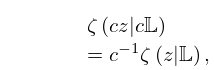
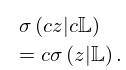
For any nonzero real or complex constant c

23.10.17\mathop{\wp\/}\nolimits\!\left(cz|c\mathbb{L}\right)=c^{{-2}}\mathop{\wp\/}%
\nolimits\!\left(z|\mathbb{L}\right),
23.10.18\mathop{\zeta\/}\nolimits\!\left(cz|c\mathbb{L}\right)=c^{{-1}}\mathop{\zeta\/%
}\nolimits\!\left(z|\mathbb{L}\right),
23.10.19\mathop{\sigma\/}\nolimits\!\left(cz|c\mathbb{L}\right)=c\mathop{\sigma\/}%
\nolimits\!\left(z|\mathbb{L}\right).

Also, when \mathbb{L} is replaced by c\mathbb{L} the lattice invariants g_{2} and g_{3} are divided by c^{4} and c^{6}, respectively.

For these results and further identities see Lawden (1989, §6.6) and Apostol (1990, p. 14).