4 Elementary FunctionsTrigonometric Functions4.20 Derivatives and Differential Equations4.22 Infinite Products and Partial Fractions
§4.21 Identities
ⓘ
- Keywords:
- identities, trigonometric functions
- Permalink:
- http://dlmf.nist.gov/4.21
- See also:
- Annotations for Ch.4
Contents
- §4.21(i) Addition Formulas
- §4.21(ii) Squares and Products
- §4.21(iii) Multiples of the Argument
- §4.21(iv) Real and Imaginary Parts; Moduli
§4.21(i) Addition Formulas
ⓘ
- Keywords:
- addition formulas, trigonometric functions
- Notes:
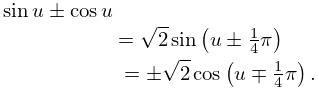
- See Hobson (1928, Chapter 4). For (4.21.1) use (4.21.2) and (4.21.3) with .
- Permalink:
- http://dlmf.nist.gov/4.21.i
- Addition (effective with 1.1.0):
-
Equation (4.21.1_5) was added.
Suggested 2018-08-14 by Ted Ersek
- See also:
- Annotations for §4.21 and Ch.4
| 4.21.1 | |||
|
ⓘ
| |||
| 4.21.1_5 | |||
| , | |||
|
ⓘ
| |||

| 4.21.2 | ||||
|
ⓘ
| ||||
| 4.21.3 | ||||
|
ⓘ
| ||||
| 4.21.4 | ||||
|
ⓘ
| ||||
| 4.21.5 | ||||
|
ⓘ
| ||||




| 4.21.6 | ||||
|
ⓘ
| ||||
| 4.21.7 | ||||
|
ⓘ
| ||||
| 4.21.8 | ||||
|
ⓘ
| ||||
| 4.21.9 | ||||
|
ⓘ
| ||||
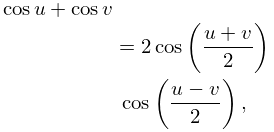
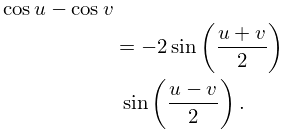
| 4.21.10 | ||||
|
ⓘ
| ||||
| 4.21.11 | ||||
|
ⓘ
| ||||

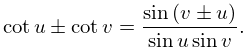
§4.21(ii) Squares and Products
ⓘ
- Keywords:
- squares and products, trigonometric functions
- Notes:
- See Hobson (1928, pp. 19, 45, 60).
- Permalink:
- http://dlmf.nist.gov/4.21.ii
- See also:
- Annotations for §4.21 and Ch.4
| 4.21.12 | |||
|
ⓘ
| |||

| 4.21.13 | |||
|
ⓘ
| |||

| 4.21.14 | |||
|
ⓘ
| |||

| 4.21.15 | |||
|
ⓘ
| |||
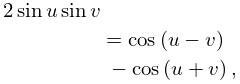
| 4.21.16 | |||
|
ⓘ
| |||
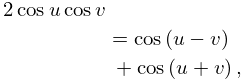
| 4.21.17 | |||
|
ⓘ
| |||
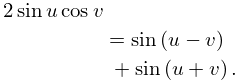
| 4.21.18 | ||||
|
ⓘ
| ||||
| 4.21.19 | ||||
|
ⓘ
| ||||
| 4.21.20 | ||||
|
ⓘ
| ||||
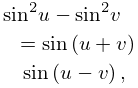
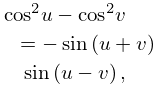
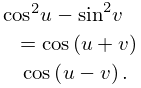
§4.21(iii) Multiples of the Argument
ⓘ
- Keywords:
- multiples of argument, trigonometric functions
- Notes:
- See Hobson (1928, pp. 21, 52–53, 63–69, 237–239). For (4.21.35) see Walker (1996, §1.9).
- Permalink:
- http://dlmf.nist.gov/4.21.iii
- See also:
- Annotations for §4.21 and Ch.4
| 4.21.21 | |||
|
ⓘ
| |||
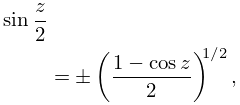
| 4.21.22 | |||
|
ⓘ
| |||
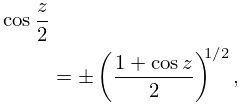
| 4.21.23 | |||
|
ⓘ
| |||
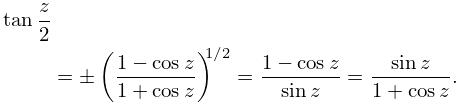
In (4.21.21)–(4.21.23) Table 4.16.1 and analytic continuation will assist in resolving sign ambiguities.
| 4.21.24 | ||||
|
ⓘ
| ||||
| 4.21.25 | ||||
|
ⓘ
| ||||
| 4.21.26 | ||||
|
ⓘ
| ||||



| 4.21.27 | |||
|
ⓘ
| |||

| 4.21.28 | |||
|
ⓘ
| |||

| 4.21.29 | |||
|
ⓘ
| |||

| 4.21.30 | ||||
|
ⓘ
| ||||
| 4.21.31 | ||||
|
ⓘ
| ||||
| 4.21.32 | ||||
|
ⓘ
| ||||
| 4.21.33 | ||||
|
ⓘ
| ||||




De Moivre’s Theorem
ⓘ
- Keywords:
- De Moivre’s theorem, trigonometric functions
- See also:
- Annotations for §4.21(iii), §4.21 and Ch.4
When
| 4.21.34 | |||
|
ⓘ
| |||

This result is also valid when is fractional or complex, provided that .
| 4.21.35 | |||
| . | |||
|
ⓘ
| |||
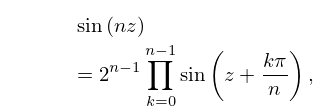
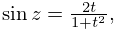
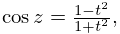
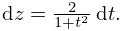
If , then
| 4.21.36 | ||||
|
ⓘ
| ||||
§4.21(iv) Real and Imaginary Parts; Moduli
ⓘ
- Keywords:
- moduli, real and imaginary parts, trigonometric functions
- Notes:
- See Hobson (1928, p. 331).
- Permalink:
- http://dlmf.nist.gov/4.21.iv
- See also:
- Annotations for §4.21 and Ch.4
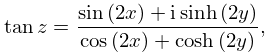
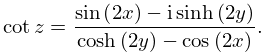
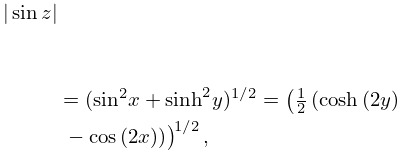
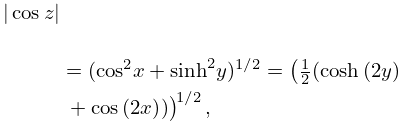
With
| 4.21.37 | |||
|
ⓘ
| |||

| 4.21.38 | |||
|
ⓘ
| |||

| 4.21.39 | |||
|
ⓘ
| |||
| 4.21.40 | |||
|
ⓘ
| |||
| 4.21.41 | |||
|
ⓘ
| |||
| 4.21.42 | |||
|
ⓘ
| |||
| 4.21.43 | |||
|
ⓘ
| |||