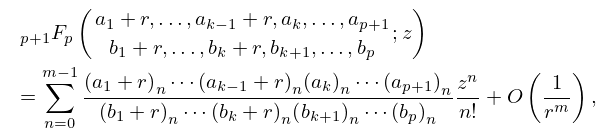
§16.11 Asymptotic Expansions
Contents
- §16.11(i) Formal Series
- §16.11(ii) Expansions for Large Variable
- §16.11(iii) Expansions for Large Parameters
§16.11(i) Formal Series
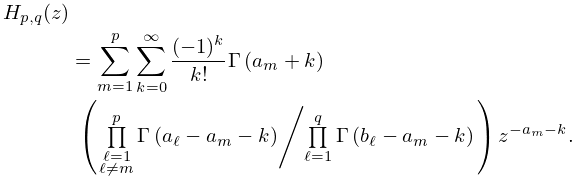
For subsequent use we define two formal infinite series, and , as follows:
| 16.11.1 | |||
| , | |||
| 16.11.2 | |||
In (16.11.1)
| 16.11.3 | ||||
and
| 16.11.4 | ||||
| , | ||||
where
| 16.11.5 | |||
and . Explicit representations for the coefficients are given in Volkmer (2023).
It may be observed that represents the sum of the residues of the poles of the integrand in (16.5.1) at , , provided that these poles are all simple, that is, no two of the differ by an integer. (If this condition is violated, then the definition of has to be modified so that the residues are those associated with the multiple poles. In consequence, logarithmic terms may appear. See (15.8.8) for an example.)
§16.11(ii) Expansions for Large Variable
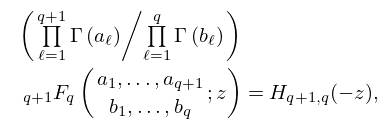
In this subsection we assume that none of is a nonpositive integer.
Case
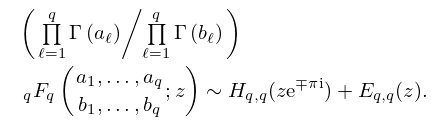
Case
As in ,
| 16.11.7 | |||
Here the upper or lower signs are chosen according as lies in the upper or lower half-plane; in consequence, in the fractional powers (§4.2(iv)) of its phases are , respectively. (Either sign may be used when since the first term on the right-hand side becomes exponentially small compared with the second term.)
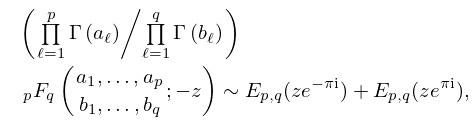
Case
As in ,
| 16.11.8 | |||
with the same conventions on the phases of .
Case
As in ,
| 16.11.9 | |||
with the same conventions on the phases of .