Digital Library of Mathematical Functions
About the Project
NIST
10 Bessel FunctionsBessel and Hankel Functions

§10.17 Asymptotic Expansions for Large Argument

Contents

§10.17(i) Hankel’s Expansions

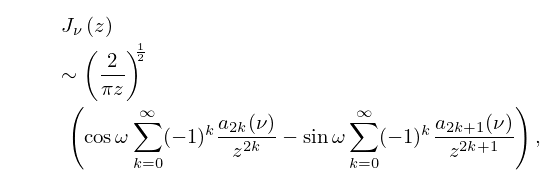
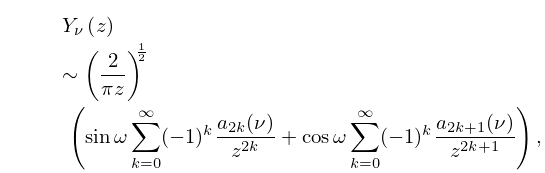
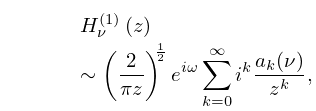
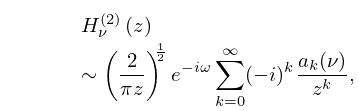
Define a_{0}(\nu)=1,

10.17.1a_{k}(\nu)=\frac{(4\nu^{2}-1^{2})(4\nu^{2}-3^{2})\cdots(4\nu^{2}-(2k-1)^{2})}{%
k!8^{k}},k\geq 1,
10.17.2\omega=z-\tfrac{1}{2}\nu\pi-\tfrac{1}{4}\pi,

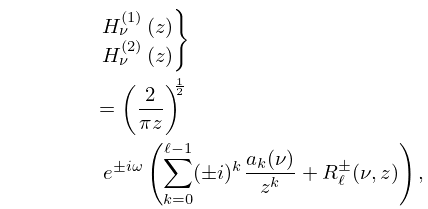
and let \delta denote an arbitrary small positive constant. Then as z\to\infty, with \nu fixed,

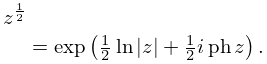
where the branch of z^{{\frac{1}{2}}} is determined by

Corresponding expansions for other ranges of \mathop{\mathrm{ph}\/}\nolimits z can be obtained by combining (10.17.3), (10.17.5), (10.17.6) with the continuation formulas (10.11.1), (10.11.3), (10.11.4) (or (10.11.7), (10.11.8)), and also the connection formula given by the second of (10.4.4).

§10.17(ii) Asymptotic Expansions of Derivatives

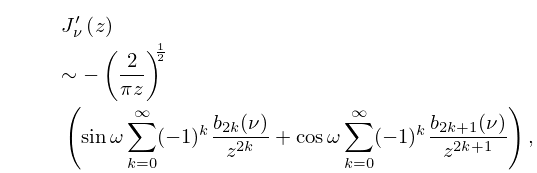
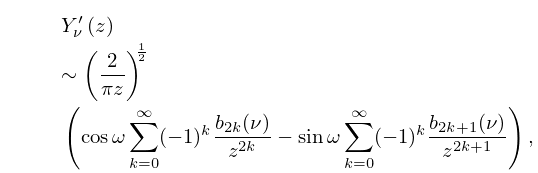
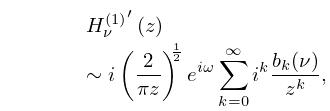
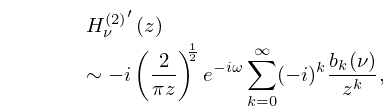
We continue to use the notation of §10.17(i). Also, b_{0}(\nu)=1, b_{1}(\nu)=(4\nu^{2}+3)/8, and for k\geq 2,

10.17.8b_{k}(\nu)=\frac{\left((4\nu^{2}-1^{2})(4\nu^{2}-3^{2})\cdots(4\nu^{2}-(2k-3)^%
{2})\right)(4\nu^{2}+4k^{2}-1)}{k!8^{k}}.

§10.17(iii) Error Bounds for Real Argument and Order

In the expansions (10.17.3) and (10.17.4) assume that \nu\geq 0 and z>0. Then the remainder associated with the sum \sum_{{k=0}}^{{\ell-1}}(-1)^{k}a_{{2k}}(\nu)z^{{-2k}} does not exceed the first neglected term in absolute value and has the same sign provided that \ell\geq\max(\tfrac{1}{2}\nu-\tfrac{1}{4},1). Similarly for \sum_{{k=0}}^{{\ell-1}}(-1)^{k}a_{{2k+1}}(\nu)z^{{-2k-1}}, provided that \ell\geq\max(\tfrac{1}{2}\nu-\tfrac{3}{4},1).

In the expansions (10.17.5) and (10.17.6) assume that \nu>-\tfrac{1}{2} and z>0. If these expansions are terminated when k=\ell-1, then the remainder term is bounded in absolute value by the first neglected term, provided that \ell\geq\max(\nu-\tfrac{1}{2},1).

§10.17(iv) Error Bounds for Complex Argument and Order

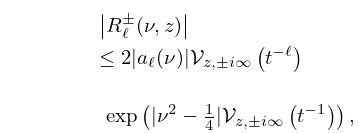
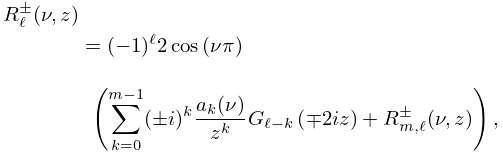
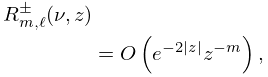
For (10.17.5) and (10.17.6) write

Then

where \mathop{\mathcal{V}\/}\nolimits denotes the variational operator (2.3.6), and the paths of variation are subject to the condition that |\imagpart{t}| changes monotonically. Bounds for \mathop{\mathcal{V}_{{z,i\infty}}\/}\nolimits\!\left(t^{{-\ell}}\right) are given by

10.17.15\mathop{\mathcal{V}_{{z,i\infty}}\/}\nolimits\!\left(t^{{-\ell}}\right)\leq%
\begin{cases}|z|^{{-\ell}},&0\leq\mathop{\mathrm{ph}\/}\nolimits z\leq\pi,\\
\chi(\ell)|z|^{{-\ell}},&\parbox[t]{224.037pt}{$-\tfrac{1}{2}\pi\leq\mathop{%
\mathrm{ph}\/}\nolimits z\leq 0$ or
$\pi\leq\mathop{\mathrm{ph}\/}\nolimits z\leq\tfrac{3}{2}\pi$,}\\
2\chi(\ell)|\imagpart{z}|^{{-\ell}},&\parbox[t]{224.037pt}{$-\pi<\mathop{%
\mathrm{ph}\/}\nolimits z\leq-\tfrac{1}{2}\pi$ or
$\tfrac{3}{2}\pi\leq\mathop{\mathrm{ph}\/}\nolimits z<2\pi$,}\end{cases}

where \chi(\ell)=\pi^{{\frac{1}{2}}}\mathop{\Gamma\/}\nolimits\!\left(\tfrac{1}{2}%
\ell+1\right)/\mathop{\Gamma\/}\nolimits\!\left(\tfrac{1}{2}\ell+\tfrac{1}{2}\right); see §9.7(i). The bounds (10.17.15) also apply to \mathop{\mathcal{V}_{{z,-i\infty}}\/}\nolimits\!\left(t^{{-\ell}}\right) in the conjugate sectors.

Corresponding error bounds for (10.17.3) and (10.17.4) are obtainable by combining (10.17.13) and (10.17.14) with (10.4.4).

§10.17(v) Exponentially-Improved Expansions

For higher re-expansions of the remainder terms see Olde Daalhuis and Olver (1995a) and Olde Daalhuis (1995, 1996).