10 Bessel FunctionsModified Bessel Functions10.39 Relations to Other Functions10.41 Asymptotic Expansions for Large Order
§10.40 Asymptotic Expansions for Large Argument
Contents
- §10.40(i) Hankel’s Expansions
- §10.40(ii) Error Bounds for Real Argument and Order
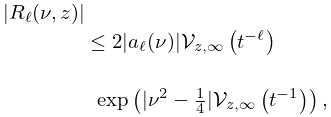
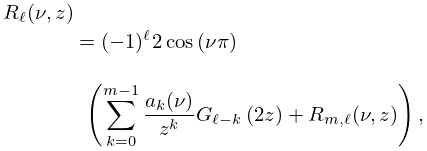
- §10.40(iii) Error Bounds for Complex Argument and Order
- §10.40(iv) Exponentially-Improved Expansions
§10.40(i) Hankel’s Expansions
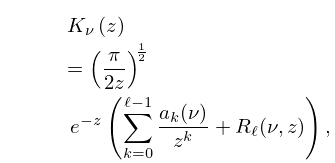
With the notation of §§10.17(i) and 10.17(ii), as with fixed,
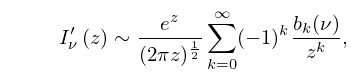
| 10.40.1 | ||||
| , | ||||
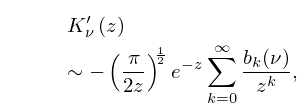
| 10.40.2 | ||||
| , | ||||
| 10.40.3 | |||
| , | |||
| 10.40.4 | |||
| . | |||
Corresponding expansions for , , , and for other ranges of are obtainable by combining (10.34.3), (10.34.4), (10.34.6), and their differentiated forms, with (10.40.2) and (10.40.4). In particular, use of (10.34.3) with yields the following more general (and more accurate) version of (10.40.1):
| 10.40.5 | |||
| . | |||
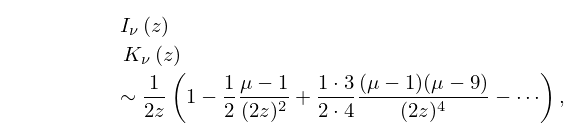
Products
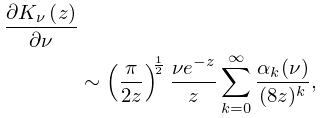
-Derivative
For fixed ,
| 10.40.8 | |||
as in . Here and
| 10.40.9 | |||
§10.40(ii) Error Bounds for Real Argument and Order
In the expansion (10.40.2) assume that and the sum is truncated when . Then the remainder term does not exceed the first neglected term in absolute value and has the same sign provided that .
For the error term in (10.40.1) see §10.40(iii).