Digital Library of Mathematical Functions
About the Project
NIST
10 Bessel FunctionsSpherical Bessel Functions

§10.49 Explicit Formulas

Contents

§10.49(i) Unmodified Functions

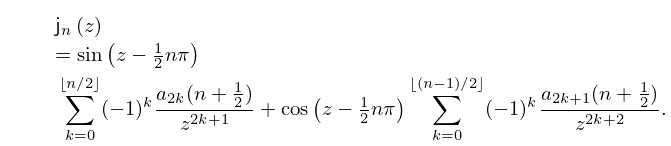
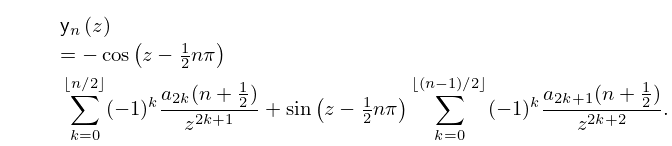
Define a_{k}(\nu) as in (10.17.1). Then

10.49.1a_{k}(n+\tfrac{1}{2})=\begin{cases}\dfrac{(n+k)!}{2^{k}k!(n-k)!},&k=0,1,\ldots%
,n,\\
0,&k=n+1,n+2,\ldots.\end{cases}
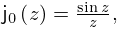
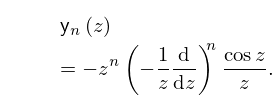
10.49.5
\mathop{\mathsf{y}_{{0}}\/}\nolimits\!\left(z\right)=-\frac{\mathop{\cos\/}%
\nolimits z}{z},
\mathop{\mathsf{y}_{{1}}\/}\nolimits\!\left(z\right)=-\frac{\mathop{\cos\/}%
\nolimits z}{z^{2}}-\frac{\mathop{\sin\/}\nolimits z}{z},
\mathop{\mathsf{y}_{{2}}\/}\nolimits\!\left(z\right)=\left(\frac{1}{z}-\frac{3%
}{z^{3}}\right)\mathop{\cos\/}\nolimits z-\frac{3}{z^{2}}\mathop{\sin\/}%
\nolimits z.

§10.49(ii) Modified Functions

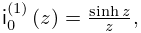
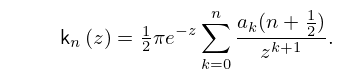
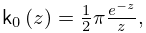
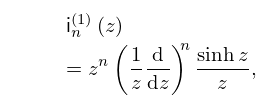
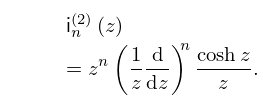
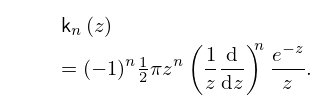
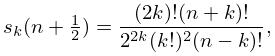
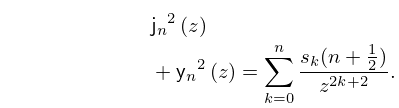
Again, with a_{k}(n+\tfrac{1}{2}) as in (10.49.1),

\sum_{{k=0}}^{n}a_{k}(n+\tfrac{1}{2})z^{{n-k}} is sometimes called the Bessel polynomial of degree n. For a survey of properties of these polynomials and their generalizations see Grosswald (1978). See also §18.34, de Bruin et al. (1981a, b), and Dunster (2001c).