§10.61 Definitions and Basic Properties
Contents
- §10.61(i) Definitions
- §10.61(ii) Differential Equations
- §10.61(iii) Reflection Formulas for Arguments
- §10.61(iv) Reflection Formulas for Orders
- §10.61(v) Orders
§10.61(i) Definitions
Throughout §§10.61–§10.71 it is assumed that , , and is a nonnegative integer.
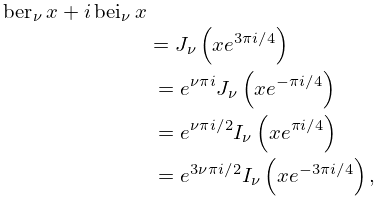
| 10.61.1 | |||
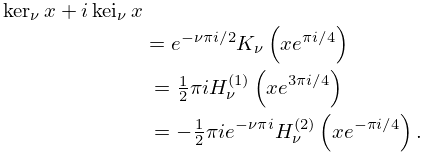
| 10.61.2 | |||
When suffices on , , , and are usually suppressed.
Most properties of , , , and follow straightforwardly from the above definitions and results given in preceding sections of this chapter.
§10.61(ii) Differential Equations
| 10.61.3 | |||
| 10.61.4 | |||
| . | |||
§10.61(iii) Reflection Formulas for Arguments
In general, Kelvin functions have a branch point at and functions with arguments are complex. The branch point is absent, however, in the case of and when is an integer. In particular,
| 10.61.5 | ||||
§10.61(iv) Reflection Formulas for Orders
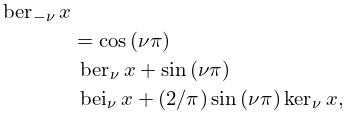
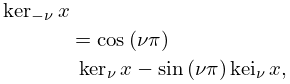
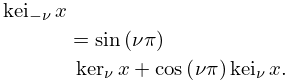
| 10.61.6 | ||||
| 10.61.7 | ||||
| 10.61.8 | ||||
§10.61(v) Orders
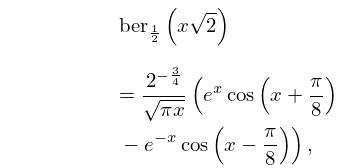
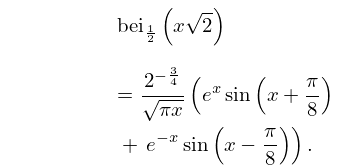
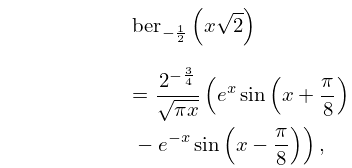
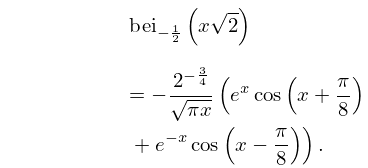
| 10.61.9 | ||||
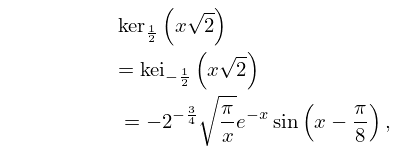
| 10.61.10 | ||||
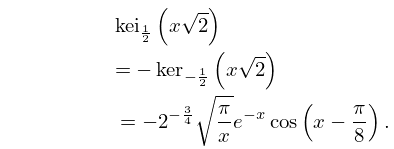
| 10.61.11 | ||||
| 10.61.12 | ||||