Digital Library of Mathematical Functions
About the Project
NIST
5 Gamma FunctionProperties

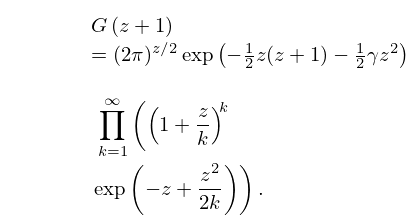
§5.17 Barnes’ \mathop{G\/}\nolimits-Function (Double Gamma Function)

5.17.1
\mathop{G\/}\nolimits\!\left(z+1\right)=\mathop{\Gamma\/}\nolimits\!\left(z%
\right)\mathop{G\/}\nolimits\!\left(z\right),
\mathop{G\/}\nolimits\!\left(1\right)=1,

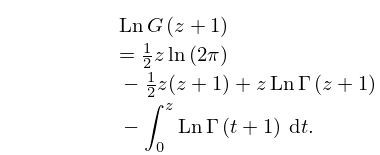
In this equation (and in (5.17.5) below), the \mathop{\mathrm{Ln}\/}\nolimits’s have their principal values on the positive real axis and are continued via continuity, as in §4.2(i).


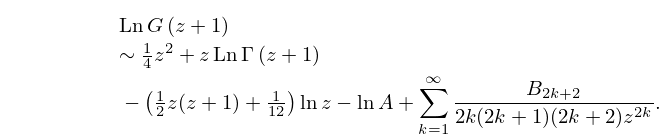
When z\to\infty in |\mathop{\mathrm{ph}\/}\nolimits z|\leq\pi-\delta\;(<\pi),

see Ferreira and López (2001). This reference also provides bounds for the error term. Here \mathop{B_{{2k+2}}\/}\nolimits is the Bernoulli number (§24.2(i)), and A is Glaisher’s constant, given by

5.17.6A=e^{C}=1.28242\;71291\;00622\;63687\;\ldots,

where

5.17.7C=\lim_{{n\to\infty}}\left(\sum_{{k=1}}^{n}k\mathop{\ln\/}\nolimits k-\left(%
\tfrac{1}{2}n^{2}+\tfrac{1}{2}n+\tfrac{1}{12}\right)\mathop{\ln\/}\nolimits n+%
\tfrac{1}{4}n^{2}\right)=\frac{\EulerConstant+\mathop{\ln\/}\nolimits\!\left(2%
\pi\right)}{12}-\frac{{\mathop{\zeta\/}\nolimits^{{\prime}}}\!\left(2\right)}{%
2\pi^{2}}=\frac{1}{12}-{\mathop{\zeta\/}\nolimits^{{\prime}}}\!\left(-1\right),

and {\mathop{\zeta\/}\nolimits^{{\prime}}} is the derivative of the zeta function (Chapter 25).

For Glaisher’s constant see also Greene and Knuth (1982, p. 100) and §2.10(i).