§26.10 Integer Partitions: Other Restrictions
Contents
- §26.10(i) Definitions
- §26.10(ii) Generating Functions
- §26.10(iii) Recurrence Relations
- §26.10(iv) Identities
- §26.10(v) Limiting Form
- §26.10(vi) Bessel-Function Expansion
§26.10(i) Definitions
denotes the number of partitions of into distinct parts. denotes the number of partitions of into at most distinct parts. denotes the number of partitions of into parts with difference at least . denotes the number of partitions of into parts with difference at least 3, except that multiples of 3 must differ by at least 6. denotes the number of partitions of into odd parts. denotes the number of partitions of into parts taken from the set . The set is denoted by . The set is denoted by . If more than one restriction applies, then the restrictions are separated by commas, for example, . See Table 26.10.1.
| 26.10.1 | |||

| and | and | and | and | |
§26.10(ii) Generating Functions
Throughout this subsection it is assumed that .
| 26.10.2 | |||

where the last right-hand side is the sum over of the generating functions for partitions into distinct parts with largest part equal to .
| 26.10.3 | |||
| , | |||

| 26.10.4 | |||

| 26.10.5 | |||

§26.10(iii) Recurrence Relations
| 26.10.6 | |||
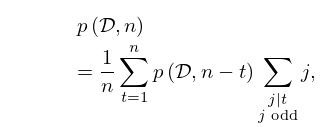
where the inner sum is the sum of all positive odd divisors of .
| 26.10.7 | |||

where the sum is over nonnegative integer values of for which .
| 26.10.8 | |||

where the sum is over nonnegative integer values of for which .
In exact analogy with (26.9.8), we have
| 26.10.9 | ||||
| 26.10.10 | ||||
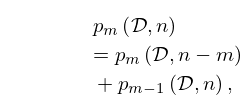

where the sum is over nonnegative integer values of for which .
| 26.10.11 | |||

where the inner sum is the sum of all positive divisors of that are in .
§26.10(iv) Identities
Equations (26.10.13) and (26.10.14) are the Rogers–Ramanujan identities. See also §17.2(vi).
| 26.10.12 | |||
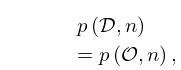
| 26.10.13 | |||
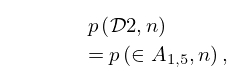
| 26.10.14 | |||
| , | |||
| 26.10.15 | |||
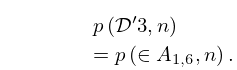
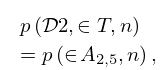
Note that , with strict inequality for . It is known that for , , with strict inequality for sufficiently large, provided that , or ; see Yee (2004).
§26.10(v) Limiting Form
| 26.10.16 | |||
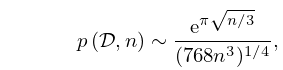
| . | |||
§26.10(vi) Bessel-Function Expansion
| 26.10.17 | |||
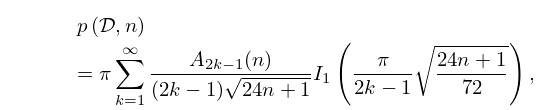
where is the modified Bessel function (§10.25(ii)), and
| 26.10.18 | |||
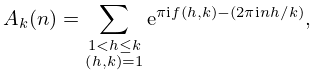
with
| 26.10.19 | |||
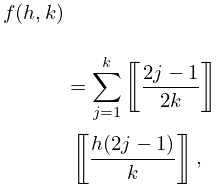
and
| 26.10.20 | |||
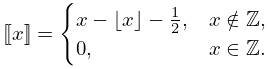
The quantity is real-valued.