§25.15 Dirichlet -functions
Contents
§25.15(i) Definitions and Basic Properties
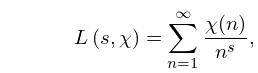
The notation was introduced by Dirichlet (1837) for the meromorphic continuation of the function defined by the series
| 25.15.1 | |||
| , | |||
where is a Dirichlet character (§27.8). For the principal character , is analytic everywhere except for a simple pole at with residue , where is Euler’s totient function (§27.2). If , then is an entire function of .
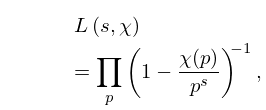
| 25.15.2 | |||
| , | |||
with the product taken over all primes , beginning with . This implies that if .
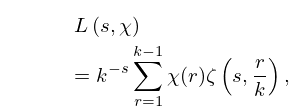
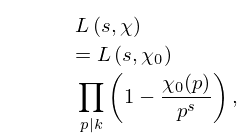
Equations (25.15.3) and (25.15.4) hold for all if , and for all () if :
| 25.15.3 | ||||
| 25.15.4 | ||||
where is a primitive character (mod ) for some positive divisor of (§27.8).
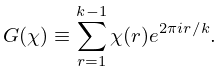
When is a primitive character (mod ) the -functions satisfy the functional equation:
| 25.15.5 | |||
where is the complex conjugate of , and
| 25.15.6 | |||
§25.15(ii) Zeros
Since if , (25.15.5) shows that for a primitive character the only zeros of for (the so-called trivial zeros) are as follows:
| 25.15.7 | |||
| , | |||
| 25.15.8 | |||
| . | |||
There are also infinitely many zeros in the critical strip , located symmetrically about the critical line , but not necessarily symmetrically about the real axis.
| 25.15.9 | |||
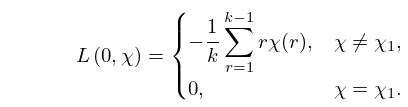
where is the principal character . This result plays an important role in the proof of Dirichlet’s theorem on primes in arithmetic progressions (§27.11). Related results are:
| 25.15.10 | |||