11 Struve and Related FunctionsRelated Functions11.9 Lommel Functions11.11 Asymptotic Expansions of Anger–Weber Functions
§11.10 Anger–Weber Functions
Contents
- §11.10(i) Definitions
- §11.10(ii) Differential Equations
- §11.10(iii) Maclaurin Series
- §11.10(iv) Graphics
- §11.10(v) Interrelations
- §11.10(vi) Relations to Other Functions
- §11.10(vii) Special Values
- §11.10(viii) Expansions in Series of Products of Bessel Functions
- §11.10(ix) Recurrence Relations and Derivatives
- §11.10(x) Integrals and Sums
§11.10(i) Definitions
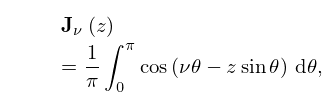
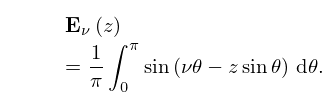
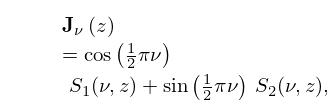
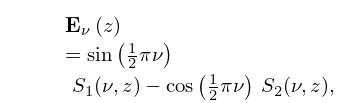
The Anger function and Weber function are defined by
| 11.10.1 | |||
| 11.10.2 | |||
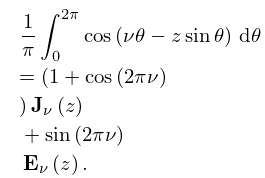
Each is an entire function of and . Also,
| 11.10.3 | |||
§11.10(ii) Differential Equations
The Anger and Weber functions satisfy the inhomogeneous Bessel differential equation
| 11.10.5 | |||
where
| 11.10.6 | |||
| , | |||
or
| 11.10.7 | |||
| . | |||
§11.10(iii) Maclaurin Series
| 11.10.8 | |||
| 11.10.9 | |||
where
| 11.10.10 | |||
| 11.10.11 | |||
These expansions converge absolutely for all finite values of .
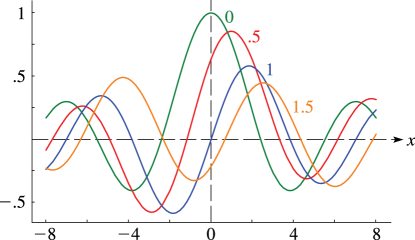
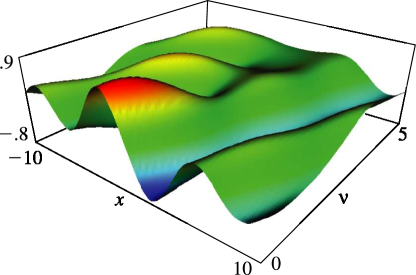
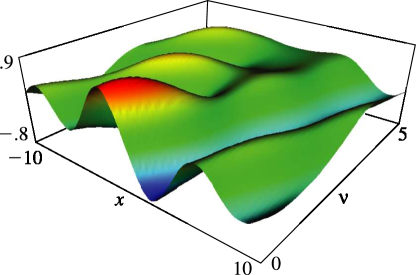
§11.10(iv) Graphics
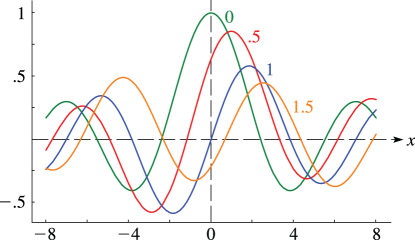
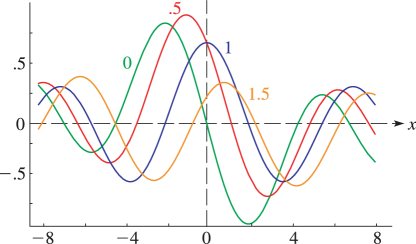
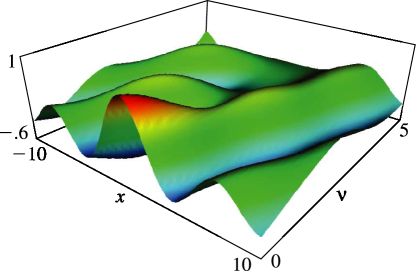
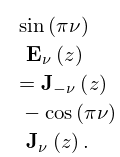
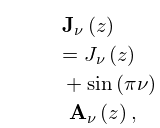
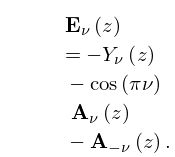
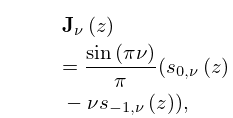
§11.10(v) Interrelations
| 11.10.12 | ||||
| 11.10.13 | ||||
| 11.10.14 | ||||
| 11.10.15 | |||
| 11.10.16 | |||
§11.10(vi) Relations to Other Functions
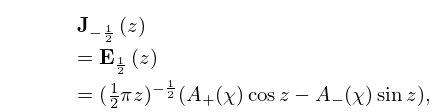
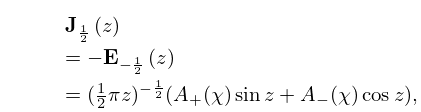
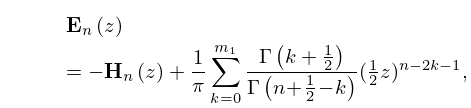
For ,
| 11.10.22 | |||
and
| 11.10.23 | |||
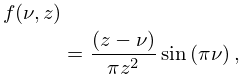
where
| 11.10.24 | ||||
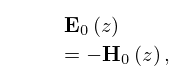
§11.10(vii) Special Values
| 11.10.25 | ||||||
| 11.10.26 | ||||||
| 11.10.27 | ||||
| 11.10.28 | ||||
| 11.10.29 | |||
| . | |||
§11.10(viii) Expansions in Series of Products of Bessel Functions
| 11.10.30 | |||
| 11.10.31 | |||
where the prime on the second summation symbols means that the first term is to be halved.
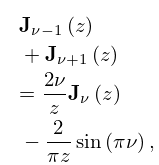
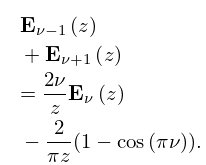
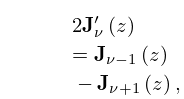
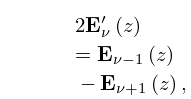
§11.10(ix) Recurrence Relations and Derivatives
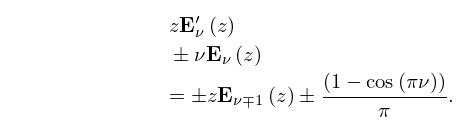
| 11.10.32 | |||
| 11.10.33 | |||
| 11.10.34 | ||||
| 11.10.35 | ||||
| 11.10.36 | |||
| 11.10.37 | |||
§11.10(x) Integrals and Sums
For collections of integral representations and integrals see Erdélyi et al. (1954a, §§4.19 and 5.17), Marichev (1983, pp. 194–195 and 214–215), Oberhettinger (1972, p. 128), Oberhettinger (1974, §§1.12 and 2.7), Oberhettinger (1990, pp. 105 and 189–190), Prudnikov et al. (1990, §§1.5 and 2.8), Prudnikov et al. (1992a, §3.18), Prudnikov et al. (1992b, §3.18), and Zanovello (1977).