Digital Library of Mathematical Functions
About the Project
NIST
1 Algebraic and Analytic MethodsAreas

§1.11 Zeros of Polynomials

Contents

§1.11(i) Division Algorithm

Horner’s Scheme

Let

1.11.1f(z)=a_{n}z^{n}+a_{{n-1}}z^{{n-1}}+\dots+a_{0}.
Then

1.11.2f(z)=(z-\alpha)(b_{n}z^{{n-1}}+b_{{n-1}}z^{{n-2}}+\dots+b_{1})+b_{0},

where b_{n}=a_{n},

1.11.3b_{k}=\alpha b_{{k+1}}+a_{k},k=n-1,n-2,\dots,0,
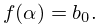
1.11.4f(\alpha)=b_{0}.

Extended Horner Scheme

With b_{k} as in (1.11.1)–(1.11.3) let c_{n}=a_{n} and

1.11.5c_{k}=\alpha c_{{k+1}}+b_{k},k=n-1,n-2,\dots,1.

Then

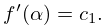
1.11.6f^{{\prime}}(\alpha)=c_{1}.

More generally, for polynomials f(z) and g(z), there are polynomials q(z) and r(z), found by equating coefficients, such that

1.11.7f(z)=g(z)q(z)+r(z),

where 0\leq\deg r(z)<\deg g(z).

§1.11(ii) Elementary Properties

A polynomial of degree n with real or complex coefficients has exactly n real or complex zeros counting multiplicity. Every monic (coefficient of highest power is one) polynomial of odd degree with real coefficients has at least one real zero with sign opposite to that of the constant term. A monic polynomial of even degree with real coefficients has at least two zeros of opposite signs when the constant term is negative.

Descartes’ Rule of Signs

The number of positive zeros of a polynomial with real coefficients cannot exceed the number of times the coefficients change sign, and the two numbers have same parity. A similar relation holds for the changes in sign of the coefficients of f(-z), and hence for the number of negative zeros of f(z).

Example

1.11.8
f(z)=z^{8}+10z^{3}+z-4,
f(-z)=z^{8}-10z^{3}-z-4.

Both polynomials have one change of sign; hence for each polynomial there is one positive zero, one negative zero, and six complex zeros.

Next, let f(z)=a_{n}z^{n}+a_{{n-1}}z^{{n-1}}+\dots+a_{0}. The zeros of z^{n}f(1/z)=a_{0}z^{n}+a_{1}z^{{n-1}}+\dots+a_{n} are reciprocals of the zeros of f(z).

The discriminant of f(z) is defined by

1.11.9D=a_{n}^{{2n-2}}\prod_{{j<k}}(z_{j}-z_{k})^{2},

where z_{1},z_{2},\dots,z_{n} are the zeros of f(z). The elementary symmetric functions of the zeros are (with a_{n}\not=0)

§1.11(iii) Polynomials of Degrees Two, Three, and Four

Quadratic Equations

The roots of az^{2}+bz+c=0 are

1.11.11
\frac{-b\pm\sqrt{D}}{2a},
D=b^{2}-4ac.

The sum and product of the roots are respectively -b/a and c/a.

Cubic Equations

Set z=w-\tfrac{1}{3}a to reduce f(z)=z^{3}+az^{2}+bz+c to g(w)=w^{3}+pw+q, with p=(3b-a^{2})/3, q=(2a^{3}-9ab+27c)/27. The discriminant of g(w) is

1.11.12D=-4p^{3}-27q^{2}.

Let

1.11.13
A=\sqrt[3]{-\tfrac{27}{2}q+\tfrac{3}{2}\sqrt{-3D}},
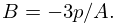
B=-3p/A.

The roots of g(w)=0 are

1.11.14
\tfrac{1}{3}(A+B),
\tfrac{1}{3}(\rho A+\rho^{2}B),
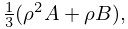
\tfrac{1}{3}(\rho^{2}A+\rho B),

with

1.11.15
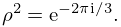
\rho=-\tfrac{1}{2}+\tfrac{1}{2}\sqrt{-3}=e^{{2\pi i/3}},
\rho^{2}=e^{{-2\pi i/3}}.

Addition of -\frac{1}{3}a to each of these roots gives the roots of f(z)=0.

Example

f(z)=z^{3}-6z^{2}+6z-2, g(w)=w^{3}-6w-6, A=3\sqrt[3]{4}, B=3\sqrt[3]{2}. Roots of f(z)=0 are 2+\sqrt[3]{4}+\sqrt[3]{2}, 2+\sqrt[3]{4}\rho+\sqrt[3]{2}\rho^{2}, 2+\sqrt[3]{4}\rho^{2}+\sqrt[3]{2}\rho.

For another method see §4.43.

Quartic Equations

Set z=w-\tfrac{1}{4}a to reduce f(z)=z^{4}+az^{3}+bz^{2}+cz+d to

1.11.16
g(w)=w^{4}+pw^{2}+qw+r,
p=(-3a^{2}+8b)/8,
q=(a^{3}-4ab+8c)/8,
r=(-3a^{4}+16a^{2}b-64ac+256d)/256.

The discriminant of g(w) is

1.11.17D=16p^{4}r-4p^{3}q^{2}-128p^{2}r^{2}+144pq^{2}r-27q^{4}+256r^{3}.

For the roots \alpha_{1},\alpha_{2},\alpha_{3},\alpha_{4} of g(w)=0 and the roots \theta_{1},\theta_{2},\theta_{3} of the resolvent cubic equation

1.11.18z^{3}-2pz^{2}+(p^{2}-4r)z+q^{2}=0,

we have

1.11.19
2\alpha_{1}=\phantom{+}\sqrt{-\theta_{1}}+\sqrt{-\theta_{2}}+\sqrt{-\theta_{3}},
2\alpha_{2}=\phantom{+}\sqrt{-\theta_{1}}-\sqrt{-\theta_{2}}-\sqrt{-\theta_{3}},
2\alpha_{3}=-\sqrt{-\theta_{1}}+\sqrt{-\theta_{2}}-\sqrt{-\theta_{3}},
2\alpha_{4}=-\sqrt{-\theta_{1}}-\sqrt{-\theta_{2}}+\sqrt{-\theta_{3}}.

The square roots are chosen so that

1.11.20\sqrt{-\theta_{1}}\;\sqrt{-\theta_{2}}\;\sqrt{-\theta_{3}}=-q.

Add -\tfrac{1}{4}a to the roots of g(w)=0 to get those of f(z)=0.

Example

f(z)=z^{4}-4z^{3}+5z+2,   g(w)=w^{4}-6w^{2}-3w+4. Resolvent cubic is z^{3}+12z^{2}+20z+9=0 with roots \theta_{1}=-1, \theta_{2}=-\tfrac{1}{2}(11+\sqrt{85}), \theta_{3}=-\tfrac{1}{2}(11-\sqrt{85}), and \sqrt{-\theta_{1}}=1, \sqrt{-\theta_{2}}=\tfrac{1}{2}(\sqrt{17}+\sqrt{5}), \sqrt{-\theta_{3}}=\tfrac{1}{2}(\sqrt{17}-\sqrt{5}). So 2\alpha_{1}=1+\sqrt{17}, 2\alpha_{2}=1-\sqrt{17}, 2\alpha_{3}=-1+\sqrt{5}, 2\alpha_{4}=-1-\sqrt{5}, and the roots of f(z)=0 are \tfrac{1}{2}(3\pm\sqrt{17}), \tfrac{1}{2}(1\pm\sqrt{5}).

§1.11(iv) Roots of Unity and of Other Constants

The roots of

1.11.21z^{n}-1=(z-1)(z^{{n-1}}+z^{{n-2}}+\dots+z+1)=0

are 1, e^{{2\pi i/n}}, e^{{4\pi i/n}},\dots,e^{{(2n-2)\pi i/n}}, and of z^{n}+1=0 they are e^{{\pi i/n}},e^{{3\pi i/n}},\dots,e^{{(2n-1)\pi i/n}}.

The roots of

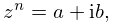
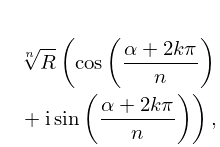
1.11.22z^{n}=a+ib,a,b real,

are

where R=(a^{2}+b^{2})^{{1/2}}, \alpha=\mathop{\mathrm{ph}\/}\nolimits\!\left(a+ib\right), with the principal value of phase (§1.9(i)), and k=0,1,\dots,n-1.

§1.11(v) Stable Polynomials

1.11.24f(z)=a_{0}+a_{1}z+\dots+a_{n}z^{n},

with real coefficients, is called stable if the real parts of all the zeros are strictly negative.

Hurwitz Criterion

Let

1.11.25
D_{1}=a_{1},
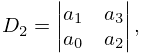
D_{2}=\begin{vmatrix}a_{1}&a_{3}\\
a_{0}&a_{2}\end{vmatrix},
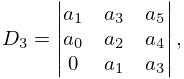
D_{3}=\begin{vmatrix}a_{1}&a_{3}&a_{5}\\
a_{0}&a_{2}&a_{4}\\
0&a_{1}&a_{3}\end{vmatrix},

and

1.11.26D_{k}=\det[h_{k}^{{(1)}},h_{k}^{{(3)}},\dots,h_{k}^{{(2k-1)}}],

where the column vector h_{k}^{{(m)}} consists of the first k members of the sequence a_{m},a_{{m-1}},a_{{m-2}},\dots with a_{j}=0 if j<0 or j>n.

Then f(z), with a_{n}\not=0, is stable iff a_{0}\not=0; D_{{2k}}>0, k=1,\dots,\left\lfloor\frac{1}{2}n\right\rfloor; \mathop{\mathrm{sign}\/}\nolimits D_{{2k+1}}=\mathop{\mathrm{sign}\/}\nolimits
a%
_{0}, k=0,1,\dots,\left\lfloor\frac{1}{2}n-\frac{1}{2}\right\rfloor.