18 Orthogonal PolynomialsClassical Orthogonal Polynomials18.13 Continued Fractions18.15 Asymptotic Approximations
§18.14 Inequalities
Contents
- §18.14(i) Upper Bounds
- §18.14(ii) Turán-Type Inequalities
- §18.14(iii) Local Maxima and Minima
- §18.14(iv) Positive Sums
§18.14(i) Upper Bounds
Jacobi
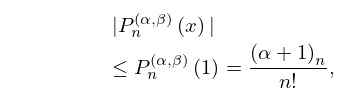
| 18.14.1 | |||
| , , , | |||
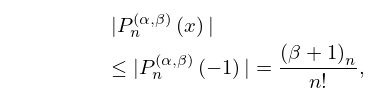
| 18.14.2 | |||
| , , . | |||
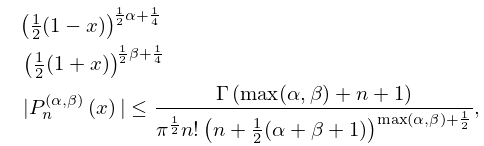
| 18.14.3 | |||
| , , . | |||
Ultraspherical
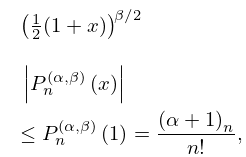
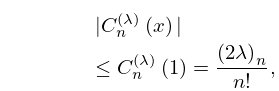
| 18.14.4 | |||
| , . | |||
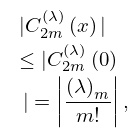
| 18.14.5 | |||
| , , | |||
| 18.14.6 | |||
| , . | |||
| 18.14.7 | |||
| , . | |||
Laguerre
| 18.14.8 | |||
| , . | |||
Hermite
| 18.14.9 | |||
| . | |||
For further inequalities see Abramowitz and Stegun (1964, §22.14).
§18.14(ii) Turán-Type Inequalities
Legendre
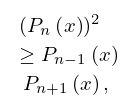
| 18.14.10 | |||
| . | |||
Jacobi
Let . Then
| 18.14.11 | |||
| , . | |||
Laguerre
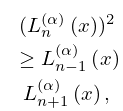
| 18.14.12 | |||
| , . | |||
Hermite
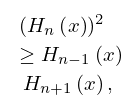
| 18.14.13 | |||
| . | |||
§18.14(iii) Local Maxima and Minima
Jacobi
Let the maxima , , of in be arranged so that
| 18.14.14 | |||
When choose so that
| 18.14.15 | |||
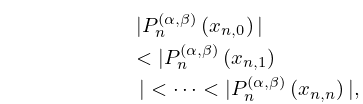
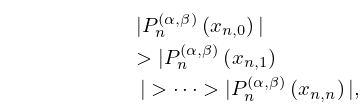
Then
| 18.14.16 | ||||
| 18.14.17 | ||||
| . | ||||
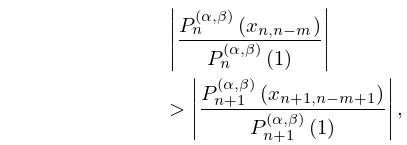
Also,
| 18.14.18 | |||
| , , | |||
| 18.14.19 | |||
| , , | |||
except that when (Chebyshev case) is constant.
Szegő–Szász Inequality
Laguerre
Let the maxima , , of in be arranged so that
| 18.14.21 | |||
When choose so that
| 18.14.22 | |||
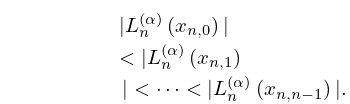
Then
| 18.14.23 | ||||
Also, when
| 18.14.24 | |||
Hermite
The successive maxima of form a decreasing sequence for , and an increasing sequence for .
§18.14(iv) Positive Sums
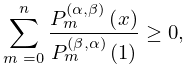
Jacobi
Laguerre
| 18.14.27 | |||
| , , . | |||