Digital Library of Mathematical Functions
About the Project
NIST
10 Bessel FunctionsSpherical Bessel Functions

§10.47 Definitions and Basic Properties

Contents

§10.47(i) Differential Equations

Here, and throughout the remainder of §§10.4710.60, n is a nonnegative integer. (This is in contrast to other treatments of spherical Bessel functions, including Abramowitz and Stegun (1964, Chapter 10), in which n can be any integer. However, there is a gain in symmetry, without any loss of generality in applications, on restricting n\geq 0.)

Equations (10.47.1) and (10.47.2) each have a regular singularity at z=0 with indices n, -n-1, and an irregular singularity at z=\infty of rank 1; compare §§2.7(i)2.7(ii).

§10.47(ii) Standard Solutions

Equation (10.47.1)

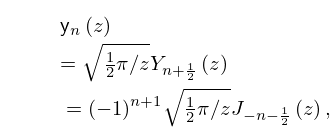
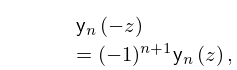
10.47.4\mathop{\mathsf{y}_{{n}}\/}\nolimits\!\left(z\right)=\sqrt{\tfrac{1}{2}\pi/z}%
\mathop{Y_{{n+\frac{1}{2}}}\/}\nolimits\!\left(z\right)=(-1)^{{n+1}}\sqrt{%
\tfrac{1}{2}\pi/z}\mathop{J_{{-n-\frac{1}{2}}}\/}\nolimits\!\left(z\right),
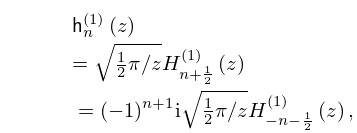
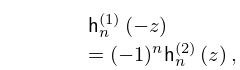
10.47.5\mathop{{\mathsf{h}^{{(1)}}_{{n}}}\/}\nolimits\!\left(z\right)=\sqrt{\tfrac{1}%
{2}\pi/z}\mathop{{H^{{(1)}}_{{n+\frac{1}{2}}}}\/}\nolimits\!\left(z\right)=(-1%
)^{{n+1}}i\sqrt{\tfrac{1}{2}\pi/z}\mathop{{H^{{(1)}}_{{-n-\frac{1}{2}}}}\/}%
\nolimits\!\left(z\right),
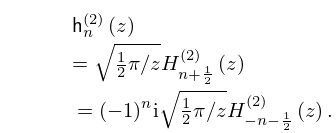
10.47.6\mathop{{\mathsf{h}^{{(2)}}_{{n}}}\/}\nolimits\!\left(z\right)=\sqrt{\tfrac{1}%
{2}\pi/z}\mathop{{H^{{(2)}}_{{n+\frac{1}{2}}}}\/}\nolimits\!\left(z\right)=(-1%
)^{n}i\sqrt{\tfrac{1}{2}\pi/z}\mathop{{H^{{(2)}}_{{-n-\frac{1}{2}}}}\/}%
\nolimits\!\left(z\right).

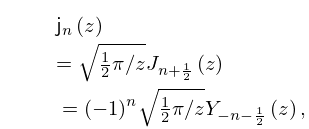
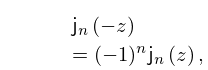
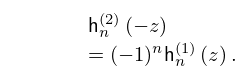
\mathop{\mathsf{j}_{{n}}\/}\nolimits\!\left(z\right) and \mathop{\mathsf{y}_{{n}}\/}\nolimits\!\left(z\right) are the spherical Bessel functions of the first and second kinds, respectively; \mathop{{\mathsf{h}^{{(1)}}_{{n}}}\/}\nolimits\!\left(z\right) and \mathop{{\mathsf{h}^{{(2)}}_{{n}}}\/}\nolimits\!\left(z\right) are the spherical Bessel functions of the third kind.

Equation (10.47.2)

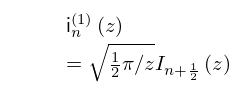
10.47.7\mathop{{\mathsf{i}^{{(1)}}_{{n}}}\/}\nolimits\!\left(z\right)=\sqrt{\tfrac{1}%
{2}\pi/z}\mathop{I_{{n+\frac{1}{2}}}\/}\nolimits\!\left(z\right)
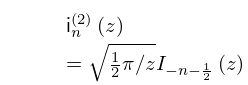
10.47.8\mathop{{\mathsf{i}^{{(2)}}_{{n}}}\/}\nolimits\!\left(z\right)=\sqrt{\tfrac{1}%
{2}\pi/z}\mathop{I_{{-n-\frac{1}{2}}}\/}\nolimits\!\left(z\right)
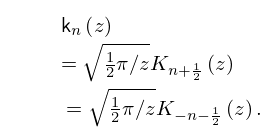
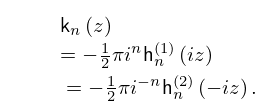
10.47.9\mathop{\mathsf{k}_{{n}}\/}\nolimits\!\left(z\right)=\sqrt{\tfrac{1}{2}\pi/z}%
\mathop{K_{{n+\frac{1}{2}}}\/}\nolimits\!\left(z\right)=\sqrt{\tfrac{1}{2}\pi/%
z}\mathop{K_{{-n-\frac{1}{2}}}\/}\nolimits\!\left(z\right).

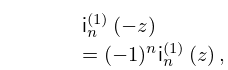
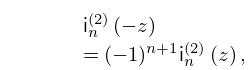
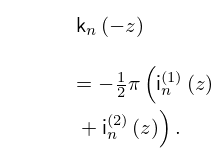
\mathop{{\mathsf{i}^{{(1)}}_{{n}}}\/}\nolimits\!\left(z\right), \mathop{{\mathsf{i}^{{(2)}}_{{n}}}\/}\nolimits\!\left(z\right), and \mathop{\mathsf{k}_{{n}}\/}\nolimits\!\left(z\right) are the modified spherical Bessel functions.

Many properties of \mathop{\mathsf{j}_{{n}}\/}\nolimits\!\left(z\right), \mathop{\mathsf{y}_{{n}}\/}\nolimits\!\left(z\right), \mathop{{\mathsf{h}^{{(1)}}_{{n}}}\/}\nolimits\!\left(z\right), \mathop{{\mathsf{h}^{{(2)}}_{{n}}}\/}\nolimits\!\left(z\right), \mathop{{\mathsf{i}^{{(1)}}_{{n}}}\/}\nolimits\!\left(z\right), \mathop{{\mathsf{i}^{{(2)}}_{{n}}}\/}\nolimits\!\left(z\right), and \mathop{\mathsf{k}_{{n}}\/}\nolimits\!\left(z\right) follow straightforwardly from the above definitions and results given in preceding sections of this chapter. For example, z^{{-n}}\mathop{\mathsf{j}_{{n}}\/}\nolimits\!\left(z\right), z^{{n+1}}\mathop{\mathsf{y}_{{n}}\/}\nolimits\!\left(z\right), z^{{n+1}}\mathop{{\mathsf{h}^{{(1)}}_{{n}}}\/}\nolimits\!\left(z\right), z^{{n+1}}\mathop{{\mathsf{h}^{{(2)}}_{{n}}}\/}\nolimits\!\left(z\right), z^{{-n}}\mathop{{\mathsf{i}^{{(1)}}_{{n}}}\/}\nolimits\!\left(z\right), z^{{n+1}}\mathop{{\mathsf{i}^{{(2)}}_{{n}}}\/}\nolimits\!\left(z\right), and z^{{n+1}}\mathop{\mathsf{k}_{{n}}\/}\nolimits\!\left(z\right) are all entire functions of z.

§10.47(iii) Numerically Satisfactory Pairs of Solutions

For (10.47.1) numerically satisfactory pairs of solutions are given by Table 10.2.1 with the symbols \mathop{J\/}\nolimits, \mathop{Y\/}\nolimits, H, and \nu replaced by \mathop{\mathsf{j}\/}\nolimits, \mathop{\mathsf{y}\/}\nolimits, \mathsf{h}, and n, respectively.

For (10.47.2) numerically satisfactory pairs of solutions are \mathop{{\mathsf{i}^{{(1)}}_{{n}}}\/}\nolimits\!\left(z\right) and \mathop{\mathsf{k}_{{n}}\/}\nolimits\!\left(z\right) in the right half of the z-plane, and \mathop{{\mathsf{i}^{{(1)}}_{{n}}}\/}\nolimits\!\left(z\right) and \mathop{\mathsf{k}_{{n}}\/}\nolimits\!\left(-z\right) in the left half of the z-plane.

§10.47(iv) Interrelations