10.43 Integrals10.45 Functions of Imaginary Order

§10.44 Sums

Contents

§10.44(i) Multiplication Theorem

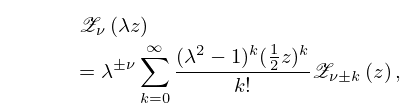
10.44.1 \mathop{\mathscr{Z}_{{\nu}}\/}\nolimits\!\left(\lambda z\right)=\lambda^{{\pm\nu}}\sum _{{k=0}}^{\infty}\frac{(\lambda^{2}-1)^{k}(\frac{1}{2}z)^{k}}{k!}\mathop{\mathscr{Z}_{{\nu\pm k}}\/}\nolimits\!\left(z\right), |\lambda^{2}-1|<1.

If \mathop{\mathscr{Z}\/}\nolimits=\mathop{I\/}\nolimits and the upper signs are taken, then the restriction on \lambda is unnecessary.

§10.44(ii) Addition Theorems

Neumann’s Addition Theorem

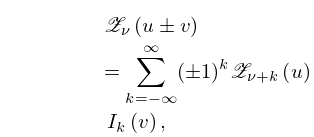
10.44.3 \mathop{\mathscr{Z}_{{\nu}}\/}\nolimits\!\left(u\pm v\right)=\sum _{{k=-\infty}}^{\infty}(\pm 1)^{k}\mathop{\mathscr{Z}_{{\nu+k}}\/}\nolimits\!\left(u\right)\mathop{I_{{k}}\/}\nolimits\!\left(v\right), |v|<|u|.

The restriction |v|<|u| is unnecessary when \mathop{\mathscr{Z}\/}\nolimits=\mathop{I\/}\nolimits and \nu is an integer.

Graf’s and Gegenbauer’s Addition Theorems

For results analogous to (10.23.7) and (10.23.8) see Watson (1944, §§11.3 and 11.41).

§10.44(iv) Compendia

For collections of sums and series involving modified Bessel functions see Erdélyi et al. (1953b, §7.15), Hansen (1975), and Prudnikov et al. (1986b, pp. 691–700).