8 Incomplete Gamma and Related FunctionsRelated Functions8.16 Generalizations8.18 Asymptotic Expansions of
§8.17 Incomplete Beta Functions
Contents
- §8.17(i) Definitions and Basic Properties
- §8.17(ii) Hypergeometric Representations
- §8.17(iii) Integral Representation
- §8.17(iv) Recurrence Relations
- §8.17(v) Continued Fraction
- §8.17(vi) Sums
- §8.17(vii) Addendum to 8.17(i) Definitions and Basic Properties
§8.17(i) Definitions and Basic Properties
Throughout §§8.17 and 8.18 we assume that , , and . However, in the case of §8.17 it is straightforward to continue most results analytically to other real values of , , and , and also to complex values.
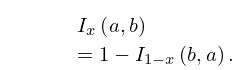
| 8.17.1 | |||
| 8.17.2 | |||
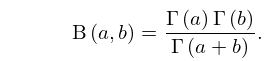
where, as in §5.12, denotes the beta function:
| 8.17.3 | |||
| 8.17.4 | |||
For a historical profile of see Dutka (1981).
§8.17(ii) Hypergeometric Representations
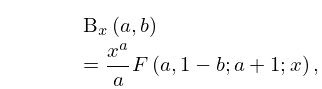
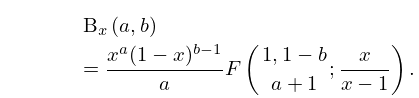
| 8.17.7 | ||||
| 8.17.8 | ||||
| 8.17.9 | ||||
For the hypergeometric function see §15.2(i).
§8.17(iii) Integral Representation
With , , and ,
| 8.17.10 | |||
where and the branches of and are continuous on the path and assume their principal values when .
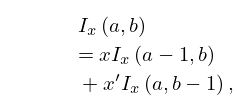
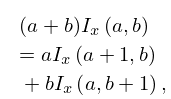
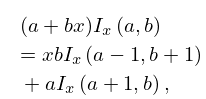
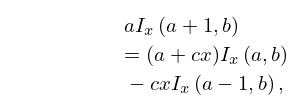
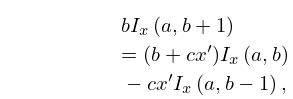
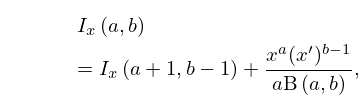
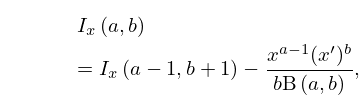
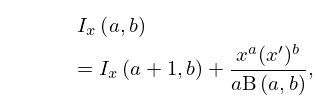
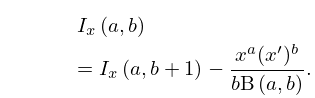
§8.17(iv) Recurrence Relations
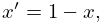
With
| 8.17.11 | ||||
| 8.17.12 | ||||
| 8.17.13 | ||||
| 8.17.14 | |||
| 8.17.15 | |||
| 8.17.16 | ||||
| 8.17.17 | ||||
| 8.17.18 | |||
| 8.17.19 | |||
| 8.17.20 | ||||
| 8.17.21 | ||||
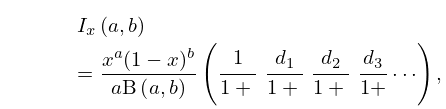
§8.17(v) Continued Fraction
| 8.17.22 | |||
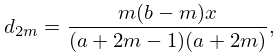
where
| 8.17.23 | ||||
The and convergents are less than , and the and convergents are greater than .
See also Cuyt et al. (2008, pp. 385–389).
§8.17(vi) Sums
For sums of infinite series whose terms involve the incomplete beta function see Hansen (1975, §62).
§8.17(vii) Addendum to 8.17(i) Definitions and Basic Properties
| 8.17.24 | |||
| positive integers; . | |||
Compare (8.17.5).