31 Heun FunctionsProperties31.11 Expansions in Series of Hypergeometric Functions31.13 Asymptotic Approximations
§31.12 Confluent Forms of Heun’s Equation
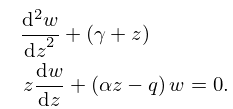
Confluent forms of Heun’s differential equation (31.2.1) arise when two or more of the regular singularities merge to form an irregular singularity. This is analogous to the derivation of the confluent hypergeometric equation from the hypergeometric equation in §13.2(i). There are four standard forms, as follows:
Confluent Heun Equation
| 31.12.1 | |||
This has regular singularities at and , and an irregular singularity of rank 1 at .
Doubly-Confluent Heun Equation
| 31.12.2 | |||
This has irregular singularities at and , each of rank .
Biconfluent Heun Equation
| 31.12.3 | |||
This has a regular singularity at , and an irregular singularity at of rank .
Triconfluent Heun Equation
| 31.12.4 | |||
This has one singularity, an irregular singularity of rank at .