§31.10 Integral Equations and Representations
Contents
§31.10(i) Type I
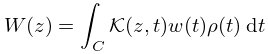
If is a solution of Heun’s equation, then another solution (possibly a multiple of ) can be represented as
| 31.10.1 | |||
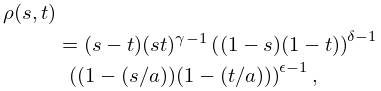
for a suitable contour . The weight function is given by
| 31.10.2 | |||
and the kernel is a solution of the partial differential equation
| 31.10.3 | |||
where is Heun’s operator in the variable :
| 31.10.4 | |||
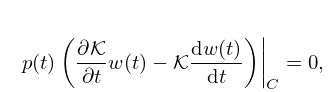
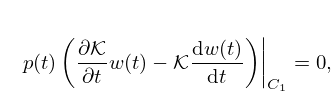
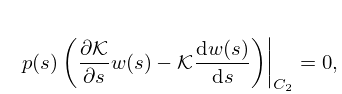
The contour must be such that
| 31.10.5 | |||
where
| 31.10.6 | |||
Kernel Functions
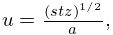
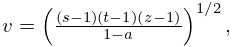
Set
| 31.10.7 | ||||
The kernel must satisfy
| 31.10.8 | |||
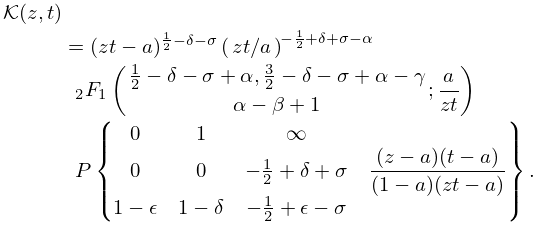
The solutions of (31.10.8) are given in terms of the Riemann -symbol (see §15.11(i)) as
| 31.10.9 | |||
where is a separation constant. For integral equations satisfied by the Heun polynomial we have , .
For suitable choices of the branches of the -symbols in (31.10.9) and the contour , we can obtain both integral equations satisfied by Heun functions, as well as the integral representations of a distinct solution of Heun’s equation in terms of a Heun function (polynomial, path-multiplicative solution).
Example 1
Example 2
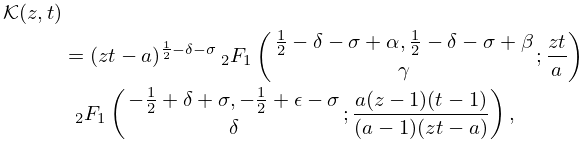
Fuchs–Frobenius solutions are represented in terms of Heun functions by (31.10.1) with , , and with kernel chosen from
| 31.10.11 | |||
Here is a normalization constant and is the contour of Example 1.
§31.10(ii) Type II
If is a solution of Heun’s equation, then another solution (possibly a multiple of ) can be represented as
| 31.10.12 | |||
for suitable contours , . The weight function is
| 31.10.13 | |||
and the kernel is a solution of the partial differential equation
| 31.10.14 | |||
where is given by (31.10.4). The contours , must be chosen so that
| 31.10.15 | ||||
| and | ||||
| 31.10.16 | ||||
where is given by (31.10.6).
Kernel Functions
Set
| 31.10.17 | ||||
The kernel must satisfy
| 31.10.18 | |||
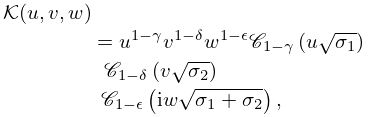
This equation can be solved in terms of cylinder functions (§10.2(ii)):
| 31.10.19 | |||
where and are separation constants.
Transformation of Independent Variable
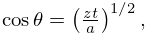
A further change of variables, to spherical coordinates,
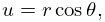
| 31.10.20 | ||||
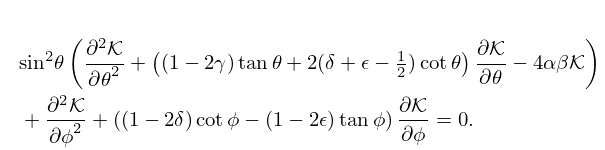
leads to the kernel equation
| 31.10.21 | |||
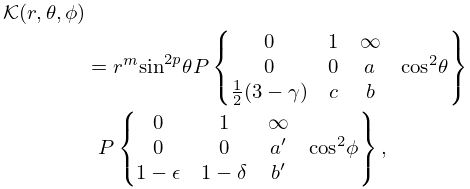
This equation can be solved in terms of hypergeometric functions (§15.11(i)):
| 31.10.22 | |||
with
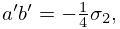
| 31.10.23 | ||||
and and are separation constants.