§27.10 Periodic Number-Theoretic Functions
If is a fixed positive integer, then a number-theoretic function is periodic (mod ) if
| 27.10.1 | |||
| . | |||
Examples are the Dirichlet characters (mod ) and the greatest common divisor regarded as a function of .
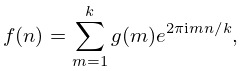
Every function periodic (mod ) can be expressed as a finite Fourier series of the form
| 27.10.2 | |||
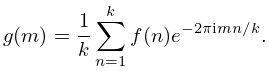
where is also periodic (mod ), and is given by
| 27.10.3 | |||
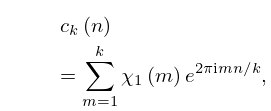
An example is Ramanujan’s sum:
| 27.10.4 | |||
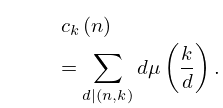
where is the principal character (mod ). This is the sum of the th powers of the primitive th roots of unity. It can also be expressed in terms of the Möbius function as a divisor sum:
| 27.10.5 | |||
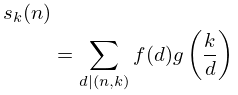
More generally, if and are arbitrary, then the sum
| 27.10.6 | |||
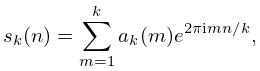
is a periodic function of and has the finite Fourier-series expansion
| 27.10.7 | |||
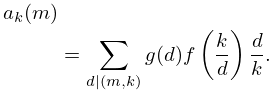
where
| 27.10.8 | |||
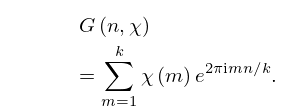
Another generalization of Ramanujan’s sum is the Gauss sum associated with a Dirichlet character . It is defined by the relation
| 27.10.9 | |||
In particular, .
is separable for some if
| 27.10.10 | |||
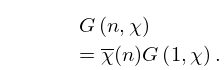
For any Dirichlet character , is separable for if , and is separable for every if and only if whenever . For a primitive character , is separable for every , and
| 27.10.11 | |||
Conversely, if is separable for every , then is primitive (mod ).
The finite Fourier expansion of a primitive Dirichlet character has the form
| 27.10.12 | |||