§24.14 Sums
Contents
- §24.14(i) Quadratic Recurrence Relations
- §24.14(ii) Higher-Order Recurrence Relations
- §24.14(iii) Compendia
§24.14(i) Quadratic Recurrence Relations
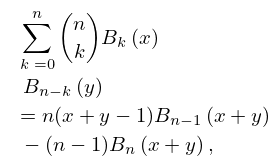
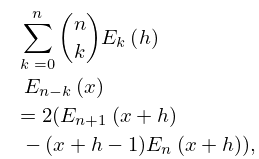
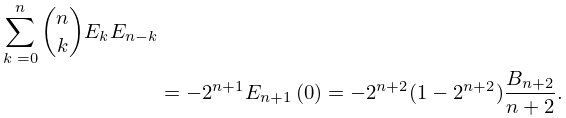
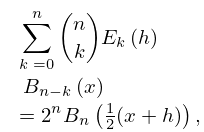
| 24.14.1 | ||||
| 24.14.2 | ||||
| 24.14.3 | ||||
| 24.14.4 | ||||
| 24.14.5 | ||||
| 24.14.6 | ||||
Let be even with and nonzero. Then
| 24.14.7 | |||
§24.14(ii) Higher-Order Recurrence Relations
In the following two identities, valid for , the sums are taken over all nonnegative integers with .
| 24.14.8 | ||||
| 24.14.9 | ||||
In the next identity, valid for , the sum is taken over all positive integers with .
| 24.14.10 | |||
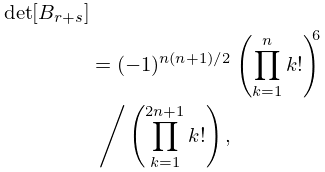
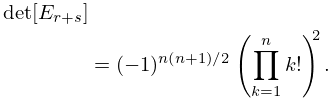
For (24.14.11) and (24.14.12), see Al-Salam and Carlitz (1959). These identities can be regarded as higher-order recurrences. Let denote a Hankel (or persymmetric) determinant, that is, an determinant with element in row and column for . Then
| 24.14.11 | ||||
| 24.14.12 | ||||
See also Sachse (1882).