Digital Library of Mathematical Functions
About the Project
NIST
8 Incomplete Gamma and Related FunctionsApplications

§8.22 Mathematical Applications

Contents

§8.22(i) Terminant Function

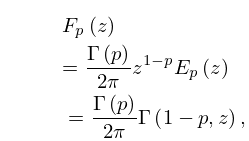
The so-called terminant function F_{p}(z), defined by

plays a fundamental role in re-expansions of remainder terms in asymptotic expansions, including exponentially-improved expansions and a smooth interpretation of the Stokes phenomenon. See §§2.11(ii)2.11(v) and the references supplied in these subsections.

§8.22(ii) Riemann Zeta Function and Incomplete Riemann Zeta Function

The function \mathop{\Gamma\/}\nolimits\!\left(a,z\right), with |\mathop{\mathrm{ph}\/}\nolimits a|\leq\tfrac{1}{2}\pi and \mathop{\mathrm{ph}\/}\nolimits z=\tfrac{1}{2}\pi, has an intimate connection with the Riemann zeta function \mathop{\zeta\/}\nolimits\!\left(s\right)25.2(i)) on the critical line \realpart{s}=\tfrac{1}{2}. See Paris and Cang (1997).

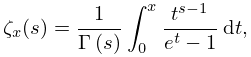
If \zeta_{x}(s) denotes the incomplete Riemann zeta function defined by

8.22.2\zeta_{x}(s)=\frac{1}{\mathop{\Gamma\/}\nolimits\!\left(s\right)}\int_{0}^{x}%
\frac{t^{{s-1}}}{e^{t}-1}dt,\realpart{s}>1,

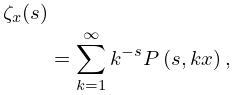
so that \lim_{{x\to\infty}}\zeta_{x}(s)=\mathop{\zeta\/}\nolimits\!\left(s\right), then

For further information on \zeta_{x}(s), including zeros and uniform asymptotic approximations, see Kölbig (1970, 1972a) and Dunster (2006).

The Debye functions \int_{0}^{x}t^{n}\left(e^{t}-1\right)^{{-1}}dt and \int_{x}^{{\infty}}t^{n}\left(e^{t}-1\right)^{{-1}}dt are closely related to the incomplete Riemann zeta function and the Riemann zeta function. See Abramowitz and Stegun (1964, p. 998) and Ashcroft and Mermin (1976, Chapter 23).