Digital Library of Mathematical Functions
About the Project
NIST
24 Bernoulli and Euler PolynomialsProperties

§24.12 Zeros

Contents

§24.12(i) Bernoulli Polynomials: Real Zeros

In the interval 0\leq x\leq 1 the only zeros of \mathop{B_{{2n+1}}\/}\nolimits\!\left(x\right), n=1,2,\ldots, are 0,\tfrac{1}{2},1, and the only zeros of \mathop{B_{{2n}}\/}\nolimits\!\left(x\right)-\mathop{B_{{2n}}\/}\nolimits, n=1,2,\ldots, are 0,1.

For the interval \tfrac{1}{2}\leq x<\infty denote the zeros of \mathop{B_{{n}}\/}\nolimits\!\left(x\right) by x_{j}^{{(n)}}, j=1,2,\ldots, with

24.12.1\tfrac{1}{2}\leq x_{1}^{{(n)}}\leq x_{2}^{{(n)}}\leq\cdots.

Then the zeros in the interval -\infty<x\leq\frac{1}{2} are 1-x_{j}^{{(n)}}.

When n(\geq 2) is even

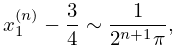
24.12.2\frac{3}{4}+\frac{1}{2^{{n+2}}\pi}<x^{{(n)}}_{1}<\frac{3}{4}+\frac{1}{2^{{n+1}%
}\pi},

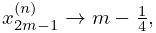
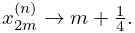
and as n\to\infty with m(\geq 1) fixed,

24.12.4
x^{{(n)}}_{{2m-1}}\to m-\tfrac{1}{4},
x^{{(n)}}_{{2m}}\to m+\tfrac{1}{4}.

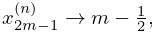
When n is odd x^{{(n)}}_{1}=\frac{1}{2}, x^{{(n)}}_{2}=1 (n\geq 3), and as n\to\infty with m(\geq 1) fixed,

24.12.5
x^{{(n)}}_{{2m-1}}\to m-\tfrac{1}{2},
x^{{(n)}}_{{2m}}\to m.

Let R(n) be the total number of real zeros of \mathop{B_{{n}}\/}\nolimits\!\left(x\right). Then R(n)=n when 1\leq n\leq 5, and

§24.12(ii) Euler Polynomials: Real Zeros

For the interval \frac{1}{2}\leq x<\infty denote the zeros of \mathop{E_{{n}}\/}\nolimits\!\left(x\right) by y^{{(n)}}_{j}, j=1,2,\ldots, with

24.12.7\tfrac{1}{2}\leq y^{{(n)}}_{1}\leq y^{{(n)}}_{2}\leq\cdots.

Then the zeros in the interval -\infty<x\leq\frac{1}{2} are 1-y^{{(n)}}_{j}.

When n(\geq 2) is even y^{{(n)}}_{1}=1, and as n\to\infty with m(\geq 1) fixed,

24.12.8y^{{(n)}}_{m}\to m.

When n is odd y^{{(n)}}_{1}=\tfrac{1}{2},

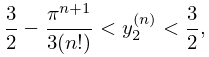
24.12.9\frac{3}{2}-\frac{\pi^{{n+1}}}{3(n!)}<y^{{(n)}}_{2}<\frac{3}{2},n=3,7,11,\dots,
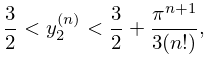
24.12.10\frac{3}{2}<y^{{(n)}}_{2}<\frac{3}{2}+\frac{\pi^{{n+1}}}{3(n!)},n=5,9,13,\dots,

and as n\to\infty with m(\geq 1) fixed,

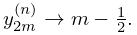
24.12.11y^{{(n)}}_{{2m}}\to m-\tfrac{1}{2}.

§24.12(iii) Complex Zeros

For complex zeros of Bernoulli and Euler polynomials, see Delange (1987) and Dilcher (1988). A related topic is the irreducibility of Bernoulli and Euler polynomials. For details and references, see Dilcher (1987b), Kimura (1988), or Adelberg (1992).

§24.12(iv) Multiple Zeros

\mathop{B_{{n}}\/}\nolimits\!\left(x\right), n=1,2,\ldots, has no multiple zeros. The only polynomial \mathop{E_{{n}}\/}\nolimits\!\left(x\right) with multiple zeros is \mathop{E_{{5}}\/}\nolimits\!\left(x\right)=(x-\frac{1}{2})(x^{2}-x-1)^{2}.