19.21 Connection Formulas19.23 Integral Representations

§19.22 Quadratic Transformations

Contents

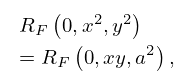
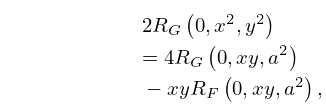
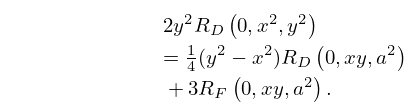
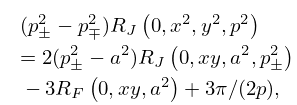
§19.22(i) Complete Integrals

Bartky’s Transformation

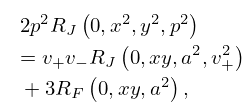
19.22.7 2p^{2}\mathop{R_{J}\/}\nolimits\!\left(0,x^{2},y^{2},p^{2}\right)=v_{{+}}v_{{-}}\mathop{R_{J}\/}\nolimits\!\left(0,xy,a^{2},v^{2}_{{+}}\right)+3\!\mathop{R_{F}\/}\nolimits\!\left(0,xy,a^{2}\right), v_{{\pm}}=(p^{2}\pm xy)/(2p).

If p=y, then (19.22.7) reduces to (19.22.3), but if p=x or p=y, then both sides of (19.22.4) are 0 by (19.20.9). If x<p<y or y<p<x, then p_{{+}} and p_{{-}} are complex conjugates.

§19.22(ii) Gauss’s Arithmetic-Geometric Mean (AGM)

The AGM, \mathop{M\/}\nolimits\!\left(a_{0},g_{0}\right), of two positive numbers a_{0} and g_{0} is defined in §19.8(i). Again, we assume that a_{0}\geq g_{0} (except in (19.22.10)), and define c_{n}=\sqrt{a_{n}^{2}-g_{n}^{2}}. Then

19.22.8 \frac{2}{\pi}\mathop{R_{F}\/}\nolimits\!\left(0,a_{0}^{2},g_{0}^{2}\right)=\frac{1}{\mathop{M\/}\nolimits\!\left(a_{0},g_{0}\right)},
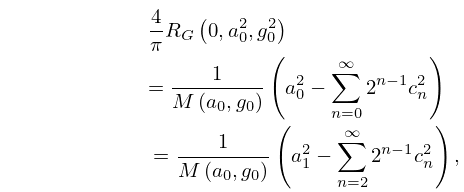
19.22.9 \frac{4}{\pi}\mathop{R_{G}\/}\nolimits\!\left(0,a_{0}^{2},g_{0}^{2}\right)=\frac{1}{\mathop{M\/}\nolimits\!\left(a_{0},g_{0}\right)}\left(a_{0}^{2}-\sum _{{n=0}}^{{\infty}}2^{{n-1}}c_{n}^{2}\right)=\frac{1}{\mathop{M\/}\nolimits\!\left(a_{0},g_{0}\right)}\left(a_{1}^{2}-\sum _{{n=2}}^{{\infty}}2^{{n-1}}c_{n}^{2}\right),

and

19.22.10 \mathop{R_{D}\/}\nolimits\!\left(0,g_{0}^{2},a_{0}^{2}\right)=\frac{3\pi}{4\!\mathop{M\/}\nolimits\!\left(a_{0},g_{0}\right)a_{0}^{2}}\sum _{{n=0}}^{{\infty}}Q_{n},

where

19.22.11
Q_{0}=1,
Q_{{n+1}}=\tfrac{1}{2}Q_{n}\frac{a_{n}-g_{n}}{a_{n}+g_{n}}.

Q_{n} has the same sign as a_{0}-g_{0} for n\geq 1.

19.22.12 \mathop{R_{J}\/}\nolimits\!\left(0,g_{0}^{2},a_{0}^{2},p_{0}^{2}\right)=\frac{3\pi}{4\!\mathop{M\/}\nolimits\!\left(a_{0},g_{0}\right)p_{0}^{2}}\sum _{{n=0}}^{{\infty}}Q_{n},

where p_{0}>0 and

19.22.13
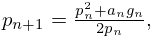
p_{{n+1}}=\frac{p_{n}^{2}+a_{n}g_{n}}{2p_{n}},
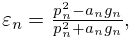
\varepsilon _{n}=\frac{p_{n}^{2}-a_{n}g_{n}}{p_{n}^{2}+a_{n}g_{n}},
Q_{0}=1,
Q_{{n+1}}=\tfrac{1}{2}Q_{n}\varepsilon _{n}.

(If p_{0}=a_{0}, then p_{n}=a_{n} and (19.22.13) reduces to (19.22.11).) As n\to\infty, p_{n} and \varepsilon _{n} converge quadratically to \mathop{M\/}\nolimits\!\left(a_{0},g_{0}\right) and 0, respectively, and Q_{n} converges to 0 faster than quadratically. If the last variable of \mathop{R_{J}\/}\nolimits is negative, then the Cauchy principal value is

19.22.14 \mathop{R_{J}\/}\nolimits\!\left(0,g_{0}^{2},a_{0}^{2},-q_{0}^{2}\right)=\frac{-3\pi}{4\!\mathop{M\/}\nolimits\!\left(a_{0},g_{0}\right)(q_{0}^{2}+a_{0}^{2})}\*\left(2+\frac{a_{0}^{2}-g_{0}^{2}}{q_{0}^{2}+g_{0}^{2}}\sum _{{n=0}}^{{\infty}}Q_{n}\right),

and (19.22.13) still applies, provided that

19.22.15 p_{0}^{2}=a_{0}^{2}(q_{0}^{2}+g_{0}^{2})/(q_{0}^{2}+a_{0}^{2}).

§19.22(iii) Incomplete Integrals

Let x, y, and z have positive real parts, assume p\neq 0, and retain (19.22.5) and (19.22.6). Define

19.22.16
a=(x+y)/2,
2z_{{\pm}}=\sqrt{(z+x)(z+y)}\pm\sqrt{(z-x)(z-y)},

so that

19.22.17
z_{{+}}z_{{-}}=za,
z_{{+}}^{2}+z_{{-}}^{2}=z^{2}+xy,
z_{{+}}^{2}-z_{{-}}^{2}=\sqrt{(z^{2}-x^{2})(z^{2}-y^{2})},
4(z_{{\pm}}^{2}-a^{2})=(\sqrt{z^{2}-x^{2}}\pm\sqrt{z^{2}-y^{2}})^{2}.

Then

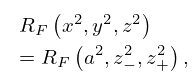
19.22.18 \mathop{R_{F}\/}\nolimits\!\left(x^{2},y^{2},z^{2}\right)=\mathop{R_{F}\/}\nolimits\!\left(a^{2},z_{{-}}^{2},z_{{+}}^{2}\right),
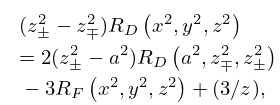
19.22.19 (z_{{\pm}}^{2}-z_{{\mp}}^{2})\mathop{R_{D}\/}\nolimits\!\left(x^{2},y^{2},z^{2}\right)={2(z_{{\pm}}^{2}-a^{2})}\mathop{R_{D}\/}\nolimits\!\left(a^{2},z_{{\mp}}^{2},z_{{\pm}}^{2}\right)-3\!\mathop{R_{F}\/}\nolimits\!\left(x^{2},y^{2},z^{2}\right)+(3/z),
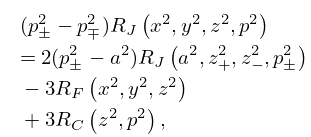
19.22.20 (p_{{\pm}}^{2}-p_{{\mp}}^{2})\mathop{R_{J}\/}\nolimits\!\left(x^{2},y^{2},z^{2},p^{2}\right)=2(p_{{\pm}}^{2}-a^{2})\mathop{R_{J}\/}\nolimits\!\left(a^{2},z_{{+}}^{2},z_{{-}}^{2},p_{{\pm}}^{2}\right)-3\!\mathop{R_{F}\/}\nolimits\!\left(x^{2},y^{2},z^{2}\right)+3\!\mathop{R_{C}\/}\nolimits\!\left(z^{2},p^{2}\right),
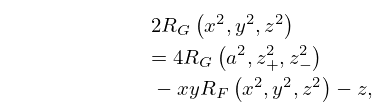
19.22.21 2\!\mathop{R_{G}\/}\nolimits\!\left(x^{2},y^{2},z^{2}\right)=4\!\mathop{R_{G}\/}\nolimits\!\left(a^{2},z_{{+}}^{2},z_{{-}}^{2}\right)-xy\mathop{R_{F}\/}\nolimits\!\left(x^{2},y^{2},z^{2}\right)-z,
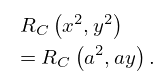
19.22.22 \mathop{R_{C}\/}\nolimits\!\left(x^{2},y^{2}\right)=\mathop{R_{C}\/}\nolimits\!\left(a^{2},ay\right).

If x,y,z are real and positive, then (19.22.18)–(19.22.21) are ascending Landen transformations when x,y<z (implying a<z_{{-}}<z_{{+}}), and descending Gauss transformations when z<x,y (implying z_{{+}}<z_{{-}}<a). Ascent and descent correspond respectively to increase and decrease of k in Legendre’s notation. Descending Gauss transformations include, as special cases, transformations of complete integrals into complete integrals; ascending Landen transformations do not.

If p=x or p=y, then (19.22.20) reduces to 0=0 by (19.20.13), and if z=x or z=y then (19.22.19) reduces to 0=0 by (19.20.20) and (19.22.22). If x<z<y or y<z<x, then z_{{+}} and z_{{-}} are complex conjugates. However, if x and y are complex conjugates and z and p are real, then the right-hand sides of all transformations in §§19.22(i) and 19.22(iii)—except (19.22.3) and (19.22.22)—are free of complex numbers and p_{\pm}^{2}-p_{\mp}^{2}=\pm|p^{2}-x^{2}|\neq 0.

The transformations inverse to the ones just described are the descending Landen transformations and the ascending Gauss transformations. The equations inverse to (19.22.5) and (19.22.16) are given by

19.22.23
x+y=2a,
x-y=(\ifrac{2}{a})\sqrt{(a^{2}-z_{{+}}^{2})(a^{2}-z_{{-}}^{2})},
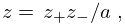
z=\ifrac{z_{{+}}z_{{-}}}{a},

and the corresponding equations with z, z_{{+}}, and z_{{-}} replaced by p, p_{{+}}, and p_{{-}}, respectively. These relations need to be used with caution because y is negative when 0<a<z_{{+}}z_{{-}}\left(z_{{+}}^{2}+z_{{-}}^{2}\right)^{{-1/2}}.