§19.21 Connection Formulas
Contents
§19.21(i) Complete Integrals
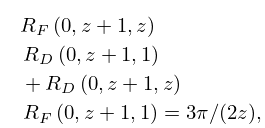
Legendre’s relation (19.7.1) can be written
The case
shows that the product of the two lemniscate constants,
(19.20.2) and (19.20.22), is
.
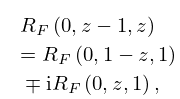
The complete cases of
and
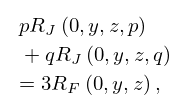
have connection formulas
resulting from those for the Gauss hypergeometric function
(Erdélyi et al. (1953a, §2.9)). Upper signs apply if
,
and lower signs if
:
§19.21(ii) Incomplete Integrals
is symmetric only in
and
, but either (nonzero)
or (nonzero)
can be moved to the third position by using
or the corresponding equation with
and
interchanged.
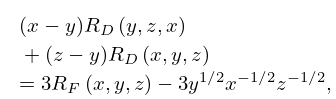
Because
is completely symmetric,
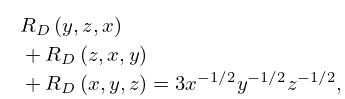
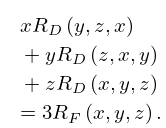
can be permuted on the
right-hand side of (19.21.10) so that
if the
variables are real, thereby avoiding cancellations when
is
calculated from
and
(see §19.36(i)).
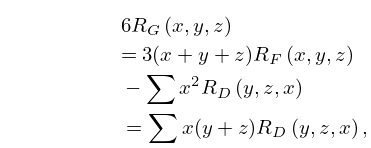
where both summations extend over the three cyclic permutations of
.
Connection formulas for
are given in
Carlson (1977b, pp. 99, 101, and 123–124).

§19.21(iii) Change of Parameter of
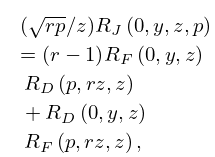
Let
be real and nonnegative, with at most one of them 0.
Change-of-parameter relations can be used to shift the parameter
of
from either circular region to the other, or from either hyperbolic
region to the other (§19.20(iii)). The latter case allows evaluation
of Cauchy principal values (see (19.20.14)).
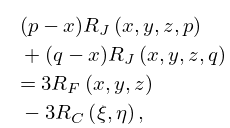
where
and
may be permuted. Also,
For each value of
, permutation of
produces three values
of
, one of which lies in the same region as
and two lie in the other
region of the same type. In (19.21.12), if
is the largest
(smallest) of
, and
, then
and
lie in the same region if it
is circular (hyperbolic); otherwise
and
lie in different regions, both
circular or both hyperbolic. If
, then
and
; hence