19.22 Quadratic Transformations19.24 Inequalities

§19.23 Integral Representations

In (19.23.1)–(19.23.3) we assume \realpart{y}>0 and \realpart{z}>0.

19.23.1 \mathop{R_{F}\/}\nolimits\!\left(0,y,z\right)=\int _{0}^{{\pi/2}}(y{\mathop{\cos\/}\nolimits^{{2}}}\theta+z{\mathop{\sin\/}\nolimits^{{2}}}\theta)^{{-1/2}}d\theta,
19.23.2 \mathop{R_{G}\/}\nolimits\!\left(0,y,z\right)=\frac{1}{2}\int _{0}^{{\pi/2}}(y{\mathop{\cos\/}\nolimits^{{2}}}\theta+z{\mathop{\sin\/}\nolimits^{{2}}}\theta)^{{1/2}}d\theta,
19.23.3 \mathop{R_{D}\/}\nolimits\!\left(0,y,z\right)=3\int _{0}^{{\pi/2}}(y{\mathop{\cos\/}\nolimits^{{2}}}\theta+z{\mathop{\sin\/}\nolimits^{{2}}}\theta)^{{-3/2}}{\mathop{\sin\/}\nolimits^{{2}}}\theta d\theta.
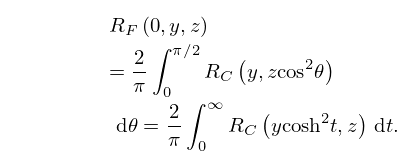
19.23.4 \mathop{R_{F}\/}\nolimits\!\left(0,y,z\right)=\frac{2}{\pi}\int _{0}^{{\pi/2}}\mathop{R_{C}\/}\nolimits\!\left(y,z{\mathop{\cos\/}\nolimits^{{2}}}\theta\right)d\theta=\frac{2}{\pi}\int _{0}^{{\infty}}\mathop{R_{C}\/}\nolimits\!\left(y{\mathop{\cosh\/}\nolimits^{{2}}}t,z\right)dt.
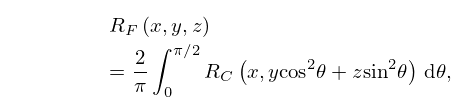
19.23.5 \mathop{R_{F}\/}\nolimits\!\left(x,y,z\right)=\frac{2}{\pi}\int _{0}^{{\pi/2}}\mathop{R_{C}\/}\nolimits\!\left(x,y{\mathop{\cos\/}\nolimits^{{2}}}\theta+z{\mathop{\sin\/}\nolimits^{{2}}}\theta\right)d\theta, \realpart{y}>0, \realpart{z}>0,
19.23.6 4\pi\mathop{R_{F}\/}\nolimits\!\left(x,y,z\right)=\int _{0}^{{2\pi}}\!\!\!\!\int _{0}^{{\pi}}\frac{\mathop{\sin\/}\nolimits\theta d\theta d\phi}{(x{\mathop{\sin\/}\nolimits^{{2}}}\theta{\mathop{\cos\/}\nolimits^{{2}}}\phi+y{\mathop{\sin\/}\nolimits^{{2}}}\theta{\mathop{\sin\/}\nolimits^{{2}}}\phi+z{\mathop{\cos\/}\nolimits^{{2}}}\theta)^{{1/2}}},

where x, y, and z have positive real parts—except that at most one of them may be 0.

In (19.23.7)–(19.23.10) one or more of the variables may be 0 if the integral converges. In (19.23.8) n=2, and in (19.23.9) n=3. Also, in (19.23.8) and (19.23.10) \mathop{\mathrm{B}\/}\nolimits denotes the beta function (§5.12).

For generalizations of (19.16.3) and (19.23.8) see Carlson (1964, (6.2), (6.12), and (6.1)).