19.19 Taylor and Related Series19.21 Connection Formulas

§19.20 Special Cases

Contents

§19.20(i) \mathop{R_{F}\/}\nolimits\!\left(x,y,z\right)

In this subsection, and also §§19.20(ii)19.20(v), the variables of all R-functions satisfy the constraints specified in §19.16(i) unless other conditions are stated.

19.20.1
\mathop{R_{F}\/}\nolimits\!\left(x,x,x\right)=x^{{-1/2}},
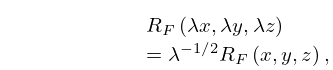
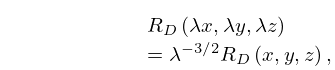
\mathop{R_{F}\/}\nolimits\!\left(\lambda x,\lambda y,\lambda z\right)=\lambda^{{-1/2}}\mathop{R_{F}\/}\nolimits\!\left(x,y,z\right),
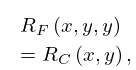
\mathop{R_{F}\/}\nolimits\!\left(x,y,y\right)=\mathop{R_{C}\/}\nolimits\!\left(x,y\right),
\mathop{R_{F}\/}\nolimits\!\left(0,y,y\right)=\tfrac{1}{2}\pi y^{{-1/2}},
\mathop{R_{F}\/}\nolimits\!\left(0,0,z\right)=\infty.

The first lemniscate constant is given by

19.20.2 \int _{0}^{1}\frac{dt}{\sqrt{1-t^{4}}}=\mathop{R_{F}\/}\nolimits\!\left(0,1,2\right)=\frac{\left(\mathop{\Gamma\/}\nolimits\!\left(\frac{1}{4}\right)\right)^{2}}{4(2\pi)^{{1/2}}}=1.31102\; 87771\; 46059\; 90523\dots.

Todd (1975) refers to a proof by T. Schneider that this is a transcendental number. The general lemniscatic case is

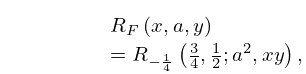
19.20.3 \mathop{R_{F}\/}\nolimits\!\left(x,a,y\right)=\mathop{R_{{-\frac{1}{4}}}\/}\nolimits\!\left(\tfrac{3}{4},\tfrac{1}{2};a^{2},xy\right), a=\frac{1}{2}(x+y).

§19.20(iii) \mathop{R_{J}\/}\nolimits\!\left(x,y,z,p\right)

19.20.6
\mathop{R_{J}\/}\nolimits\!\left(x,x,x,x\right)=x^{{-3/2}},
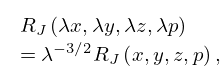
\mathop{R_{J}\/}\nolimits\!\left(\lambda x,\lambda y,\lambda z,\lambda p\right)=\lambda^{{-3/2}}\mathop{R_{J}\/}\nolimits\!\left(x,y,z,p\right),
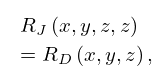
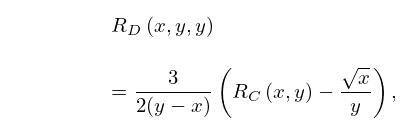
\mathop{R_{J}\/}\nolimits\!\left(x,y,z,z\right)=\mathop{R_{D}\/}\nolimits\!\left(x,y,z\right),
\mathop{R_{J}\/}\nolimits\!\left(0,0,z,p\right)=\infty,
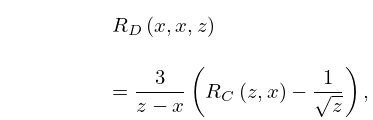
\mathop{R_{J}\/}\nolimits\!\left(x,x,x,p\right)=\mathop{R_{D}\/}\nolimits\!\left(p,p,x\right)=\frac{3}{x-p}\left(\mathop{R_{C}\/}\nolimits\!\left(x,p\right)-\frac{1}{\sqrt{x}}\right), x\neq p, xp\neq 0.
19.20.7 \mathop{R_{J}\/}\nolimits\!\left(x,y,z,p\right)\to+\infty, p\to 0+ or 0-; x,y,z>0.
19.20.8
\mathop{R_{J}\/}\nolimits\!\left(0,y,y,p\right)=\frac{3\pi}{2(y\sqrt{p}+p\sqrt{y})}, p>0,
\mathop{R_{J}\/}\nolimits\!\left(0,y,y,-q\right)=\frac{-3\pi}{2\sqrt{y}(y+q)}, q>0,
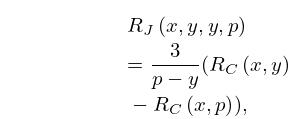
\mathop{R_{J}\/}\nolimits\!\left(x,y,y,p\right)=\frac{3}{p-y}(\mathop{R_{C}\/}\nolimits\!\left(x,y\right)-\mathop{R_{C}\/}\nolimits\!\left(x,p\right)), p\neq y,
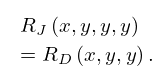
\mathop{R_{J}\/}\nolimits\!\left(x,y,y,y\right)=\mathop{R_{D}\/}\nolimits\!\left(x,y,y\right).
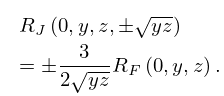
19.20.9 \mathop{R_{J}\/}\nolimits\!\left(0,y,z,\pm\sqrt{yz}\right)=\pm\frac{3}{2\sqrt{yz}}\mathop{R_{F}\/}\nolimits\!\left(0,y,z\right).
19.20.10
\lim _{{p\to 0+}}\sqrt{p}\mathop{R_{J}\/}\nolimits\!\left(0,y,z,p\right)=\frac{3\pi}{2\sqrt{yz}},
\lim _{{p\to 0-}}\mathop{R_{J}\/}\nolimits\!\left(0,y,z,p\right)={-\mathop{R_{D}\/}\nolimits\!\left(0,y,z\right)-\mathop{R_{D}\/}\nolimits\!\left(0,z,y\right)}=\frac{-6}{yz}\mathop{R_{G}\/}\nolimits\!\left(0,y,z\right).
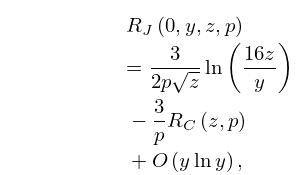
19.20.11 \mathop{R_{J}\/}\nolimits\!\left(0,y,z,p\right)\sim\frac{3}{2p\sqrt{z}}\mathop{\ln\/}\nolimits\left(\frac{16z}{y}\right), y\to 0+; p (\neq 0) real.
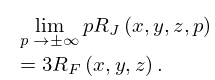
19.20.12 \lim _{{p\to\pm\infty}}p\mathop{R_{J}\/}\nolimits\!\left(x,y,z,p\right)=3\!\mathop{R_{F}\/}\nolimits\!\left(x,y,z\right).
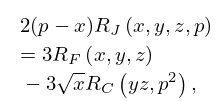
19.20.13 2(p-x)\mathop{R_{J}\/}\nolimits\!\left(x,y,z,p\right)=3\!\mathop{R_{F}\/}\nolimits\!\left(x,y,z\right)-3\sqrt{x}\mathop{R_{C}\/}\nolimits\!\left(yz,p^{2}\right), p=x\pm\sqrt{(y-x)(z-x)},

where x,y,z may be permuted.

When the variables are real and distinct, the various cases of \mathop{R_{J}\/}\nolimits\!\left(x,y,z,p\right) are called circular (hyperbolic) cases if (p-x)(p-y)(p-z) is positive (negative), because they typically occur in conjunction with inverse circular (hyperbolic) functions. Cases encountered in dynamical problems are usually circular; hyperbolic cases include Cauchy principal values. If x,y,z are permuted so that 0\leq x<y<z, then the Cauchy principal value of \mathop{R_{J}\/}\nolimits is given by

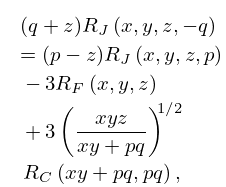
19.20.14 (q+z)\mathop{R_{J}\/}\nolimits\!\left(x,y,z,-q\right)=(p-z)\mathop{R_{J}\/}\nolimits\!\left(x,y,z,p\right)-3\!\mathop{R_{F}\/}\nolimits\!\left(x,y,z\right)+3\left(\frac{xyz}{xy+pq}\right)^{{1/2}}\mathop{R_{C}\/}\nolimits\!\left(xy+pq,pq\right),

valid when

19.20.15
q>0,
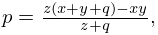
p=\frac{z(x+y+q)-xy}{z+q},

or

19.20.16
p=wy+(1-w)z,
w=\frac{z-x}{z+q},
0<w<1.

Since x<y<p<z, p is in a hyperbolic region. In the complete case (x=0) (19.20.14) reduces to

19.20.17 (q+z)\mathop{R_{J}\/}\nolimits\!\left(0,y,z,-q\right)=(p-z)\mathop{R_{J}\/}\nolimits\!\left(0,y,z,p\right)-3\!\mathop{R_{F}\/}\nolimits\!\left(0,y,z\right), p=z(y+q)/(z+q), w=z/(z+q).

§19.20(iv) \mathop{R_{D}\/}\nolimits\!\left(x,y,z\right)

The second lemniscate constant is given by

19.20.22 \int _{0}^{1}\frac{t^{2}dt}{\sqrt{1-t^{4}}}=\tfrac{1}{3}\mathop{R_{D}\/}\nolimits\!\left(0,2,1\right)=\frac{\left(\mathop{\Gamma\/}\nolimits\!\left(\frac{3}{4}\right)\right)^{2}}{(2\pi)^{{1/2}}}=0.59907\; 0 1173\; 67796\; 10371\dots.

Todd (1975) refers to a proof by T. Schneider that this is a transcendental number. Compare (19.20.2). The general lemniscatic case is

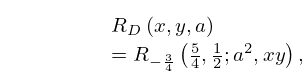
19.20.23 \mathop{R_{D}\/}\nolimits\!\left(x,y,a\right)=\mathop{R_{{-\frac{3}{4}}}\/}\nolimits\!\left(\tfrac{5}{4},\tfrac{1}{2};a^{2},xy\right), a=\tfrac{1}{2}x+\tfrac{1}{2}y.

§19.20(v) \mathop{R_{{-a}}\/}\nolimits\!\left(\mathbf{b};\mathbf{z}\right)

Define c=\sum _{{j=1}}^{n}b_{j}. Then

19.20.24
\mathop{R_{{0}}\/}\nolimits\!\left(\mathbf{b};\mathbf{z}\right)=1,
\mathop{R_{{N}}\/}\nolimits\!\left(\mathbf{b};\mathbf{z}\right)=\frac{N!}{\left(c\right)_{{N}}}T_{N}(\mathbf{b},\mathbf{z}), N=0,1,2,\dots,

where T_{N} is defined by (19.19.1). Also,

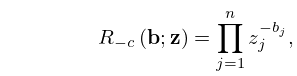
19.20.25 \mathop{R_{{-c}}\/}\nolimits\!\left(\mathbf{b};\mathbf{z}\right)=\prod _{{j=1}}^{n}z_{j}^{{-b_{j}}},
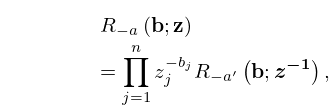
19.20.26 \mathop{R_{{-a}}\/}\nolimits\!\left(\mathbf{b};\mathbf{z}\right)=\prod _{{j=1}}^{n}z_{j}^{{-b_{j}}}\mathop{R_{{-a^{{\prime}}}}\/}\nolimits\!\left(\mathbf{b};\boldsymbol{{z^{{-1}}}}\right), a+a^{{\prime}}=c, \boldsymbol{{z^{{-1}}}}=(z_{1}^{{-1}},\dots,z_{n}^{{-1}}).

See also (19.16.11) and (19.16.19).