29.11 Lamé Wave Equation29.13 Graphics

§29.12 Definitions

Contents

§29.12(i) Elliptic-Function Form

Throughout §§29.1229.16 the order \nu in the differential equation (29.2.1) is assumed to be a nonnegative integer.

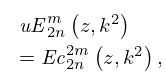
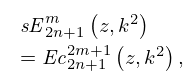
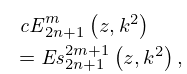
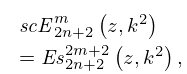
The Lamé functions \mathop{\mathit{Ec}^{{m}}_{{\nu}}\/}\nolimits\!\left(z,k^{2}\right), m=0,1,\dots,\nu, and \mathop{\mathit{Es}^{{m}}_{{\nu}}\/}\nolimits\!\left(z,k^{2}\right), m=1,2,\dots,\nu, are called the Lamé polynomials. There are eight types of Lamé polynomials, defined as follows:

29.12.1 \mathop{\mathit{uE}^{{m}}_{{2n}}\/}\nolimits\!\left(z,k^{2}\right)=\mathop{\mathit{Ec}^{{2m}}_{{2n}}\/}\nolimits\!\left(z,k^{2}\right),
29.12.2 \mathop{\mathit{sE}^{{m}}_{{2n+1}}\/}\nolimits\!\left(z,k^{2}\right)=\mathop{\mathit{Ec}^{{2m+1}}_{{2n+1}}\/}\nolimits\!\left(z,k^{2}\right),
29.12.3 \mathop{\mathit{cE}^{{m}}_{{2n+1}}\/}\nolimits\!\left(z,k^{2}\right)=\mathop{\mathit{Es}^{{2m+1}}_{{2n+1}}\/}\nolimits\!\left(z,k^{2}\right),
29.12.4 \mathop{\mathit{dE}^{{m}}_{{2n+1}}\/}\nolimits\!\left(z,k^{2}\right)=\mathop{\mathit{Ec}^{{2m}}_{{2n+1}}\/}\nolimits\!\left(z,k^{2}\right),
29.12.5 \mathop{\mathit{scE}^{{m}}_{{2n+2}}\/}\nolimits\!\left(z,k^{2}\right)=\mathop{\mathit{Es}^{{2m+2}}_{{2n+2}}\/}\nolimits\!\left(z,k^{2}\right),
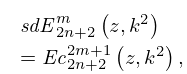
29.12.6 \mathop{\mathit{sdE}^{{m}}_{{2n+2}}\/}\nolimits\!\left(z,k^{2}\right)=\mathop{\mathit{Ec}^{{2m+1}}_{{2n+2}}\/}\nolimits\!\left(z,k^{2}\right),
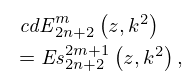
29.12.7 \mathop{\mathit{cdE}^{{m}}_{{2n+2}}\/}\nolimits\!\left(z,k^{2}\right)=\mathop{\mathit{Es}^{{2m+1}}_{{2n+2}}\/}\nolimits\!\left(z,k^{2}\right),
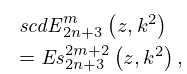
29.12.8 \mathop{\mathit{scdE}^{{m}}_{{2n+3}}\/}\nolimits\!\left(z,k^{2}\right)=\mathop{\mathit{Es}^{{2m+2}}_{{2n+3}}\/}\nolimits\!\left(z,k^{2}\right),

where n=0,1,2,\dots, m=0,1,2,\dots,n. These functions are polynomials in \mathop{\mathrm{sn}\/}\nolimits\left(z,k\right), \mathop{\mathrm{cn}\/}\nolimits\left(z,k\right), and \mathop{\mathrm{dn}\/}\nolimits\left(z,k\right). In consequence they are doubly-periodic meromorphic functions of z.

The superscript m on the left-hand sides of (29.12.1)–(29.12.8) agrees with the number of z-zeros of each Lamé polynomial in the interval (0,\!\mathop{K\/}\nolimits\!), while n-m is the number of z-zeros in the open line segment from \!\mathop{K\/}\nolimits\! to \!\mathop{K\/}\nolimits\!+i\!\mathop{{K^{{\prime}}}\/}\nolimits\!.

The prefixes \mathit{u}, \mathit{s}, \mathit{c}, \mathit{d}, \mathit{sc}, \mathit{sd}, \mathit{cd}, \mathit{scd} indicate the type of the polynomial form of the Lamé polynomial; compare the 3rd and 4th columns in Table 29.12.1. In the fourth column the variable z and modulus k of the Jacobian elliptic functions have been suppressed, and P({\mathop{\mathrm{sn}\/}\nolimits^{{2}}}) denotes a polynomial of degree n in {\mathop{\mathrm{sn}\/}\nolimits^{{2}}}\left(z,k\right) (different for each type). For the determination of the coefficients of the P’s see §29.15(ii).

§29.12(ii) Algebraic Form

With the substitution \xi={\mathop{\mathrm{sn}\/}\nolimits^{{2}}}\left(z,k\right) every Lamé polynomial in Table 29.12.1 can be written in the form

29.12.9 \xi^{\rho}(\xi-1)^{\sigma}(\xi-k^{{-2}})^{\tau}P(\xi),

where \rho, \sigma, \tau are either 0 or \frac{1}{2}. The polynomial P(\xi) is of degree n and has m zeros (all simple) in (0,1) and n-m zeros (all simple) in (1,k^{{-2}}). The functions (29.12.9) satisfy (29.2.2).

§29.12(iii) Zeros

Let \xi _{1},\xi _{2},\dots,\xi _{n} denote the zeros of the polynomial P in (29.12.9) arranged according to

29.12.10 0<\xi _{1}<\dots<\xi _{m}<1<\xi _{{m+1}}<\dots<\xi _{n}<k^{{-2}}.

Then the function

29.12.11 g(t_{1},t_{2},\dots,t_{n})=\left(\prod _{{p=1}}^{n}t_{p}^{{\rho+\frac{1}{4}}}|t_{p}-1|^{{\sigma+\frac{1}{4}}}(k^{{-2}}-t_{p})^{{\tau+\frac{1}{4}}}\right)\prod _{{q<r}}(t_{r}-t_{q}),

defined for (t_{1},t_{2},\dots,t_{n}) with

29.12.12 0\leq t_{1}\leq\cdots\leq t_{m}\leq 1\leq t_{{m+1}}\leq\cdots\leq t_{n}\leq k^{{-2}},

attains its absolute maximum iff t_{j}=\xi _{j}, j=1,2,\dots,n. Moreover,

29.12.13 {\frac{\rho+\frac{1}{4}}{\xi _{p}}+\frac{\sigma+\frac{1}{4}}{\xi _{p}-1}+\frac{\tau+\frac{1}{4}}{\xi _{p}-k^{{-2}}}+\sum _{{\substack{q=1\\
q\neq p}}}^{n}\frac{1}{\xi _{p}-\xi _{q}}=0}, p=1,2,\dots,n.

This result admits the following electrostatic interpretation: Given three point masses fixed at t=0, t=1, and t=k^{{-2}} with positive charges \rho+\tfrac{1}{4}, \sigma+\tfrac{1}{4}, and \tau+\tfrac{1}{4}, respectively, and n movable point masses at t_{1},t_{2},\dots,t_{n} arranged according to (29.12.12) with unit positive charges, the equilibrium position is attained when t_{j}=\xi _{j} for j=1,2,\dots,n.