29.13 Graphics29.15 Fourier Series and Chebyshev Series

§29.14 Orthogonality

Lamé polynomials are orthogonal in two ways. First, the orthogonality relations (29.3.19) apply; see §29.12(i). Secondly, the system of functions

29.14.1 f_{n}^{m}(s,t)=\mathop{\mathit{uE}^{{m}}_{{2n}}\/}\nolimits\!\left(s,k^{2}\right)\mathop{\mathit{uE}^{{m}}_{{2n}}\/}\nolimits\!\left(\!\mathop{K\/}\nolimits\!+it,k^{2}\right), n=0,1,2,\dots, m=0,1,\dots,n,

is orthogonal and complete with respect to the inner product

29.14.2 \langle g,h\rangle=\int _{0}^{{\!\mathop{K\/}\nolimits\!}}\!\!\int _{0}^{{\!\mathop{{K^{{\prime}}}\/}\nolimits\!}}w(s,t)g(s,t)h(s,t)dtds,

where

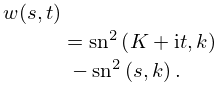
29.14.3 w(s,t)={\mathop{\mathrm{sn}\/}\nolimits^{{2}}}\left(\!\mathop{K\/}\nolimits\!+it,k\right)-{\mathop{\mathrm{sn}\/}\nolimits^{{2}}}\left(s,k\right).

Each of the following seven systems is orthogonal and complete with respect to the inner product (29.14.2):

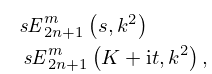
29.14.4 \mathop{\mathit{sE}^{{m}}_{{2n+1}}\/}\nolimits\!\left(s,k^{2}\right)\mathop{\mathit{sE}^{{m}}_{{2n+1}}\/}\nolimits\!\left(\!\mathop{K\/}\nolimits\!+it,k^{2}\right),
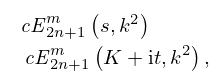
29.14.5 \mathop{\mathit{cE}^{{m}}_{{2n+1}}\/}\nolimits\!\left(s,k^{2}\right)\mathop{\mathit{cE}^{{m}}_{{2n+1}}\/}\nolimits\!\left(\!\mathop{K\/}\nolimits\!+it,k^{2}\right),
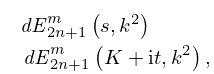
29.14.6 \mathop{\mathit{dE}^{{m}}_{{2n+1}}\/}\nolimits\!\left(s,k^{2}\right)\mathop{\mathit{dE}^{{m}}_{{2n+1}}\/}\nolimits\!\left(\!\mathop{K\/}\nolimits\!+it,k^{2}\right),
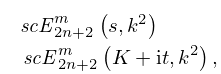
29.14.7 \mathop{\mathit{scE}^{{m}}_{{2n+2}}\/}\nolimits\!\left(s,k^{2}\right)\mathop{\mathit{scE}^{{m}}_{{2n+2}}\/}\nolimits\!\left(\!\mathop{K\/}\nolimits\!+it,k^{2}\right),
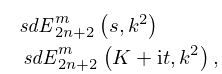
29.14.8 \mathop{\mathit{sdE}^{{m}}_{{2n+2}}\/}\nolimits\!\left(s,k^{2}\right)\mathop{\mathit{sdE}^{{m}}_{{2n+2}}\/}\nolimits\!\left(\!\mathop{K\/}\nolimits\!+it,k^{2}\right),
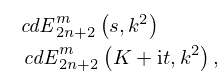
29.14.9 \mathop{\mathit{cdE}^{{m}}_{{2n+2}}\/}\nolimits\!\left(s,k^{2}\right)\mathop{\mathit{cdE}^{{m}}_{{2n+2}}\/}\nolimits\!\left(\!\mathop{K\/}\nolimits\!+it,k^{2}\right),
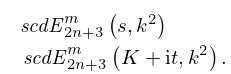
29.14.10 \mathop{\mathit{scdE}^{{m}}_{{2n+3}}\/}\nolimits\!\left(s,k^{2}\right)\mathop{\mathit{scdE}^{{m}}_{{2n+3}}\/}\nolimits\!\left(\!\mathop{K\/}\nolimits\!+it,k^{2}\right).

In each system n ranges over all nonnegative integers and m=0,1,\dots,n. When combined, all eight systems (29.14.1) and (29.14.4)–(29.14.10) form an orthogonal and complete system with respect to the inner product

29.14.11 \langle g,h\rangle=\int _{0}^{{4\!\mathop{K\/}\nolimits\!}}\!\!\int _{0}^{{2\!\mathop{{K^{{\prime}}}\/}\nolimits\!}}w(s,t)g(s,t)h(s,t)dtds,

with w(s,t) given by (29.14.3).